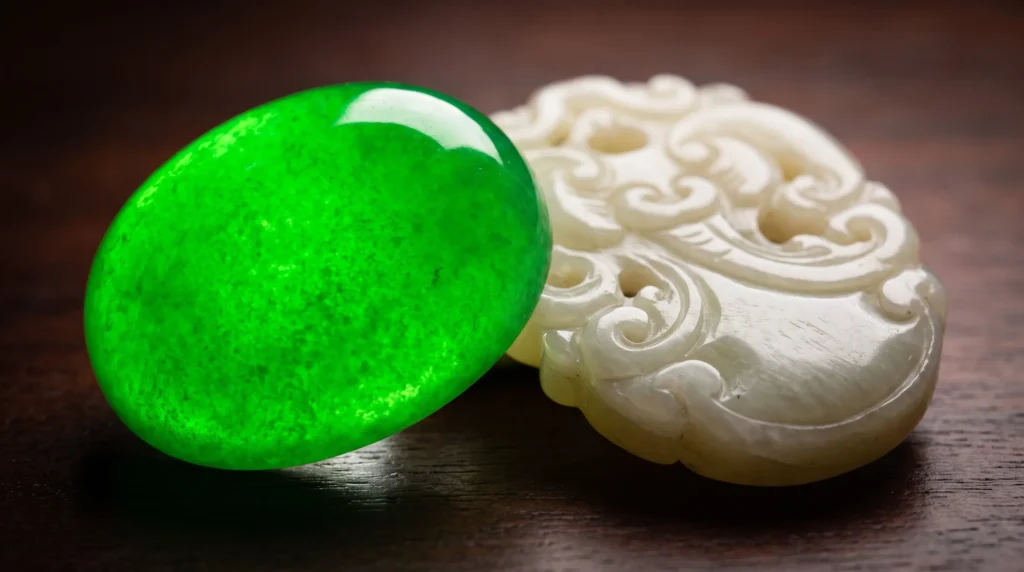
“Jade” isn’t actually one mineral, it’s a shared common name for two chemically and structurally different minerals, jadeite and nephrite, that happen to look similar and have been valued by cultures around the world for thousands of years. Understanding this one fact changes how you should think about everything else regarding jade, from its price to how it’s treated.
What Is Jade? (It’s Actually Two Different Minerals)
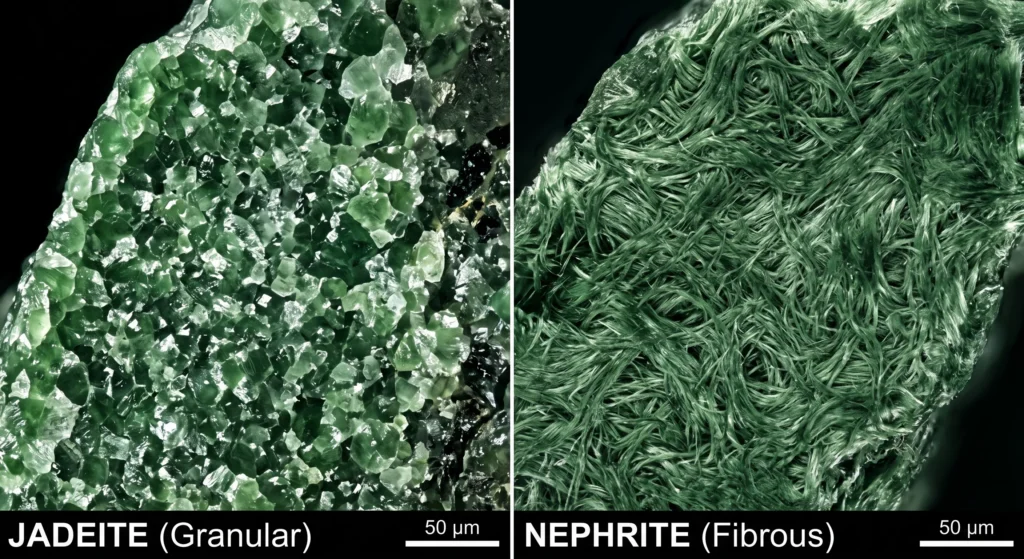
Jadeite is a pyroxene mineral, a sodium aluminum silicate, forming as tightly interlocking granular crystals. Nephrite is an entirely different mineral, an amphibole (specifically an actinolite-tremolite series mineral), forming as densely packed, interwoven fibrous crystals rather than granular ones. Both minerals share the common name “jade” purely because they look alike and have overlapping cultural histories, not because they’re related chemically. This distinction matters enormously for value: jadeite is rarer and, at its finest, considerably more valuable than nephrite, with the two historically confused until a French mineralogist formally distinguished them as separate minerals in 1863 after examining jadeite artifacts looted from China’s Old Summer Palace. Both minerals owe their famous toughness, genuinely harder to break than steel despite only moderate Mohs hardness, to the same underlying structural principle: tightly interlocking crystals (granular in jadeite, fibrous in nephrite) that resist fracturing even though individual crystals aren’t especially hard.
Why Is It Green? (And Why Jade Comes in So Many Other Colors)
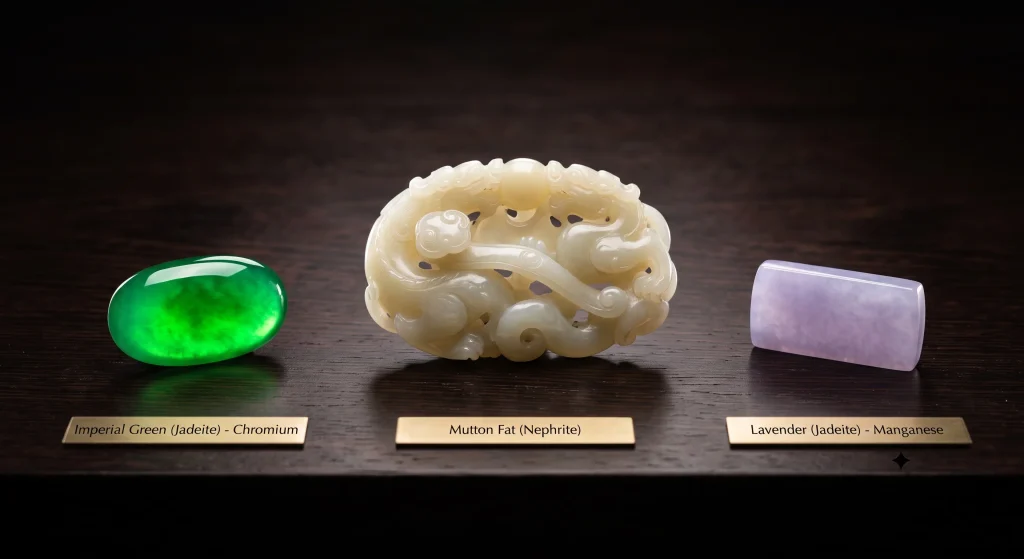
In jadeite, the prized “imperial green” color comes from trace chromium substituted into the crystal structure, even very small amounts produce the vivid, saturated emerald-like hue that defines the finest imperial jade. Iron is responsible for jadeite’s brown and orange-red tones, and manganese produces violet (lavender) jadeite. Surface oxidation of iron in the outer “skin” of a jadeite boulder, occurring naturally over long exposure to weathering, produces the reddish-orange-brown spectrum sometimes marketed as “red jade. ” In nephrite, iron is the dominant cause of color across nearly its entire range, from the deep forest greens prized in Canadian nephrite to the pale, creamy “mutton fat” white nephrite especially valued in traditional Chinese jade carving. Worth knowing: one detailed technical source directly disputes a commonly repeated claim that jade’s color can fade or change through gradual chemical valence shifts at room temperature, stating plainly that no authoritative published research actually demonstrates this a good example of a widely repeated gem-trade claim that doesn’t hold up to scrutiny.
Where It Comes From
Myanmar (Burma) is the world’s dominant source of fine jadeite, producing roughly 70% of the global gem-grade supply, with the Hpakant region specifically responsible for nearly all top-grade imperial green material. Burmese jadeite remains the classic standard every other source is compared against. Guatemala also produces genuine chromium-colored jadeite with its own recognizable character, generally carrying more iron content than Burmese material. Nephrite has a much broader geographic spread, sourced from British Columbia in Canada (prized for its rich, deep green color), Xinjiang in China (the historic heartland of ancient Chinese jade carving), New Zealand (where it’s known as “pounamu” and holds deep cultural significance for Māori communities), Russia’s Siberia region, and Taiwan. Sri Lanka is not a significant documented source of either jadeite or nephrite.
Is It Treated? (This Is the Most Important Section for Jade Buyers)
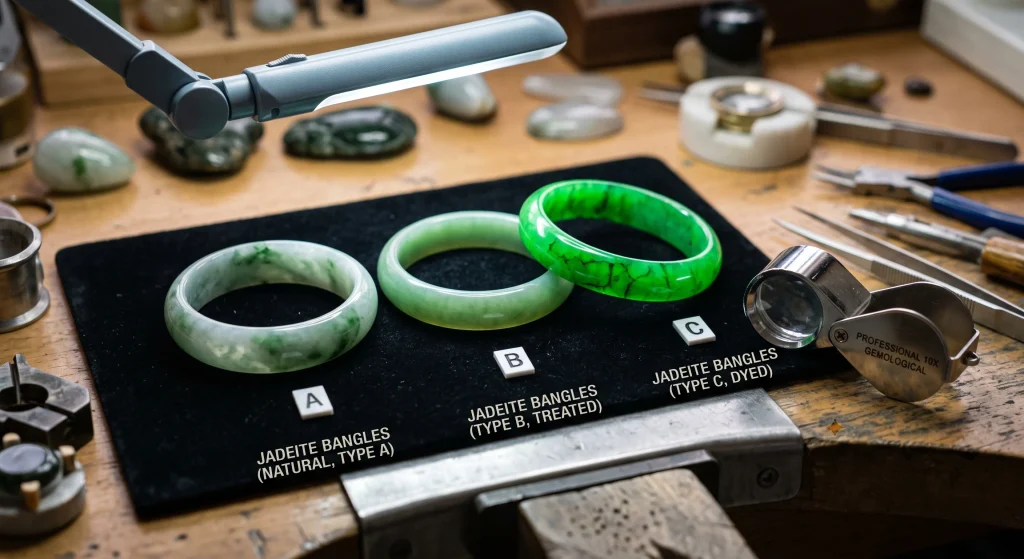
This is genuinely the single most important thing to understand before buying jade, and it’s a bigger, more formalized issue than treatment disclosure for almost any other gemstone. The jade trade uses a specific classification system. Type A, Type B, and Type C—to describe treatment status, and according to GIA’s own FAQ on the subject, this system is widely used in the trade specifically because treatment is so commercially significant:
- Type A jadeite is natural, untreated material, polished with nothing more than traditional surface wax, wax that sits on the surface and doesn’t alter the stone’s actual color or structure.
- Type B jadeite has been chemically bleached with acid to remove unwanted staining or impurities, then impregnated under pressure with colorless polymer resin to restore the transparency and appearance the acid treatment damaged. This process has existed commercially since at least the mid-1970s, and some Type B jadeite has historically been sold without proper disclosure, which has caused real, documented controversy in the jade market.
- Type C jadeite has been dyed to introduce or enhance color, often combined with bleaching and polymer impregnation (sometimes labeled “B+C” when both treatments are present). Dye in Type C material can fade over time or under heat and light exposure.
Type B and C treatments genuinely reduce value significantly compared to natural Type A material, and reliably distinguishing between them typically requires laboratory testing (FTIR or Raman spectroscopy, which detect the chemical signature of polymer resin or dye that’s invisible to the naked eye) rather than visual inspection alone. For anything beyond an inexpensive, casual piece, requesting a lab report confirming Type A status is genuinely worthwhile.
Durability: Can You Wear It Every Day?
Both jadeite and nephrite measure roughly 6 to 7 on the Mohs hardness scale, only moderate by gemstone standards, comparable to quartz. But hardness isn’t the full story here:
- Jade is exceptionally tough despite moderate hardness because both minerals are made of densely interlocking crystals (granular in jadeite, fibrous in nephrite) rather than one continuous crystal structure. This interlocking structure is genuinely harder to fracture than many gems with a higher hardness number but a single, more uniform crystal structure.
- Treatment status affects long-term durability, not just appearance. Type B jadeite’s acid-bleaching process leaves the material more porous internally, even after polymer fills the resulting voids. Worth knowing if durability matters as much as looks to you.
- Everyday wear verdict: genuine, untreated (Type A) jade is one of the more practical, durable choices for daily-wear jewelry on this list, which is part of why it’s been worked into bangles, carvings, and jewelry meant to last for generations across multiple cultures throughout history.
What Determines Value
- Color, especially for jadeite, a vivid, evenly saturated, pure “imperial” green with good translucency, is the benchmark, and even small shifts toward gray or brown substantially reduce value.
- Translucency and texture. Fine jadeite shows a smooth, slightly glowing translucency when light passes through it; nephrite typically shows a more oily-looking, less transparent luster even in top material.
- Treatment status, as detailed above. Type A commands dramatically more value than Type B, C, or B+C material of similar visual appearance.
- Species. Jadeite is rarer and, at the top end, commands significantly higher prices than nephrite. Fine imperial jadeite can exceed the price of diamonds by weight.
- Color evenness. Jadeite rarely displays color perfectly evenly; green distributed as fine dots, veins, or streaks against a paler background is common, and more even, saturated distribution adds real value.
- Carving quality, for worked pieces, Jade’s long tradition of fine carving means skilled craftsmanship is itself a major value factor beyond the raw material.
How to Care for Jade
Clean jade with warm water, mild soap, and a soft cloth. Genuine Type A jadeite and nephrite tolerate normal handling well given their toughness, though avoiding harsh chemicals is still sensible, particularly for Type B material where the internal polymer treatment can potentially be affected by solvents over time. Avoid extreme temperature changes and prolonged direct sunlight, which can affect dye stability in Type C material specifically. Store jade separately from harder gemstones to prevent scratching, even though jade’s toughness makes it more resistant to chipping than many gems at a similar hardness. If you own antique or inherited jade of uncertain treatment status, having it examined by a gemological lab is a worthwhile step before assuming its care needs or value.
A Brief, Factual History
Nephrite jade has been worked in China for over 5,000 years, long predating the arrival of jadeite there. Jadeite didn’t reach China until the 1700s, when the Qing Dynasty opened trade routes with what is now Myanmar. The distinction between the two minerals wasn’t formally established until 1863, when a French mineralogist examined jadeite artifacts taken from Beijing’s Old Summer Palace and recognized them as chemically distinct from the nephrite long known as “Oriental jade,” coining the term “jadeite” to separate the two. Independently, and without any connection to Chinese jade culture, Mesoamerican civilizations. The Olmec, Maya, and later Aztec worked jadeite extensively for thousands of years, prizing it even above gold in many contexts; unlike China, these cultures worked almost exclusively with jadeite rather than nephrite. In New Zealand, nephrite (pounamu) holds deep ongoing cultural significance for Māori communities, with specific carving traditions and meanings tied to particular forms passed down across generations.
Jade vs. Serpentine: The Most Common Jade Imitation Worth Knowing
Jade is one of the most commonly imitated gem materials, and serpentine, sometimes sold under names like “new jade” or “Korea jade,” is the substitute most buyers encounter without realizing it:
- Species: Jadeite and nephrite are, as covered above, a pyroxene and an amphibole, respectively. Serpentine is a different mineral group entirely, a magnesium silicate with a much softer, more easily scratched structure.
- Hardness: Serpentine measures only about 2.5 to 4 on the Mohs scale, dramatically softer than genuine jade’s 6 to 7 a basic hardness test (serpentine scratches easily with a steel point; genuine jade does not) reliably separates the two.
- Visual similarity: Serpentine can show a genuinely similar green, waxy-to-greasy luster at a casual glance, which is exactly why it’s a popular, inexpensive substitute marketed under jade-adjacent names.
- Value: Serpentine is dramatically less expensive than genuine jadeite or nephrite, and buying it unknowingly at jade prices is one of the more common ways casual buyers get misled in this market.
- Practical takeaway: if a “jade” piece seems unusually inexpensive for its size and color, serpentine (or glass, another common imitator) is worth ruling out before assuming you’ve found a bargain.
🪨 Explore More Gemstone Durability & Optical Realities:
Understanding how crystal matrices handle impact, pressure, and environmental exposure helps separate marketing claims from practical wearability:
- Discover why natural internal fissures make high-hardness beryl delicate in our Emerald Gemstone Guide.
- Learn the diagnostic difference between surface oils, resin degradation, and optical doubling in our Gemstone Cloudiness Breakdown.