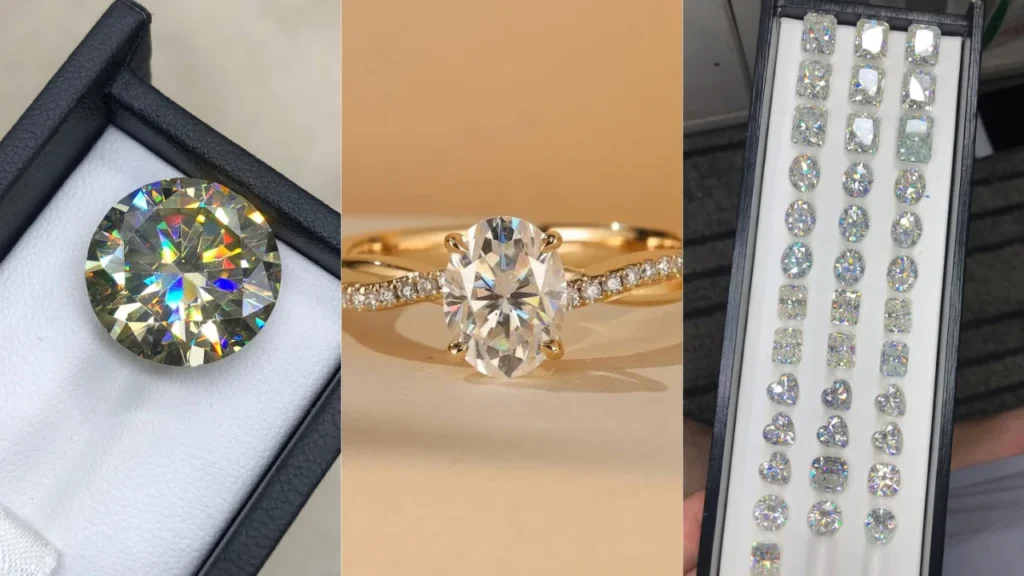
Search this question and you’ll find the same answer repeated across dozens of jewelry retailer blogs, almost word for word: no, moissanite doesn’t get cloudy. That kind of uniformity is usually worth a second look. Is it genuine consensus, or has everyone just copied the same marketing line? In this case, after checking the actual material science rather than more retail copy, the consensus holds up. But the question itself is doing double or triple duty, covering three genuinely different things that deserve separate answers.
The short answer, and why it’s true
No, moissanite does not develop internal cloudiness over time. This isn’t a brand claim; it comes down to what the stone actually is. Moissanite is silicon carbide, a crystal with exceptionally strong atomic bonds and a Mohs hardness of 9.25, second only to diamond among anything you’d wear as jewelry. That hardness matters for cloudiness specifically because it makes the surface highly resistant to the microscopic scratching that lets residue work its way in and accumulate. Just as important: silicon carbide is non-porous and chemically inert, meaning it doesn’t absorb oils, lotions, or moisture into its structure the way some other materials do.
Put plainly, there’s no mechanism by which the stone itself degrades or fogs internally under normal wear. Worth being precise about the evidence here, though: this conclusion rests on the known material properties of silicon carbide and the design of the stone, repeated consistently across gemological and retail sources, rather than a specific long-term independent laboratory study I could locate tracking moissanite clarity over, say, a 20-year period. The physics is sound; a formal longitudinal study is something I didn’t find.
What’s actually causing that dull look, then?
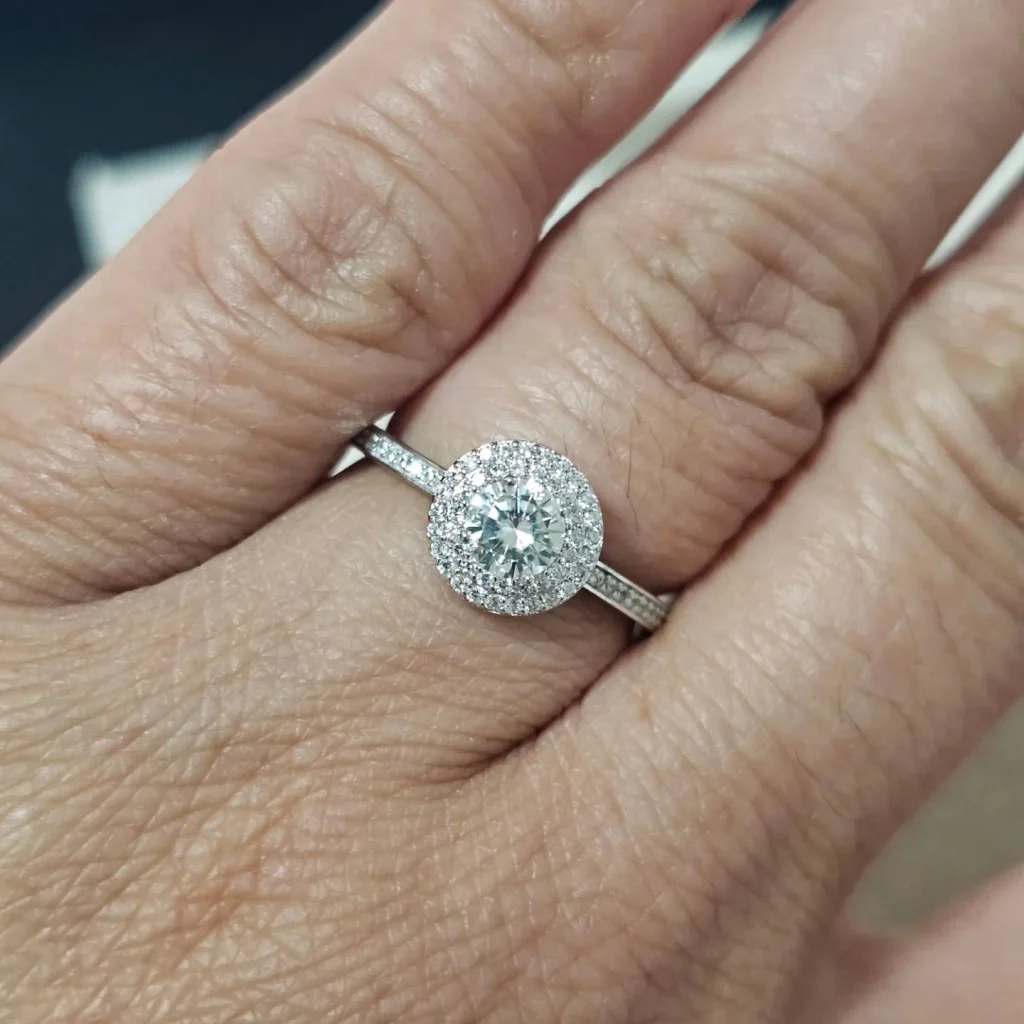
If a moissanite genuinely isn’t clouding from within, but people genuinely do report it looking cloudy, something real is still happening. Multiple sources converge on the same explanation: a thin surface film from everyday contact skin oils, hand lotion, soap residue, hard water minerals, or even chlorine from pool or hot tub exposure. This buildup sits on top of the stone rather than inside it, scattering light and dulling the sparkle rather than permanently damaging anything. It’s sometimes nicknamed the “oil slick” effect in trade discussion. The fix is simple: clean with warm water, mild dish soap, and a soft brush, and the stone returns to full brilliance, which is itself a useful confirmation: if cleaning restores it, you were looking at surface film, not genuine clouding.
The comparison everyone makes, and whether it’s fair
Nearly every source draws the same contrast with cubic zirconia, and it’s a legitimate one rather than pure competitive marketing. Cubic zirconia is zirconium dioxide, a chemically different and genuinely softer material at roughly 8 to 8.5 on the Mohs scale, with a more porous structure. Multiple sources describe CZ as absorbing oils into that porous structure over time, combined with surface scratching from the slightly lower hardness, producing real, often permanent internal cloudiness within one to two years of regular wear in lower-quality stones. That’s a different failure mode entirely from moissanite’s surface-film issue, and the comparison holds up as accurate rather than just a talking point retailers use to upsell moissanite over CZ.
The thing almost none of the retail sources separate out clearly
Here’s where a more balanced source, rather than another retailer blog, adds something useful. A buyer’s-guide piece reviewing moissanite’s genuine drawbacks lists cut quality variation as a real, distinct issue, noting that generic, cheaply cut overseas moissanite can show poor pavilion angles, facet asymmetry, and visible flaws like a strong bowtie effect or light leakage. A stone with these cutting problems can look dull, dead, or “fake” in a way a casual observer might describe as cloudy, even though nothing about the material is clouding at all. This is a manufacturing and craftsmanship issue, separate from both the surface-film question and the internal-stability question, and conflating it with “moissanite gets cloudy” muddies what’s actually three different, independently answerable concerns:
- Does the material itself degrade and fog internally? No—this is the well-supported chemistry answer.
- Can the surface look temporarily dull from everyday residue? Yes—normal, common, and fixable with basic cleaning.
- Can a poorly cut stone look dull or lifeless regardless of cleaning? Yes—but that’s a cutting-quality problem, not a cloudiness problem, and buying from a reputable cutter avoids it entirely.
How to actually prevent and fix surface buildup
- Clean with warm water, a few drops of mild dish soap, and a soft-bristled brush, working gently around and behind the stone where residue collects
- Rinse thoroughly and dry with a lint-free cloth
- Remove moissanite jewelry before applying lotion, hand sanitizer, or sunscreen, and before swimming in chlorinated water, since chlorine is specifically flagged across sources as accelerating film buildup
- A monthly cleaning routine for daily-wear pieces keeps buildup from becoming noticeable in the first place
Buying to avoid the cut-quality issue entirely
Since genuine material cloudiness isn’t a real risk but cut quality is a genuine variable, the more useful buying question is about the cutter, not the stone. Reputable moissanite retailers that specify precision faceting and quality control are the practical safeguard here—the Twirlweddings Guide’s own framing is worth repeating: most “moissanite looks fake” complaints trace back to poorly cut, low-quality stones rather than anything inherent to the material.
Source: Wikipedia’s entry on moissanite (https://en.wikipedia.org/wiki/Moissanite) and cubic zirconia (https://en.wikipedia.org/wiki/Cubic_zirconia).
💎 Explore More High-Dispersion & Diamond Alternative Gems:
Separating optical phenomena from physical stone deterioration is critical when evaluating daily-wear jewelry:
- Discover the history and diagnostic facet doubling of Earth-mined diamond alternatives in our Colorless Zircon Guide.
- Learn how high refractive index and double refraction create intense natural fire in our Blue Zircon Overview.