
Colorless zircon has one of the more surprising résumés in the gem world: for over a century before cubic zirconia or moissanite existed, it was the natural gemstone people reached for when they wanted something that looked and sparkled like a diamond. It carries its own historic trade name, a genuinely diamond-rivaling amount of fire, and one honest limitation worth knowing before you buy.
What Is Colorless Zircon?
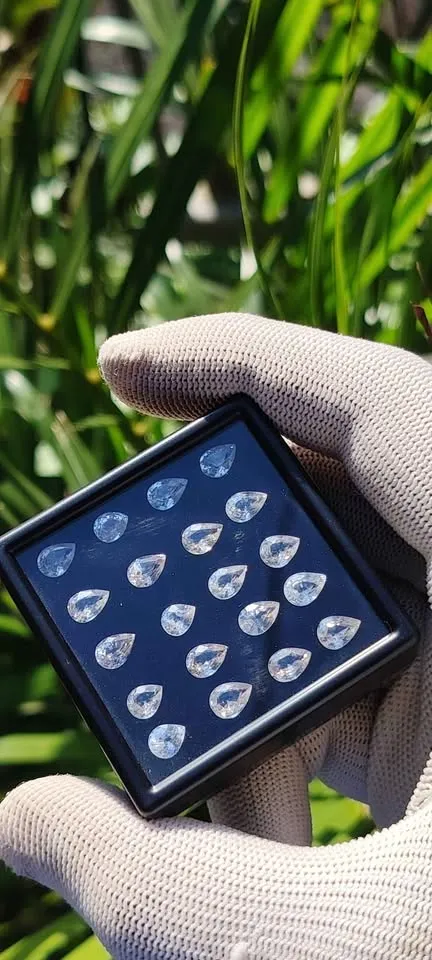
Colorless zircon (also called white zircon) is a colorless-to-near-colorless variety of zircon, a zirconium silicate mineral (ZrSiO₄) and one of the oldest minerals on Earth. Historically, it carried the trade name “Matura diamond,” named after Matara, Sri Lanka, one of the historic sources of fine material a name that speaks directly to how convincing colorless zircon was as a diamond substitute, long before any lab-created alternative existed.
As with every zircon color, it’s worth being clear upfront: zircon and cubic zirconia are entirely unrelated materials. Colorless zircon is a genuine natural mineral with centuries of history behind it; cubic zirconia is a lab-created diamond simulant invented in the 1970s. The naming overlap is a coincidence, but it causes near-constant confusion, especially for a color where the comparison to a diamond comes up constantly anyway.

Why Does Colorless Zircon Rival Diamond’s Sparkle?
Zircon has the highest refractive index of any gemstone in common use (1.81–2.02), giving it exceptional brilliance, and its strong dispersion produces the flashes of spectral color gemologists call “fire” — in zircon’s case, genuinely comparable to diamond’s. Add to that zircon’s pronounced double refraction, which causes a visible doubling of the back facet edges when you look through the top of a well-cut stone, and you have a gem that, in the right light, can be mistaken for diamond by anyone without gemological training.
Most colorless zircon on the market today has been heat-treated from brownish rough, generally in a reducing atmosphere, a process that also restores the crystal’s structure to its fully ordered “high” (crystalline) state — the same underlying transformation used to produce blue zircon, just carried one step further to remove color entirely rather than shift it toward blue.
Colorless Zircon vs. Diamond: An Honest Comparison
Colorless zircon’s convincing sparkle comes with a genuine limitation, and it’s worth stating plainly rather than glossing over: zircon rates 6.5–7.5 on the Mohs hardness scale, well below diamond’s 10, and it carries some brittleness that makes facet edges more prone to chipping and abrasion over time. The Smithsonian’s own gemology collection notes this directly colorless zircon’s inferior hardness and brittleness reveal it as an “imposter” on close, long-term inspection, even as it performs beautifully in the moment.
One practical identification method gemologists use is the “dot test”: because of zircon’s strong double refraction, a dot drawn on paper and viewed through the stone’s table facet will appear doubled, an effect true diamond (which is singly refractive) doesn’t produce. This is one of the more reliable low-tech ways to distinguish the two without lab equipment.
Where Colorless Zircon Comes From
- Sri Lanka: The source is most closely tied to colorless zircon’s history, giving rise to the “Matura diamond” trade name. Zircon here is typically recovered from the same alluvial gem gravel deposits known locally as illam, that also produce the island’s sapphires and spinel, traditionally hand-panned using woven baskets called vatti around Ratnapura.
- Cambodia, Myanmar, Thailand, and Vietnam: All contribute brownish zircon rough that’s commonly heat-treated toward colorless, alongside blue and other colors.
- Australia, Madagascar, and Tanzania: Additional global sources of zircon rough suitable for heat treatment.
Is Colorless Zircon Treated?
Generally, yes. Most colorless zircon reaching the market has been heat-treated from brownish rough, a long-established, disclosed, standard industry practice rather than something to view with suspicion. Natural, untreated colorless zircon does exist but is considerably less common. As always, ask your dealer directly about treatment status, since it affects both price and how the stone is marketed.
Colorless Zircon Durability: Should You Wear It Every Day?
Treat it carefully, more so than you might expect from how convincingly it mimics a diamond. Its hardness (6.5–7.5) and brittleness make it better suited to earrings, pendants, and occasional-wear rings than to a piece meant for constant daily use. If you do want it in a ring worn regularly, a protective setting is a sensible precaution rather than an optional extra.
What Determines the Value of Colorless Zircon?
- Clarity and lack of visible color tint — Truly colorless, eye-clean material is more desirable than stones with a faint yellow, grey, or brown cast.
- Cut quality — Given how central fire and brilliance are to colorless zircon’s appeal, a well-executed round or oval cut significantly affects performance.
- Carat weight — Larger, fine colorless zircon is less commonly available than smaller stones.
- Natural vs. heat-treated origin—Confirmed natural material is rarer and can carry a premium, though heat-treated colorless zircon remains the market standard and isn’t seen as a downside.
How to Care for Colorless Zircon
Clean it with warm water, mild soap, and a soft brush, and avoid ultrasonic and steam cleaners given zircon’s brittleness and vulnerability to stress fractures under vibration and heat. Store it separately from harder gems like sapphire and spinel to prevent surface abrasion, and be mindful of facet edges knocking against hard surfaces during regular wear.
Colorless Zircon vs. Moissanite: How to Tell Them Apart
Both are marketed at various points as diamond alternatives, but they come from very different eras and materials. Moissanite is a lab-created silicon carbide gem, harder than zircon at 9.25 on the Mohs scale and closer to diamond’s durability, while colorless zircon is a genuine natural mineral with a far older history as a diamond substitute , predating moissanite’s commercial availability by decades. Moissanite also has even higher dispersion than zircon, giving it noticeably more rainbow “fire,” which can actually look less diamond-like to a trained eye than zircon’s more measured brilliance. For buyers prioritizing durability, moissanite is the stronger daily-wear choice; for those drawn to natural origin and gemological history, colorless zircon offers something moissanite simply can’t.
💡 Gemology Note: Choosing between colorless zircon and white sapphire comes down to fire versus hardness. Zircon delivers more dispersion, while white sapphire provides maximum scratch resistance. Learn more in our White Sapphire Feature Guide.