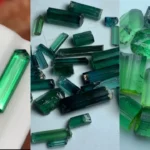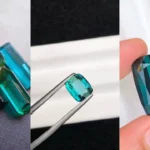
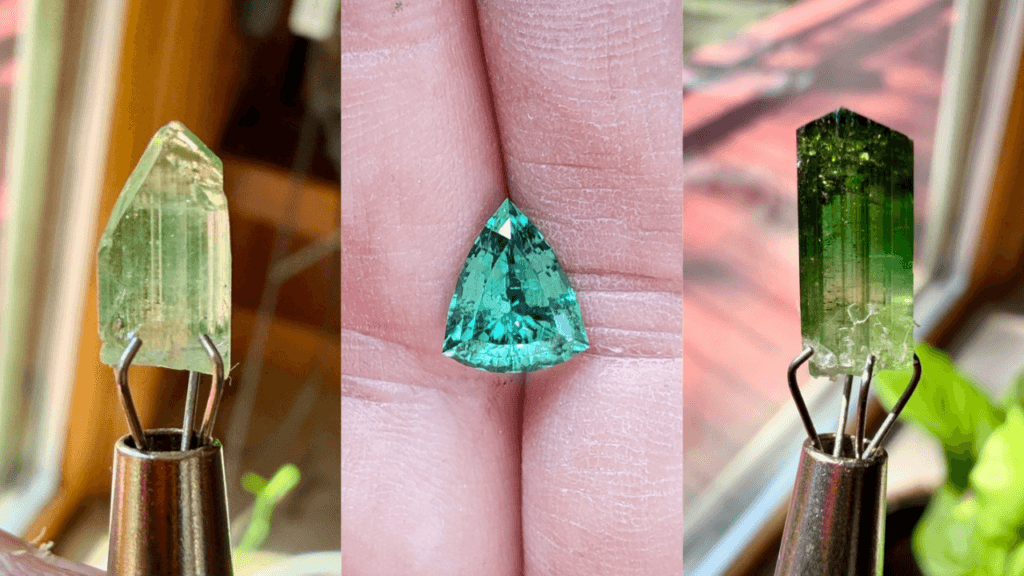
Maine tourmaline is gem tourmaline from pegmatite pockets in western and southern Maine, where tourmaline is the state mineral. It comes in green, pink, blue, and watermelon colors, and GIA calls the 1972 Newry find the largest gem tourmaline discovery in North America. If you’re buying, treat “Maine” as a claim to check: ask the seller about origin and treatment.
Table of Contents
What is Maine tourmaline?
Tourmaline is Maine’s state mineral. It is a group of minerals with similar crystal structures but complex, variable chemistry. The most common species in Maine is schorl, a black, iron-bearing tourmaline. The colorful but less common species is elbaite.
Maine’s finest gem tourmalines come from pegmatite pockets, open cavities in very coarse-grained granite where crystals grew with greater perfection and clarity. The Maine Geological Survey describes the range as black or white to vibrant shades of red, green, and blue.
Most crystals never become gems. Transparent crystals clear enough to be faceted are highly prized, while lesser grades are tumble-polished for use in jewelry.
Where Maine tourmaline comes from
Slow cooling of pegmatite veins let the mineral grains grow far larger than in ordinary granite. The Survey notes that the best gem-producing localities lie on a straight line running southeast through this part of the state.
| Locality | What the sources say |
|---|---|
| Mount Mica, Paris | Site of Maine’s first major tourmaline discovery in 1820. A quarry there has produced gem tourmaline on and off to the present (Maine Geological Survey) |
| Newry | Site of the 1972 Big Find. GIA places it at an abandoned mine near the top of Plumbago Mountain; the Survey names the Dunton Mine |
| Oxford County and the Auburn-Poland area | Where the colored crystals occur mainly (Maine Geological Survey) |
| Black Mountain, Rumford | Named by the Survey as a place where collectors can find pieces |
Two discoveries that shaped Maine tourmaline
1820: the Survey dates Maine’s first major tourmaline discovery to 1820 at Mount Mica in Paris. Fine stones from that quarry appear in the Hamlin Necklace, held at Harvard University’s Mineralogical Museum.
1972: GIA describes the Big Find as North America’s largest and most significant unearthing of gem-quality tourmaline. Vast pockets of tourmaline in every color yielded more than a ton of rough from 1972 to 1974, and the find reawakened gem mining in Maine. The Survey adds that hundreds of pounds of red and green crystals were found, including the 10-inch Jolly Green Giant, now at the Smithsonian’s National Museum of Natural History.
In 2022, for the 50th anniversary, the Maine Mineral & Gem Museum asked 12 jewelry designers to make one-of-a-kind pieces from 12 stones from the find, ranging from 9.78 to 49.30 carats (GIA).
Maine tourmaline colors
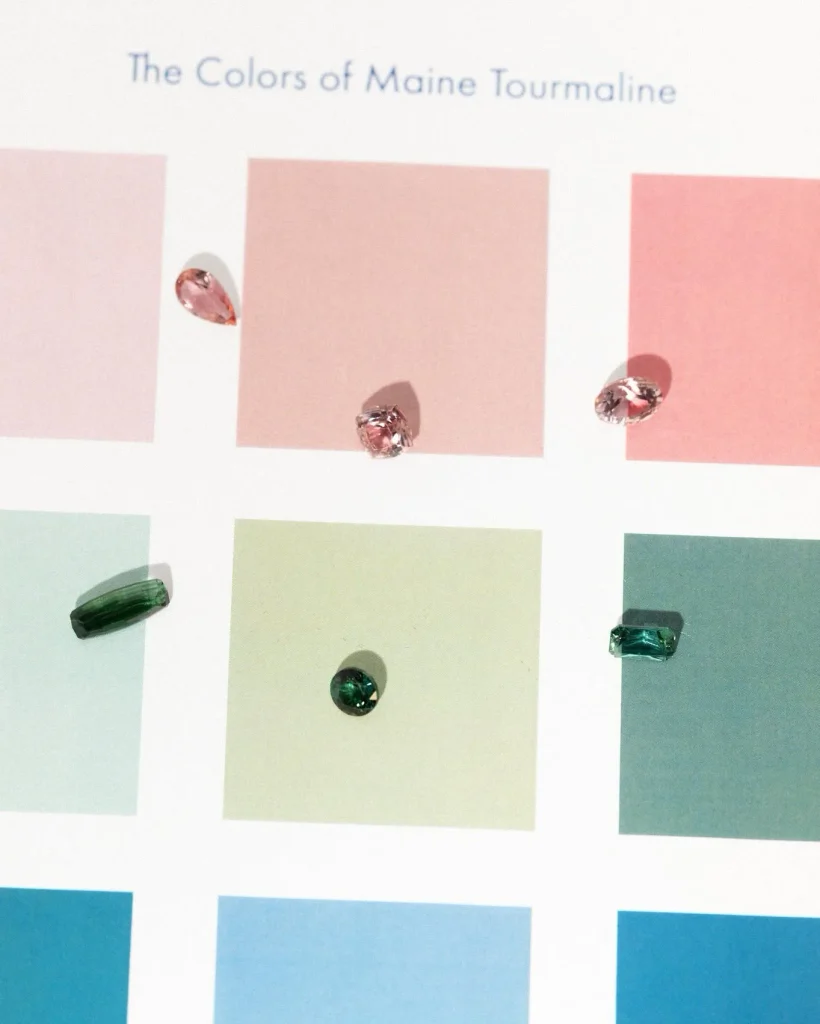
- Green, pink and red, blue: the Survey lists vibrant shades of red, green, and blue, and says the color of the best Maine specimens rivals tourmaline from California, Brazil, Pakistan, and Afghanistan.
- Watermelon: a green outer layer around a pink core.
- Black schorl: the most common species in Maine, and not a gem variety.
- A retailer’s claims: one Maine jeweler’s history page calls blue the rarest Maine color and describes bi-color crystals that are green at one end and pink at the other. These are a single retailer’s claims.
Does Maine origin make a stone better?
Origin gives a stone a story. It doesn’t set its quality. Judge any tourmaline by color, clarity, and cut, and see our gemstone buying guides for how to do that. For green stones, our green tourmaline guide goes deeper.
Treatment applies here too. The Rare Gemstone Company says heating is the most common tourmaline treatment, used when a stone is too dark, and that irradiation and oiling also occur. That guide covers tourmaline in general. None of the sources used for this article says Maine stones are exempt, so ask about treatment on every stone.
Buying Maine tourmaline jewelry: what to check
- Ask which mine or locality the stone came from, and whether the seller can document it.
- Ask whether the stone is treated.
- Confirm the variety and color: green, pink, blue, watermelon, or bi-color.
- Get the carat weight and dimensions.
- Ask whether there is a lab report, and which lab issued it. Our guide to certification and authenticity explains what those reports cover.
- Check the return policy in case the stone isn’t as described.
Whether a lab can confirm that a stone came from Maine isn’t covered by the sources used for this article, so treat origin as the seller’s claim until it is documented.
For rings, the International Gem Society lists tourmaline hardness at 7 to 7.5 with no cleavage, which gives good durability. Stones with flaws or low clarity may be weaker, so check inclusions.
Where to see and collect Maine tourmaline
The Survey lists the Maine State Museum in Augusta, which shows the Peary Necklace and one of the largest crystals from Newry, and Harvard University’s Mineralogical Museum. GIA names the Maine Mineral & Gem Museum.
The Survey also says pieces of pink, green, blue, or watermelon tourmaline can be found at the Dunton Mine, Mt. Mica, and Black Mountain (Rumford), with collecting usually allowed for a small fee. That page was last updated in January 2015, so confirm access, rules, and fees before you visit.
FAQ
What is Maine tourmaline jewelry?
Maine tourmaline jewelry is jewelry set with gem tourmaline from Maine, where tourmaline is the state mineral. The Maine Geological Survey says transparent crystals clear enough to be faceted are highly prized, while lesser grades are tumble-polished for use in jewelry.
Where can you buy tourmaline jewelry in Maine?
The Maine Geological Survey says cut tourmaline gems and crystal specimens can be bought from jewelers or mineral dealers. Whichever seller you use, ask where the stone came from, whether it is treated, and whether there is a lab report.
What should I know about a Maine tourmaline ring?
The International Gem Society lists tourmaline hardness at 7 to 7.5 with no cleavage, which gives good durability, though stones with flaws or low clarity may be weaker. Heating is a common treatment for tourmaline that is too dark, so ask whether the stone has been treated.