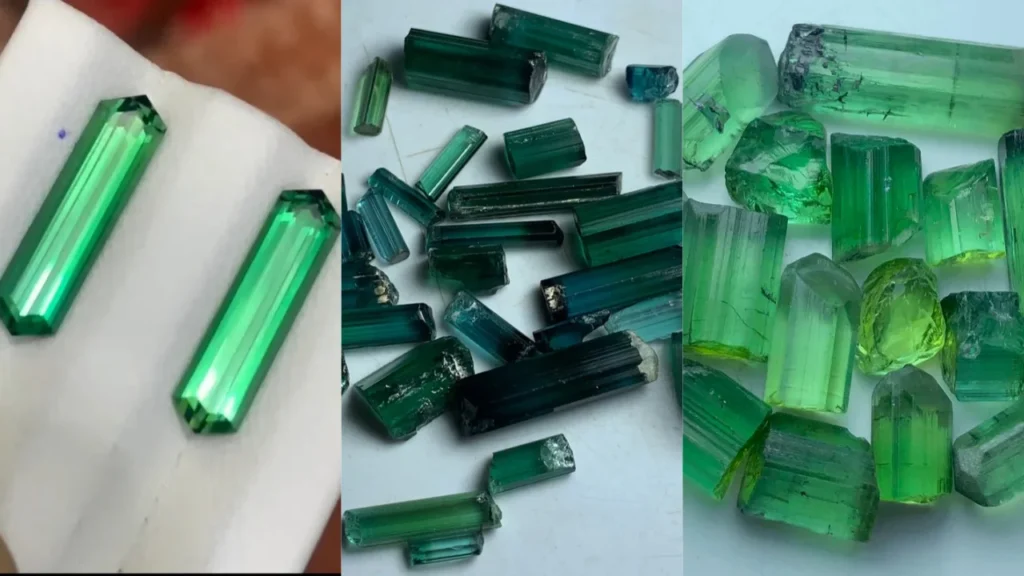
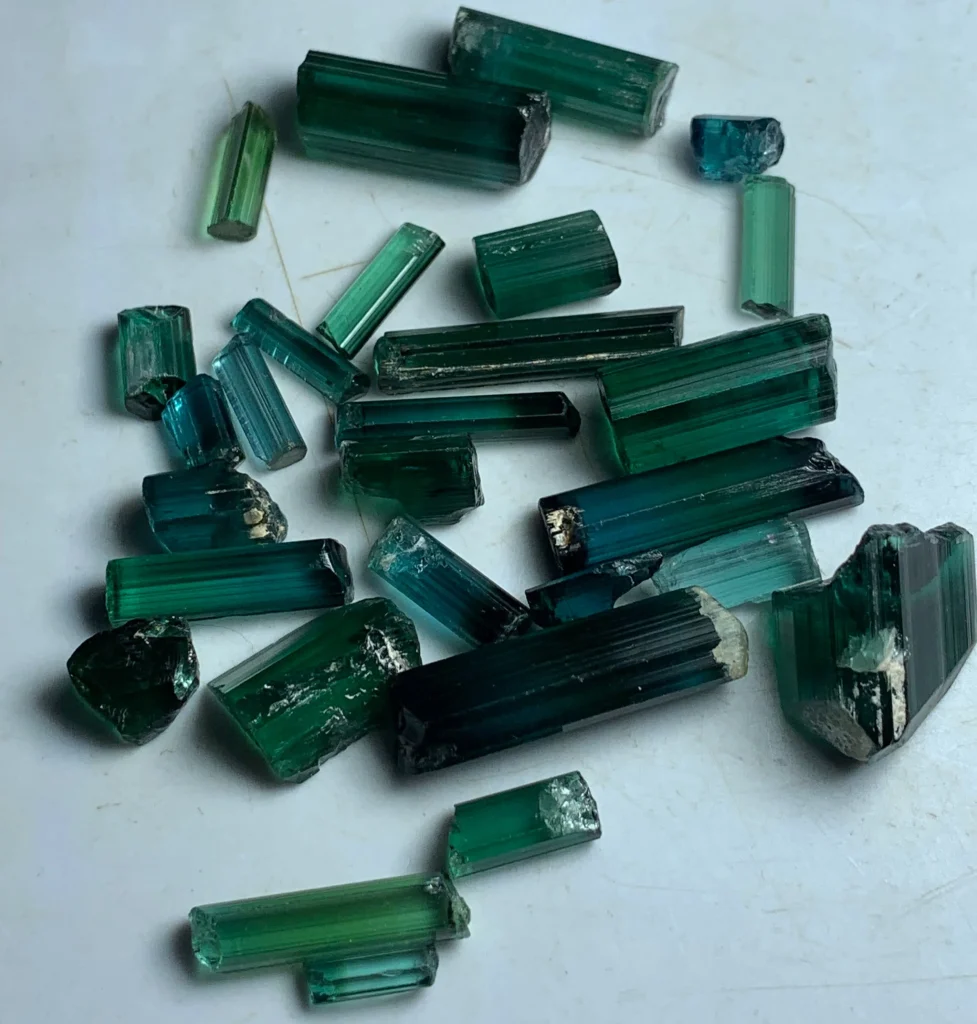
Green tourmaline is a durable gemstone, with a hardness of 7 to 7.5, that gem dealers call verdelite when green is the dominant color. Judge it by color saturation first, then clarity and cut. A vivid, medium-tone stone with good light return is the one to look for.
What is green tourmaline?
Tourmaline comes in many colors. Green tourmaline covers any shade of green, from yellow-green through green to blue-green. When green dominates, the stone is a verdelite. If it shows more blue than green, it is usually called indicolite, and where that line falls is a judgment call.
One variety is sold separately. Chrome tourmaline has a deep, emerald-like green produced by traces of chromium and sometimes vanadium. Because it is chemically different, it is usually distinguished from verdelite and priced higher, according to the International Gem Society.
| Verdelite | Chrome tourmaline | Indicolite | |
|---|---|---|---|
| Color | Yellow-green to green to blue-green | Deep, emerald-like green | More blue than green |
| Color source | Not covered by the sources I read | Chromium, sometimes vanadium | Not covered by the sources I read |
| Price per carat | Doesn’t jump much before about 5 carats | Significantly higher, and can jump after 1 carat | Not covered by the sources I read |
Tourmaline can also build up an electric charge when heated or rubbed, a property called pyroelectricity. The name comes from the Sinhalese word turmali. For how tourmalines form, see the Gem Society’s explainer.
How to judge green tourmaline color
Gemologists judge color in three parts: hue, tone, and saturation, an approach laid out in The Rare Gemstone Company’s tourmaline buying guide. In tourmaline, hue has the least effect on quality. Tone is how light or dark the stone looks. Look for a medium tone, not too light and not too dark.
Saturation, how deep and vivid the color is, matters most. The more intense the color, the more valuable the stone.
Undertones shape the look of a stone. A yellow-leaning green can feel warm and relaxed. A blue-leaning green reads cooler and more formal.
Two habits help when you shop:
- Check more than one light source. Greens and blues look better in daylight or white light than under warm bulbs.
- Tilt the stone. Tourmaline is strongly dichroic, so it can show different colors depending on the viewing direction.
Clarity: what inclusions mean
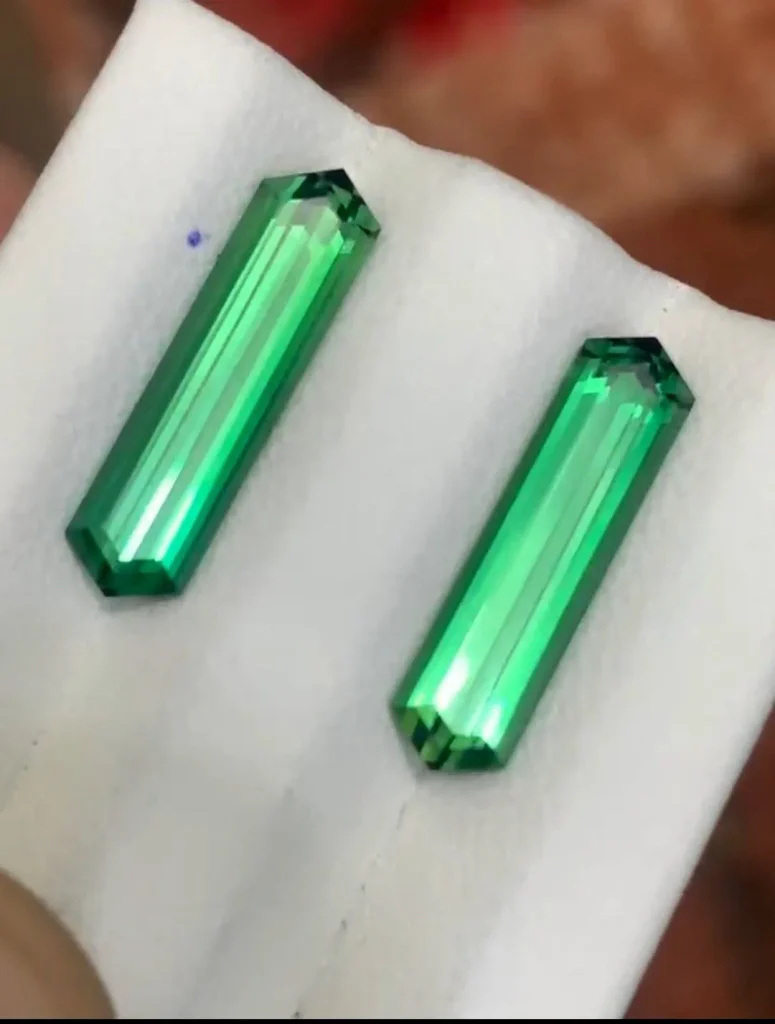
GIA groups gems by how often they contain inclusions. Green tourmaline falls in Type 2, meaning it usually has some. Typical inclusions are cracks, crystals of the same or another mineral, needles, and liquid-filled healed fractures called fingerprints.
What matters is the effect on the stone. If it still looks lively and open, minor inclusions rarely detract. When inclusions are dense or block the light, the stone looks dull. Heavily included stones may also be weaker.
Cut matters more than shape.
Oval, round, or emerald cut: the shape doesn’t change quality. The quality of the cut does. Look for symmetry, well-placed facets, and good light return. Avoid a bulged pavilion, the bottom of the stone swelling outward, and lopsided outlines.
One jeweler notes that elongated shapes, such as emerald and oval cuts, tend to suit green tourmaline because light travels through the length of the stone.
Size and carat weight
As with most gems, larger stones are rarer. The Rare Gemstone Company says chrome tourmaline is most common under 2 carats. The International Gem Society says verdelite’s price per carat doesn’t jump much before 5 carats. Confirm both against current listings.
Is green tourmaline durable enough for rings?
Largely, yes. The International Gem Society lists tourmaline hardness at 7 to 7.5 with no cleavage, which gives good durability. Its caution is to watch for stones with flaws or low clarity.
For a ring, a bezel or prong setting protects the stone better than wire-wrapped or tension settings. Clean it with mild soap, warm water, and a soft brush, and avoid harsh chemicals. Treatments and look-alikes
The most common treatment is heating, usually done when a tourmaline is too dark, to give a lighter and more attractive color. Irradiation and oiling to hide fractures also occur, particularly in rubellite, the red and pink variety. Details are in The Rare Gemstone Company’s guide.
Imitations on the market include glass, apatite, topaz, and andalusite. One gemologist’s guide states that tourmaline has never been successfully synthesized in a lab [Unverified: single source]. Either way, ask the seller whether the stone is treated, and for higher-value purchases look for an independent lab report.
Green tourmaline vs emerald
Both are green, and both are popular in jewelry. Retailer sources describe emerald as typically more included and more expensive than green tourmaline of similar appearance and tourmaline as the more affordable choice for everyday wear. [Unverified: retailer claims; hardness figures differ between sources, so they are not compared here.]
For the other side of the comparison, read our emerald gemstone guide.
Where green tourmaline comes from
According to The Rare Gemstone Company, tourmaline in general is mined in Brazil, Afghanistan, Tanzania, Kenya, Mozambique, the Democratic Republic of Congo, Madagascar, Sri Lanka, Pakistan, and the USA. That list covers all tourmaline colors, not green alone.
What drives the price
Five things move the price: color saturation, size, variety (chrome tourmaline costs more than verdelite), cut quality, and whether the stone is treated. This guide doesn’t quote per-carat prices, because they vary with quality and seller. Compare several current listings for stones that match on color, size, and treatment before you pay.
Green tourmaline meaning
In crystal-healing tradition, green tourmaline is linked with the heart chakra, growth, and nature. These associations come from metaphysical belief, not gemology, and this guide does not treat them as proven or make health claims for the stone.
Green tourmaline buying checklist
Green tourmaline buying checklist
0 of 6 checked
For more on judging stones before you buy, browse our gemstone buying guides.
FAQ
What does green tourmaline mean?
In crystal-healing tradition, green tourmaline is linked with the heart chakra, growth, and nature. These associations come from metaphysical belief, not gemology, and this guide does not treat them as proven.
Is green tourmaline good for jewelry?
Yes, for most uses. The International Gem Society lists tourmaline hardness at 7 to 7.5 with no cleavage, which gives good durability. Stones with low clarity may be weaker, so check inclusions before buying a ring.
What is a green tourmaline stone called?
Gem dealers call green tourmaline verdelite when green is the dominant color. Deep, emerald-like green tourmaline colored by chromium is usually sold separately as chrome tourmaline, and stones that look more blue than green are called indicolite.