


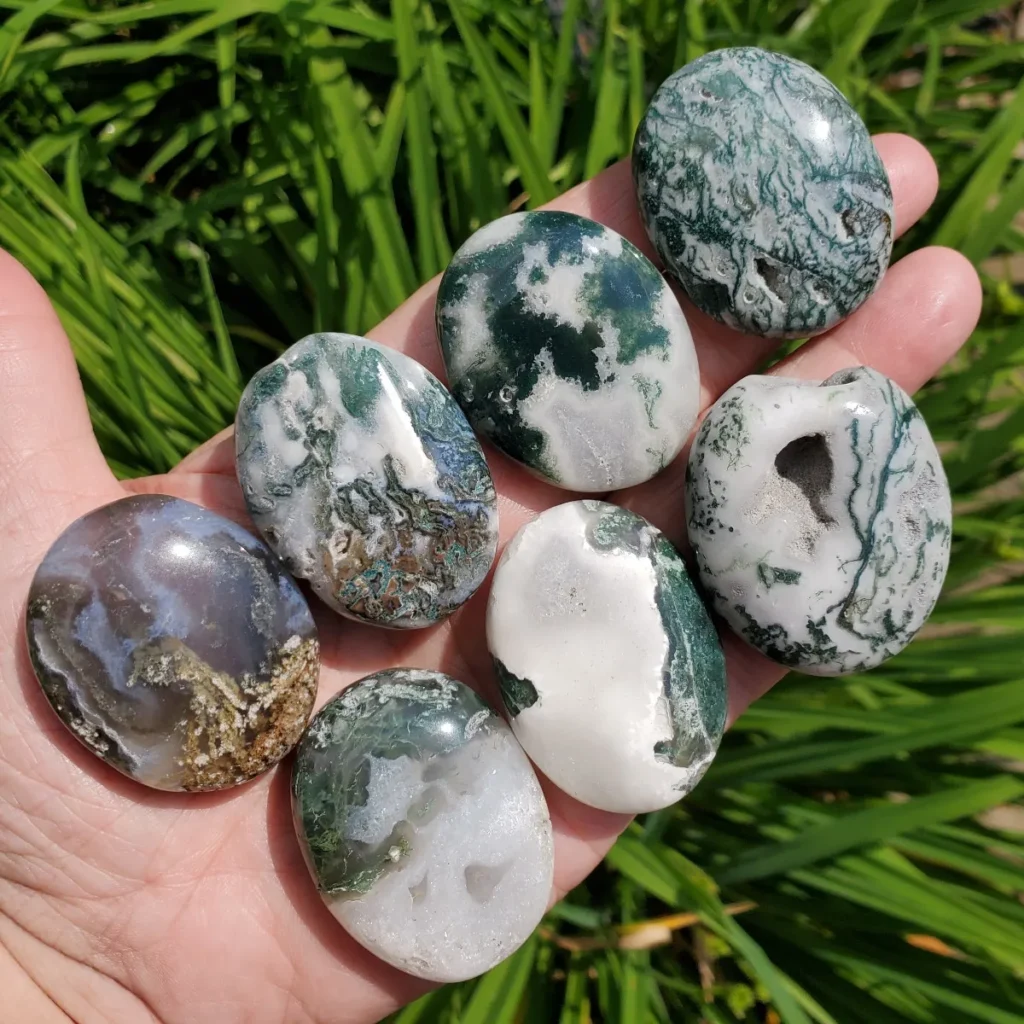
Moss agate is one of the most visually striking stones in the gem world, prized for the green, plant-like patterns that seem to grow inside it. Despite the name, it isn’t actually agate, and what looks like moss isn’t moss at all.
What Moss Agate Actually Is
Moss agate is a variety of chalcedony, a form of cryptocrystalline quartz, meaning its crystals are so small they can’t be seen even under standard magnification. True agate is defined by concentric or parallel banding, and moss agate doesn’t show that structure at all. Mineralogically, it’s really a patterned chalcedony rather than a true agate, but the trade name has stuck for so long that nobody’s bothered to correct it.
Why It Looks Like It Has Tiny Forests Inside
The “moss” pattern comes from mineral inclusions trapped inside the stone as it formed, mainly manganese and iron, sometimes both together. These minerals seeped into tiny fractures in the developing chalcedony and crystallized into thin, branching, tree-like shapes called dendrites.
There’s no plant material inside a moss agate at all. The resemblance to moss, ferns, or a miniature forest is a coincidence of mineral chemistry, though it’s such a convincing one that people have been fooled by it for centuries. Depending on which minerals were involved and how concentrated they were, the inclusions can appear green (the most common and recognizable version), brown, or occasionally red.
Where the Best Moss Agate Comes From
India is the world’s largest producer of moss agate, and the Aurangabad region of Maharashtra specifically has built a reputation for exceptionally high-quality material, sourced through a genuinely interesting, low-impact process.
Local farmers plowing their fields often uncover pieces of moss agate and bloodstone sitting near the surface. Rather than digging immediately, these finds simply get noted as markers. Mining only happens in the window after the harvest is complete and before the next planting season begins, so it never interferes with the farming calendar. Once a miner extracts the stone from beneath the topsoil, that topsoil gets replaced so the field is ready for the next crop cycle. It’s a system built around the rhythm of the seasons rather than continuous extraction, and it’s part of why moss agate from this region tends to carry a stronger reputation for both quality and traceable origin.
Why Smaller Stones Are Often Better
Here’s something most buyers never think to ask about: bigger isn’t necessarily better with moss agate, and cutters know it.
Because the dendritic inclusions are often dense in the rough material, larger cut stones can end up looking cluttered or muddy, with individual patterns blurring together into an indistinct dark mass. For this reason, many cutters deliberately keep finished stones at 5 carats or smaller, since that size tends to preserve the clarity of individual branches and lets light pass through the surrounding chalcedony properly. Common cutting styles include hex tablets, sugarloaf cabochons, emerald cuts, and baguettes, each chosen to frame the internal pattern rather than just maximize size.
If you’re comparing two moss agate stones and one is noticeably larger but looks hazier or less defined, that’s not necessarily a flaw in the stone; it’s often just a sign it was cut past the point where the pattern stays sharp.
How to Judge Quality in Moss Agate
Pattern clarity. The best stones show sharp, well-defined “moss” patterns rather than a muddy, indistinct green haze.
Translucency. Higher-quality moss agate lets light pass through enough to make the internal patterns glow, rather than looking flat and opaque.
Even distribution. A pattern that spreads attractively across the stone, rather than clustering awkwardly in one corner, is generally more desirable.
Size relative to clarity. As covered above, a smaller stone with a crisp, well-defined pattern is often worth more than a larger one with muddy inclusions.
Is Moss Agate Valuable?
Moss agate is generally an affordable gemstone, which is part of why it’s become popular in accessible jewelry, including as an engagement ring stone for buyers who want something distinctive and nature-inspired without a high price tag. Moss agate is also typically sold untreated, with no heat or chemical enhancement, since its natural coloring is already considered attractive enough on its own. Stones with especially vivid, well-formed patterns and strong translucency do command a real premium over duller, less patterned material.
Caring for Moss Agate
Moss agate ranks about 6.5 to 7 on the Mohs hardness scale, making it reasonably durable for everyday jewelry, including rings. Clean it with warm water, mild soap, and a soft brush, and avoid harsh chemicals or prolonged direct sunlight, which can occasionally affect the stone’s appearance over time. Store it separately from harder gemstones like sapphire or diamond to prevent surface scratches.
The Bottom Line
Moss agate earns its name honestly enough in spirit, even if it’s technically neither moss nor true agate. Once you understand that its beauty comes from mineral inclusions rather than any organic material and know why smaller, clearer stones often outshine larger ones, you’re in a much better position to choose a stone that’s genuinely worth its price.
Learn more about chalcedony formations, mineral inclusions, and historical origins in the Wikipedia entry for moss agate.
For detailed gemological and mineralogical data—including structure, classification, and reference standards—you can consult the Mindat database entry on quartz varieties.
For a comprehensive look at this fascinating gem, check out Root & Carat’s guide to rainbow moonstone. It clears up the common industry confusion around the name, explaining why rainbow moonstone is technically a variety of transparent labradorite rather than traditional orthoclase moonstone and how its distinct multi-colored flash occurs.

