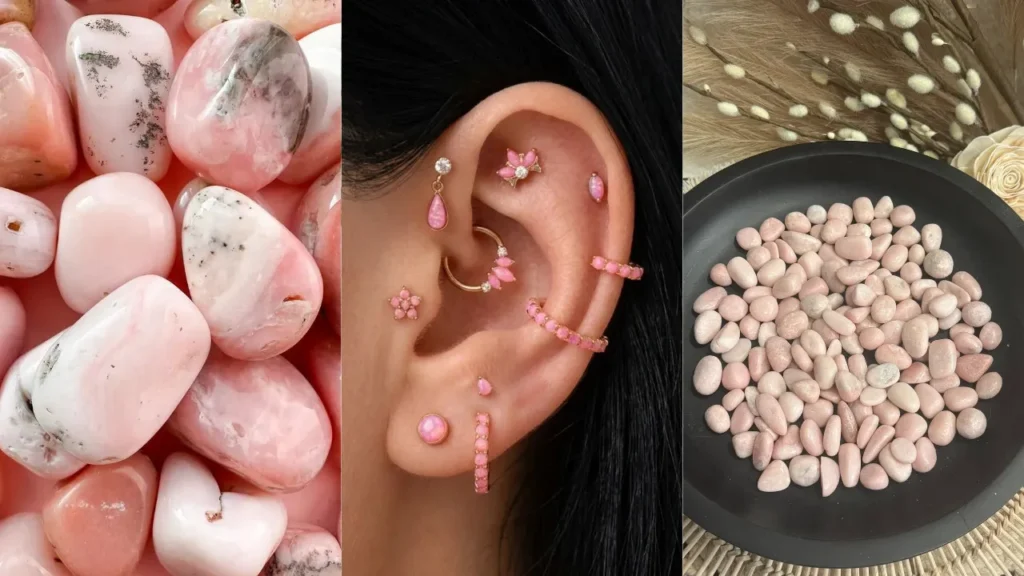
Pink opal is a variety of common opal, opal without the flashing “play-of-color” seen in precious opal, valued instead for its soft, uniform pink to rose color. Most of what reaches the jewelry market comes from a single mining district in southern Peru, discovered only in the early 1980s, which makes pink opal a relatively recent addition to the gem trade compared to most classic colored stones.
What Is Pink Opal?
Pink opal is a type of common opal, a hydrated amorphous form of silica (SiO₂·nH₂O) that lacks the internal microsphere structure responsible for precious opal’s flashing play-of-color. Instead, pink opal is valued for its even, opaque-to-translucent body color, ranging from pale “angel skin” pink to a deeper rose or magenta. It’s frequently intergrown with chalcedony (a microcrystalline quartz), which can raise its effective hardness slightly above that of pure opal. The material most associated with the name is often marketed as Peruvian pink opal or Andean pink opal, which comes from a deposit discovered around 1983 in the Acari copper mining district of the Arequipa region in southern Peru, alongside the country’s better-known blue opal.

Why Is It Pink?
The cause of pink opal’s color depends on its origin, and gemological sources genuinely disagree or, more precisely, describe two different mechanisms depending on where the stone formed. According to the Smithsonian’s National Museum of Natural History, Peruvian pink opal’s color comes from trace amounts of quinones, organic compounds incorporated into the silica gel as the opal formed. Other trade and mineralogical sources instead attribute pink opal’s color, particularly material from the United States and Australia, to trace manganese content. Both explanations appear consistently across credible sources, so the honest answer is that pink opal’s color cause isn’t a single universal mechanism: Peruvian material is generally linked to organic quinone content, while North American and Australian material is more consistently tied to manganese. Either way, the color is a natural product of trace elements incorporated during formation, not something painted on afterward, a distinction that matters given how common dyeing is in this particular gem’s market (more on that below).
Where It Comes From
Peru is by far the dominant commercial source, with the Acari district in the Arequipa region supplying the great majority of pink opal sold worldwide since its discovery in the early 1980s. It’s young enough that pink opal doesn’t have the centuries-long mining history many other gems do. Mexico also produces pink opal, notably from Durango, and material from the United States (Idaho and Oregon) and Western Australia rounds out global supply, though in smaller volumes. Australian material sold as “pink opal” is sometimes technically opalized radiolarite, a sedimentary rock rather than pure hydrated silica opal. Is it worth knowing if provenance and exact material composition matter to you? Sri Lanka is not a source of pink opal, so unlike several other RootAndCarat.com articles, there’s no genuine illam/vatti mining connection to draw here.
Is It Treated?
This is the section where honesty matters most for pink opal specifically: dyeing and resin stabilization are both widespread in the pink opal trade, more so than in many other colored gemstones. Pink opal’s porosity, a structural property of common opal, generally makes it especially receptive to both treatments. Resin impregnation and stabilization, used to improve durability and reduce the risk of surface crazing, is common on lower-quality or more porous material; when disclosed, it’s broadly accepted in the trade but commands a lower price than untreated natural opal. Dyeing is also documented, particularly to intensify a weak or grayish natural pink into a more saleable bubblegum tone. Dyed stones can sometimes be identified by color pooling in fractures or along grain boundaries, though confirming this reliably usually requires lab testing. For any pink opal purchase beyond casual, low-cost jewelry, it’s worth asking the seller directly whether the stone is natural, dyed, or stabilized, and requesting documentation for higher-value pieces.
Durability: Can You Wear It Every Day?
Pink opal sits at roughly 5 to 6 on the Mohs hardness scale, sometimes reaching a touch higher where chalcedony content raises it, but it remains one of the softer gemstones commonly used in jewelry notably softer than quartz, garnet, or sapphire. A few real caveats:
- Water content makes it heat- and dehydration-sensitive. Like all opal, pink opal contains bound water within its structure. Extreme heat, very dry environments, or rapid temperature swings can cause dehydration, which may lead to surface crazing (fine cracking) or color change over time.
- No ultrasonic or steam cleaning. These are contraindicated for essentially all opal, pink opal included, due to both the heat/vibration risk to the water content and the risk of aggravating porosity-related fractures.
- UV and chemical sensitivity for organically colored material. Because Peruvian pink opal’s color is linked to organic quinone content, prolonged UV exposure and harsh chemical cleaners can accelerate fading over years of wear.
- Everyday wear verdict: pink opal is better suited to earrings, pendants, and occasional-wear rings than a ring subjected to daily knocks, water exposure, and temperature swings. It’s a beautiful stone, but not the most practical choice for a hard-wearing everyday ring.
What Determines Value
- Color saturation and evenness. Rich, saturated bubblegum-to-rose pink with even, uniform color throughout is the most desirable; pale, washed-out, or grayish material is worth considerably less.
- Translucency. Material with attractive translucency (light passing through at the edges) generally outperforms fully opaque stones of similar color.
- Treatment status. Natural, untreated pink opal with strong color and good translucency is the most valuable form; dyed or heavily stabilized material is worth notably less, even when the color looks similar to the eye.
- Absence of crazing or visible fractures. Given pink opal’s dehydration sensitivity, stones free of surface cracking hold their value and appearance far better over time.
- Origin. Peruvian material, as the source most associated with the finest saturated pink color, is generally the trade benchmark; other origins are priced relative to how closely they match that standard.
- Presence of dendritic inclusions. Some pink opal shows black, fern-like manganese oxide inclusions, sometimes nicknamed “peppermint opal” — these are a matter of taste rather than a strict value driver, appealing to some buyers and detracting for others who prefer a cleaner, unpatterned stone.

How to Care for Pink Opal
Clean the pink opal with a soft, slightly damp cloth and mild soap only; never use ultrasonic or steam cleaners. Avoid prolonged exposure to direct sunlight or very dry conditions (such as near heating vents or in a hot car), since both can accelerate dehydration and surface crazing over time. Keep pink opal away from harsh chemicals, including many household cleaners and some perfumes, which can affect both the stone’s surface and, for organically colored Peruvian material, its color stability. Store it separately from harder gemstones to prevent scratching, and remove pink opal jewelry before swimming, exercising, or manual work. If you live in a very dry climate, some opal owners keep a small dish of water near stored opal pieces to maintain ambient humidity, though this is a precaution rather than a strict requirement for common opal varieties like pink opal.
Pink Opal vs. Rose Quartz: Don’t Confuse Them
Pink opal and rose quartz are frequently mixed up in the jewelry market because both present as a soft, milky pink stone at a similar price point. The distinction matters for buyers:
- Species: Pink opal is hydrated amorphous silica (opal); rose quartz is crystalline quartz colored by trace titanium, iron, or manganese—chemically related (both silica-based) but structurally very different.
- Hardness: Rose quartz is notably harder at 7 Mohs, compared to pink opal’s 5–6, making rose quartz the more durable and practical everyday-wear choice between the two.
- Water sensitivity: Rose quartz has no bound water content and isn’t vulnerable to the heat/dehydration crazing risk that affects pink opal.
- Look: Pink opal tends toward a more opaque, milky, uniform pink; rose quartz often shows a subtler, slightly translucent pink with occasional visible internal rutile needles (asterism in star rose quartz is a related but separate phenomenon).
- Value: Fine, richly colored, untreated pink opal generally commands a higher price per carat than comparable rose quartz, despite rose quartz’s greater durability.
A jeweler can distinguish the two instantly by hardness testing or refractive index the visual similarity at a glance isn’t reliable, especially for lower-saturation stones of either type.
💡 Gemology Note: Unlike common pink opal, which is non-phenomenal, labradorite is famous for its optical play-of-color called labradorescence. Learn what causes this striking optical phenomenon in our Labradorite Gemstone Guide.