
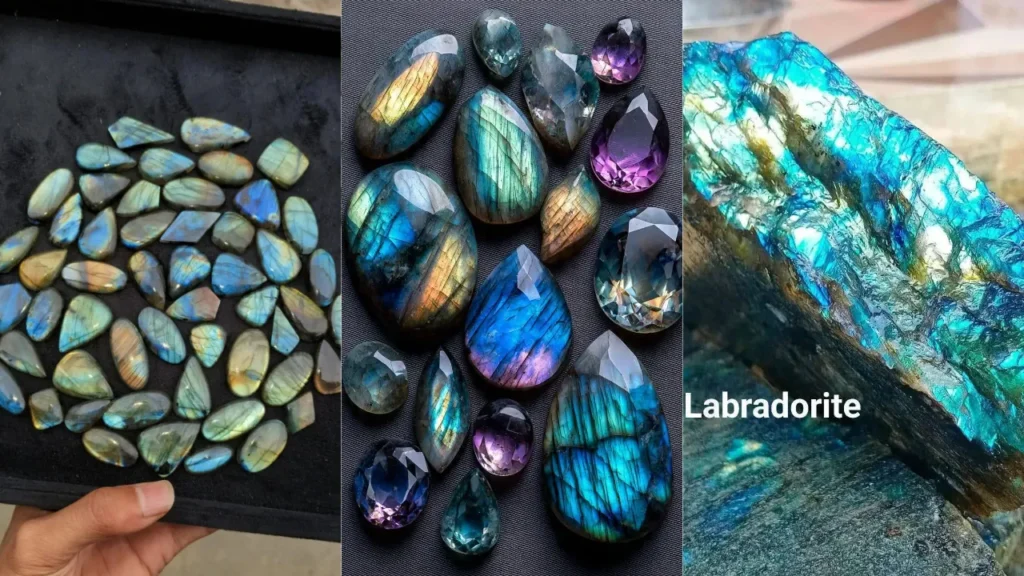
Labradorite is a feldspar mineral best known for labradorescence, a flash of blue, green, gold, or multicolor light that appears to move across the stone’s surface as it’s turned. That effect isn’t pigment or coating; it’s a physical optical phenomenon caused by microscopic layered structures inside the crystal itself, the same basic principle that produces the colors in a soap bubble or an oil slick.
What Is Labradorite?
Labradorite is a calcium-sodium plagioclase feldspar, part of the albite-anorthite solid solution series, typically composed of roughly 50–70% anorthite and 30–50% albite. It crystallizes in the triclinic system and forms in igneous rocks that cool extremely slowly, a condition essential to producing the mineral’s signature optical effect. The name comes from Paul’s Island in Labrador, Canada, where the mineral was first formally described in the 18th century and which remains its type locality, the location a mineral is officially defined by. Most labradorite is gray to gray-black in body color and translucent to opaque, though transparent, faceting-grade material exists from a few localities. Labradorite is closely related to moonstone, both are feldspars, but they’re gemologically distinct: moonstone is a potassium-sodium feldspar (orthoclase or microcline), while labradorite is calcium-sodium.
Why Does It Flash Color?
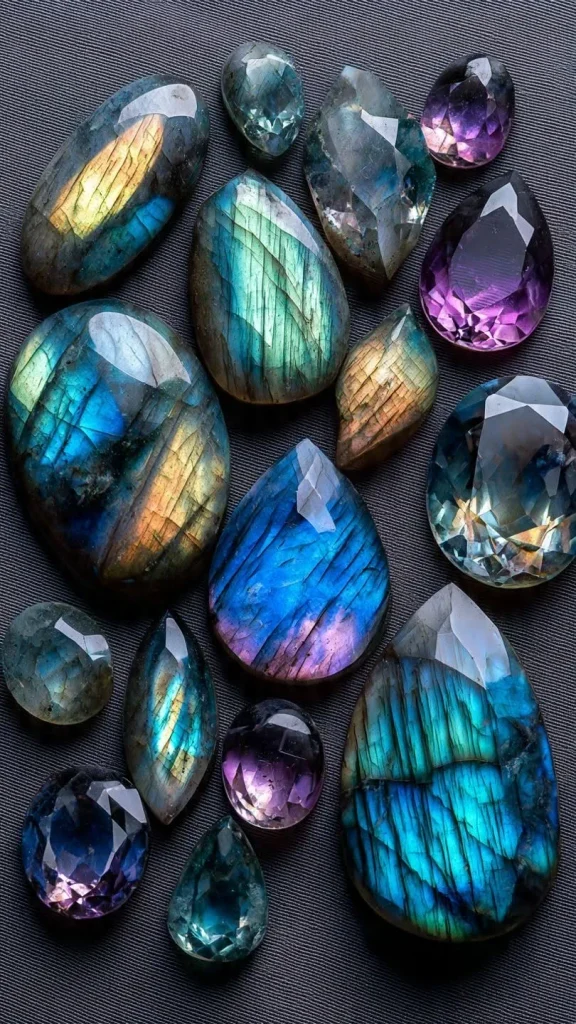
Labradorite’s signature color play, called labradorescence, comes from an internal structure called exsolution lamellae, microscopically thin, alternating layers of calcium-rich and sodium-rich feldspar that separate out as the crystal cools slowly over long geological timescales. When these lamellae fall within a specific thickness range, roughly 128 to 252 nanometers, light entering the stone reflects and interferes between the layers in a way that reinforces certain wavelengths and cancels others, a thin-film interference effect, the same physics behind the color in a soap bubble. Thinner lamellae produce blue and violet flashes; thicker lamellae shift the color toward green and gold. This is why labradorescence appears to move as the stone is tilted: the angle of light hitting the internal layers changes, and different wavelengths reinforce at different viewing angles. It’s worth distinguishing labradorescence from adularescence. The softer, milky glow seen in moonstone comes from internal layered feldspar structures, but adularescence scatters light diffusely rather than producing the sharp, directional color flashes of labradorescence.
Where It Comes From
Finland is home to the most celebrated Labradorite locality in the gem trade. Material with the richest, most complete spectrum of color, discovered near Ylämaa in 1940 during construction of wartime fortifications, is marketed under the trade name spectrolite, a term now closely associated with Finnish origin specifically, even though gem-quality labradorite with strong color from other countries is sometimes loosely called spectrolite as well. Madagascar has become one of the largest modern commercial sources, producing labradorite with vivid blue and green flashes in significant volume. Canada, the type locality in Labrador, still produces fine material, some of it rivaling Finnish spectrolite in brightness; the Smithsonian’s National Museum of Natural History holds an 810-carat carved labradorite specimen from Labrador, Newfoundland, in its permanent mineral collection. Smaller but notable deposits exist in Russia, India, and the United States, particularly Oregon, which produces transparent, faceting-grade labradorite in colors like orange, yellow, and blue without the labradorescence effect. Sri Lanka is not a meaningful source of labradorite, so unlike several other RootAndCarat.com garnet and gem articles, there’s no genuine illam/vatti connection to draw here.
Is It Treated?
Natural labradorite showing labradoritecence is not treated; the effect is entirely structural and can’t be added or enhanced through heat or chemical processing. However, buyers should be aware of a related and important trade issue: andesine, a different but closely related feldspar, has in some cases been diffusion-treated with copper to produce vivid red and orange colors, then sold under names implying it’s natural “red labradorite” or “red andesine” without disclosure. This became a documented controversy in the gem trade in the late 2000s. If you’re offered labradorite or a related feldspar in an unusually vivid red or orange color at a low price, ask directly whether it’s natural, and request lab documentation for higher-value purchases. Standard gray-to-black labradorite with blue, green, or gold labradorite fluorescence carries no such concern; it’s the color-treated red/orange feldspar market specifically where caution applies.
Durability: Can You Wear It Every Day?
Labradorite sits at 6 to 6.5 on the Mohs hardness scale, softer than quartz (7) and considerably softer than sapphire or diamond. Two real factors affect how it holds up in jewelry:
- Perfect cleavage in two directions. Labradorite splits cleanly along internal planes that intersect at roughly 86–94 degrees. This means a hard, direct knock — not just surface scratching — can cause the stone to fracture or split rather than just scuff, which is a different kind of vulnerability than simple hardness alone implies.
- Susceptible to scratching in daily wear. At 6–6.5 Mohs, labradorite can be scratched by household dust (which often contains quartz particles) and by contact with harder gems in storage.
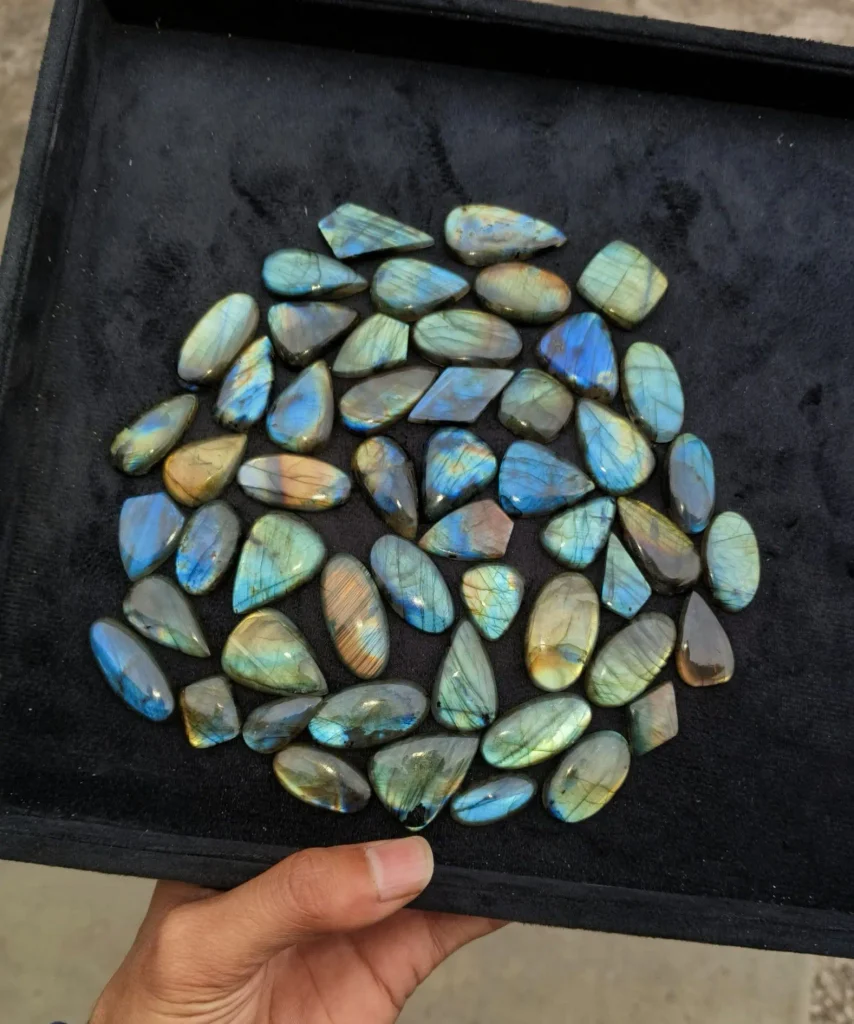
- Everyday wear verdict: Labradorite works well in earrings, pendants, and low-impact rings but isn’t the best choice for an everyday-wear ring subjected to regular knocks. Cabochon cuts, which are how most labradorescent material is cut to showcase the flash, are somewhat more resilient than thin faceted stones.
What Determines Value
- Range and intensity of labradorescence. Full-spectrum flash showing multiple colors (blue, green, gold, and beyond) is far more valuable than single-color flash, and brighter, more saturated flash outperforms dim or patchy color play.
- Body color and background. A darker, more uniform body color tends to make the labradorescence flash appear more vivid by contrast.
- Origin and trade name. Genuine Finnish spectrolite, known for its complete-spectrum color and brightness, commands a premium over standard labradorite from other localities.
- Cut orientation. Because labradorescence is angle-dependent, a well-oriented cut that shows the flash clearly face-up is significantly more valuable than a poorly oriented stone where the color barely shows.
- Transparency and size. Rare transparent, faceted labradorite (as opposed to the more common opaque cabochon material) commands specialist collector interest, and larger clean cabochons with strong, even flash are harder to source.
- Absence of visible cleavage cracks or chips. Given labradorite’s cleavage sensitivity, stones free of internal stress lines or edge damage are worth more.
How to Care for Labradorite
Clean Labradorite with warm water, mild soap, and a soft cloth. Avoid ultrasonic and steam cleaners, since the vibration and heat can aggravate the stone’s cleavage planes and cause internal cracking. Store labradorite separately from harder gems to prevent scratching, and avoid tossing it loosely into a jewelry box where it can knock against other pieces. Remove Labradorite jewelry before swimming, cleaning with household chemicals, applying lotions or perfume, or any activity with a real risk of impact. Dry it fully after cleaning, since prolonged moisture exposure isn’t ideal for the stone’s polish over time.
Labradorite vs. Moonstone: Don’t Confuse Them
Labradorite and moonstone are both feldspars and both show internally generated optical effects, which leads to frequent confusion, especially since a labradorite variety called “rainbow moonstone” is actually labradorite, not true moonstone, adding to the mix-up. The real distinctions:
- Species and chemistry: Labradorite is a calcium-sodium feldspar (plagioclase); moonstone is a potassium-sodium feldspar (orthoclase or microcline) — different minerals within the broader feldspar family.
- Optical effect: Labradorite shows labradorescence — sharp, directional flashes of distinct colors (blue, green, gold) that appear and disappear as the stone turns. Moonstone shows adularescence — a soft, diffuse, billowy glow, usually bluish-white, that seems to float just beneath the surface rather than flashing in discrete colors.
- Typical body color: Labradorite is usually gray to black; classic moonstone is typically colorless to white or pale blue, though moonstone comes in other body colors too.
- “Rainbow moonstone” naming confusion: the gem trade sells labradorite with a white body and blue adularescence-like sheen under the name “rainbow moonstone,” even though it’s mineralogically labradorite, not moonstone — a naming quirk worth knowing before buying.
A gemologist can confirm species with refractive index testing; visual inspection alone can be misleading, particularly with white-bodied labradorite marketed as rainbow moonstone.
💡 Gemology Note: While labradorite is celebrated for its shifting spectral flashes, rhodolite garnet is prized for its steady, untreated raspberry-red body color and superior scratch resistance. Learn how to grade its clarity and hue in our Rhodolite Garnet Guide.

