

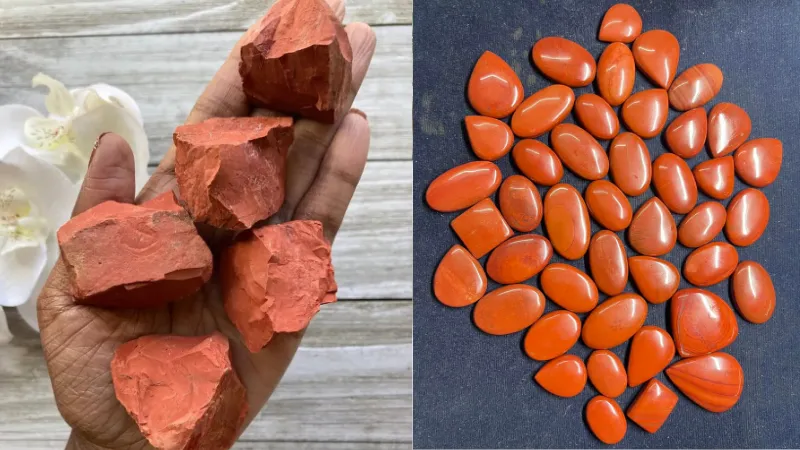
Red jasper is an opaque variety of chalcedony, microcrystalline quartz colored by iron oxide inclusions, primarily hematite, embedded throughout its silica structure. It’s one of the most widely distributed gem materials on Earth, found on nearly every continent, and one of the longest continuously used: red jasper amulets and seals survive from ancient Egypt more than 3,000 years old.
What Is Red Jasper?
Red jasper is a member of the chalcedony family, a microcrystalline (technically cryptocrystalline) form of quartz, the same broad mineral group that includes agate, carnelian, and onyx. What separates jasper from its translucent cousins is opacity: jasper contains a substantial volume of foreign mineral material, commonly cited at 20% or more by weight, densely packed within the silica matrix. That foreign material scatters light completely, which is why jasper never shows the translucency you’ll see at the edges of carnelian or agate. Red jasper forms as a dense, solid mass rather than as individual crystal points, typically through silica-rich fluids infiltrating sedimentary or volcanic host rock and gradually cementing fine sediment or filling cavities and fractures over long geological timescales. Its Mohs hardness generally falls between 6.5 and 7, and its structure gives it a vitreous to waxy luster with a fracture pattern (conchoidal to uneven) typical of quartz-family minerals.
Why Is It Red?
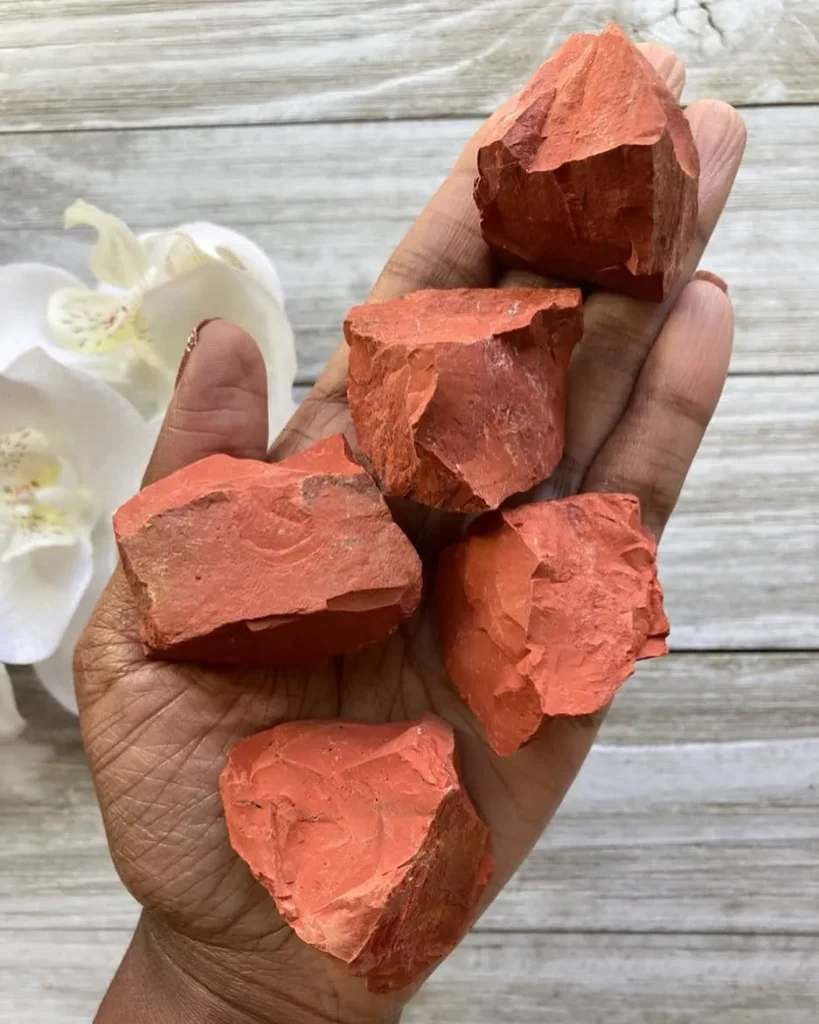
Red jasper’s color comes from iron oxide minerals, primarily hematite (Fe₂O₃), with goethite (FeOOH) sometimes contributing as well, incorporated into the silica matrix as the stone formed. Microcrystalline hematite absorbs short-wavelength visible light, which is what produces the characteristic brick-red to deep maroon coloration; a smaller concentration of hematite yields lighter pinkish tones, while abundant, finely and evenly distributed hematite produces the vivid, saturated reds most prized in fine specimens. Where goethite is also present in meaningful amounts, it can pull the color toward a warmer brown or ochre undertone rather than a pure red. This is the same iron oxide chemistry responsible for the color of rust, which is a genuinely useful way to think about what’s happening at a mineral level, it’s iron reacting with oxygen, just locked into a quartz matrix rather than a piece of metal. Carnelian, worth mentioning for comparison, shares this same iron oxide coloration mechanism but with less iron oxide content, which is why carnelian remains translucent while red jasper is fully opaque.
Where It Comes From
Red jasper is exceptionally widely distributed geologically, occurring on nearly every continent, which is part of why it’s remained an affordable and accessible gem material throughout history rather than a rare, geographically concentrated one. Significant deposits are found across the United States (notably in the southwestern states, where volcanic terrain hosts vivid material), Brazil, India, Russia, Madagascar, and parts of Africa. Historically, red and other jasper varieties were also sourced in Egypt’s Eastern Desert and used extensively by ancient Egyptian craftspeople. Because red jasper forms so broadly rather than being tied to one or two commercially dominant localities, there isn’t a single “premium origin” the way there is for, say, Colombian emerald or Kashmir sapphire quality is driven far more by color saturation and pattern than by where a given specimen was mined. Sri Lanka is not a notable red jasper source, so unlike several other RootAndCarat.com articles, there’s no genuine illam/vatti mining connection to draw here.
Is It Treated?
Natural red jasper’s color is essentially always the product of its iron oxide content and requires no treatment to achieve; this is one of the more straightforward gems in that respect. That said, dyed chalcedony is a documented issue in the broader jasper and agate market, particularly for lower-cost material sold as generic “red jasper” or “red agate” online and at gem shows. A practical field test: natural red jasper is fully opaque and shows consistent color throughout the stone’s depth, while dyed chalcedony often shows slight translucency at thin edges when held to strong light, along with color concentrated unevenly near the surface or along fractures rather than distributed evenly. For casual jewelry purchases this usually isn’t worth worrying over, but for carved pieces, larger cabochons, or anything sold at a premium price, it’s reasonable to ask directly whether the material is natural, untreated red jasper.
Durability: Can You Wear It Every Day?
Red jasper sits at roughly 6.5 to 7 on the Mohs hardness scale, comparable to quartz generally, and notably more durable than many popular gemstones like opal, pearl, or turquoise. A few practical points:
- Good everyday durability. With hardness on par with quartz and weak-to-absent cleavage (meaning it doesn’t split cleanly along internal planes the way garnet or labradorite can), red jasper handles rings, bracelets, and daily wear well.
- Scratch resistance is solid but not top-tier. It’s harder than glass and most household materials but softer than sapphire, ruby, or topaz, so it can still be scratched by harder gems if stored carelessly.
- Takes a strong polish and holds it. This durability is part of why Jasper has been used for carving, seals, and cameos for thousands of years it withstands both fine detail work and centuries of handling.
- Everyday wear verdict: red jasper is genuinely one of the more practical, low-maintenance gemstones for daily jewelry, requiring less special care than most colored stones on this site.
What Determines Valu
- Color saturation and evenness. Deep, rich brick-red to maroon tones with consistent color throughout are more desirable than pale, patchy, or unevenly colored material.
- Pattern and variety. Brecciated red jasper (angular red fragments naturally re-cemented by hematite or calcite after geological fracturing) and orbicular “poppy jasper” patterns are prized by collectors for their visual uniqueness—each piece is genuinely one of a kind.
- Clarity of banding or patterning, where present. Well-defined, high-contrast patterns generally carry more value than muddy or indistinct ones.
- Polish quality. Because red jasper is prized partly for taking an excellent polish, a mirror-smooth finish free of pits or scratches significantly affects perceived quality and value.
- Size and use case. Because red jasper is abundant and inexpensive relative to most colored gemstones, size drives value more gradually than it does for rarer stones—large carved pieces or sculptural specimens can still command real prices, but per-carat premiums for size alone are modest.
- Absence of dye. Natural, untreated material is preferred by collectors and typically holds value better than dyed chalcedony sold under the same name.
How to Care for Red Jasper
Clean red jasper with warm water, mild soap, and a soft brush, its hardness and lack of significant cleavage make it more forgiving than many gemstones, and it generally tolerates ultrasonic cleaning reasonably well, though ordinary hand-washing is still the safest default for any stone. Store it separately from harder gemstones like sapphire, topaz, or diamond to avoid surface scratching over time. Red jasper doesn’t carry the heat or dehydration sensitivity that affects porous stones like opal, so it’s a comparatively low-maintenance choice for jewelry worn daily. As with any polished gemstone, avoid harsh abrasive cleaners that could dull its finish, and periodically check that jewelry settings remain secure.
Red Jasper’s Ancient History: A Quick Note
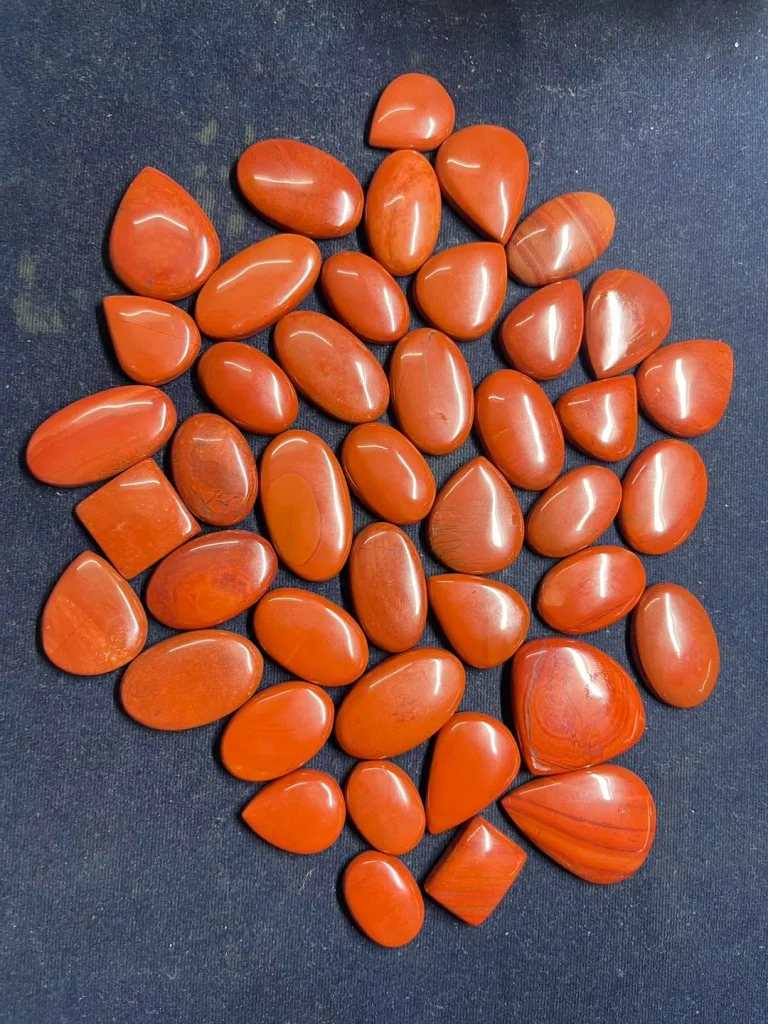
Red jasper has one of the longest documented histories of any gem material used by humans. In ancient Egypt, it was carved into amulets, seals, and jewelry inlays from the Late Predynastic period through the Roman era. One particularly well-documented example, described in the UCLA Encyclopedia of Egyptology, is the “girdle-tie-of-Isis” amulet, a red jasper amulet from Egypt’s New Kingdom period associated with protective symbolism tied to the goddess Isis. Its durability and workability made it a practical choice for carved objects that needed to survive centuries of handling, and archaeological red jasper artifacts recovered from sites across multiple ancient civilizations have helped researchers trace trade routes and cultural connections across the ancient world.
Red Jasper vs. Carnelian: Don’t Confuse Them
Red jasper and carnelian are frequently confused because both are red-to-orange chalcedony colored by the same iron oxide chemistry. The key distinction is opacity, not color:
- Species and chemistry: Both are chalcedony (microcrystalline quartz) colored primarily by hematite and goethite, genuinely close cousins, not just visually similar stones.
- Transparency: This is the reliable test. Red jasper is fully opaque; hold it to a bright light, and no light passes through. Carnelian is translucent to semi-transparent; thin edges glow with a warm orange-red light when held up to a lamp.
- Iron oxide concentration: Jasper contains significantly more iron oxide and other foreign mineral material (the 20%-plus threshold that defines jasper as a category), which is precisely what blocks light transmission and makes it opaque, versus carnelian’s lower concentration.
- Typical use: Jasper’s opacity and durability made it historically favored for carved seals, amulets, and cameos, while carnelian’s translucency has made it popular for cut and polished jewelry stones where light interaction matters more.
A simple light test resolves the identification instantly; no lab equipment is needed, just a bright light source and a thin edge of the stone.
💡 Gemology Note: While red jasper gets its opaque color from microcrystalline quartz mixed with iron, pink opal is an amorphous mineraloid valued for its soft, pastel appearance. Learn how to identify and care for delicate common opals in our Pink Opal Gemstone Guide.

