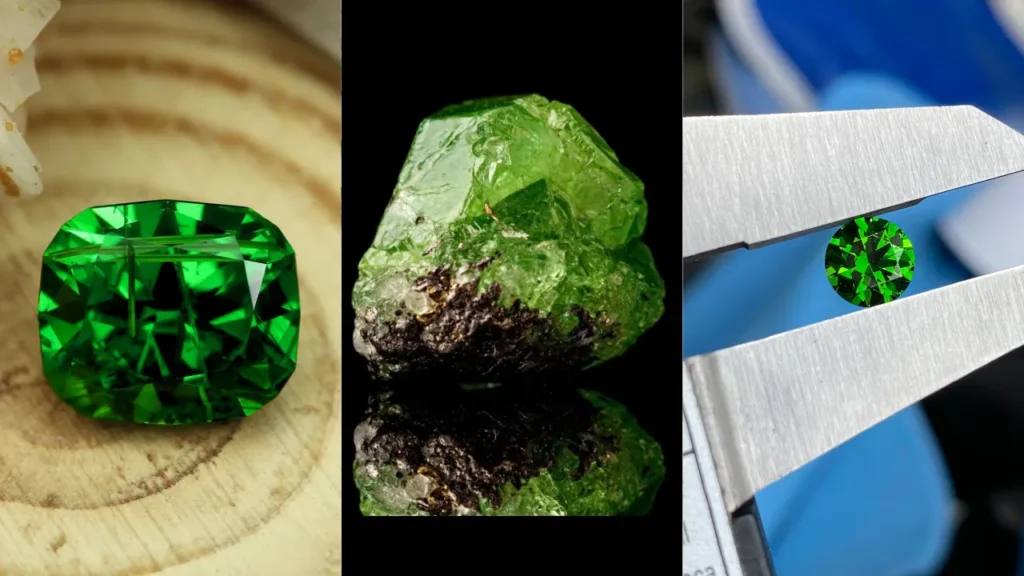
Demantoid garnet is a rare green gemstone famous for a rainbow “fire” that actually outperforms diamond and for a strange, prized flaw: wispy golden inclusions nicknamed “horsetails” that can increase rather than reduce its value. Once a favorite of Fabergé and Russian Imperial jewelers, it remains one of the most technically dazzling colored gems in the world.
What Is Demantoid Garnet?
Demantoid garnet is the green variety of andradite, a calcium-iron garnet species, prized for a color range spanning bright yellowish-green to deep, saturated emerald-like green. The name comes from the Dutch word for “diamond-like,” a nod to its unusually strong dispersion, the optical property that splits white light into flashes of spectral color.
It was first discovered in Russia’s Ural Mountains in the early 1850s and quickly became a favorite of court jeweler Peter Carl Fabergé, who used it in imperial jewelry and the famous Fabergé eggs. That Russian material, especially stones with visible internal “horsetail” inclusions, is still considered the benchmark against which all other demantoid is judged today.
Why Is Demantoid Garnet Green? The Science of the Color
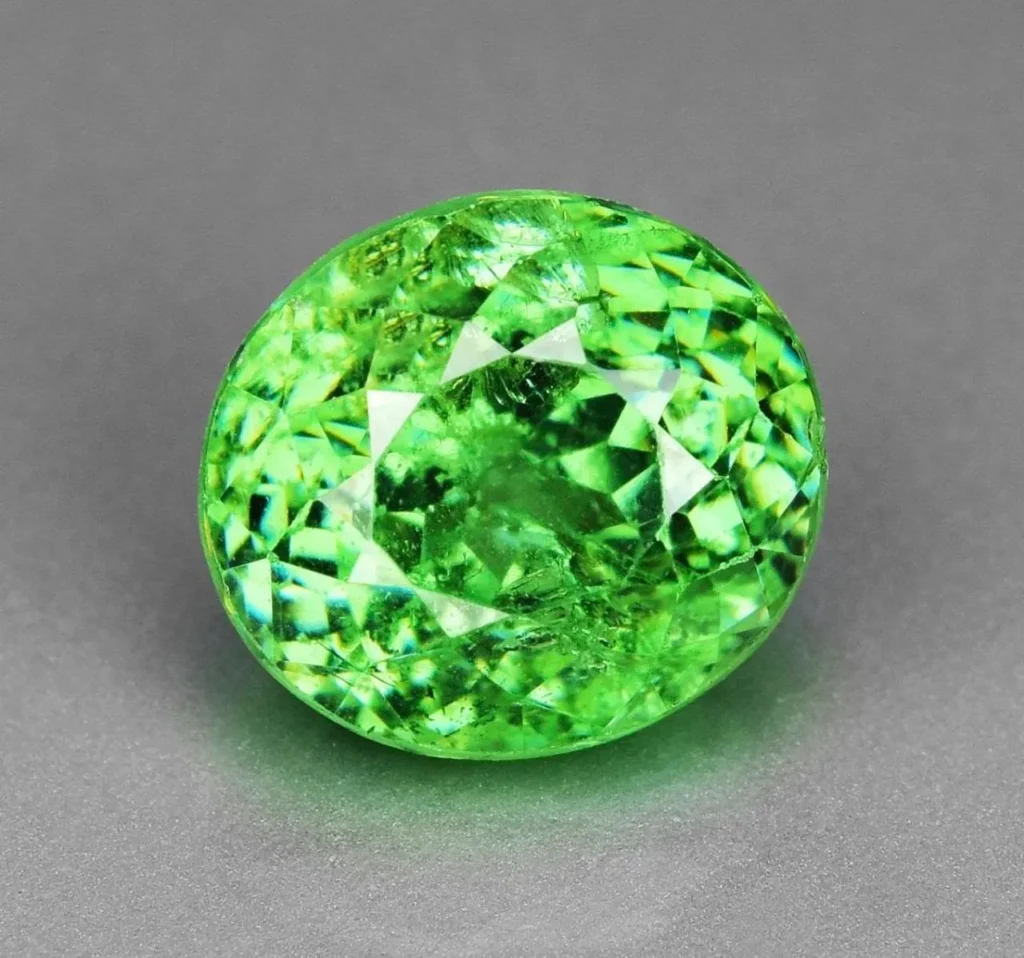
Demantoid’s green color comes primarily from chromium (Cr³⁺) trapped in its crystal structure during formation, the same element responsible for the vivid green in emerald. Iron, which is part of andradite’s base chemistry, also plays a role and can shift the tone toward yellow or olive rather than pure green, depending on the ratio between the two elements. This is why demantoid from different sources can look noticeably different even at similar clarity: Russian material tends toward a vivid, slightly yellowish-emerald green driven by chromium, while African-origin material more often leans yellowish-green, olive, or brownish due to a higher iron content relative to chromium.
Beyond color, demantoid’s defining trait is dispersion, its ability to break light into spectral flashes of red, orange, and green. Its dispersion rating is actually higher than a diamond’s, which is why well-cut demantoid can show more visible “fire” than a diamond of similar size, even though it lacks a diamond’s brilliance and hardness.
Horsetail Inclusions: A Flaw That Adds Value
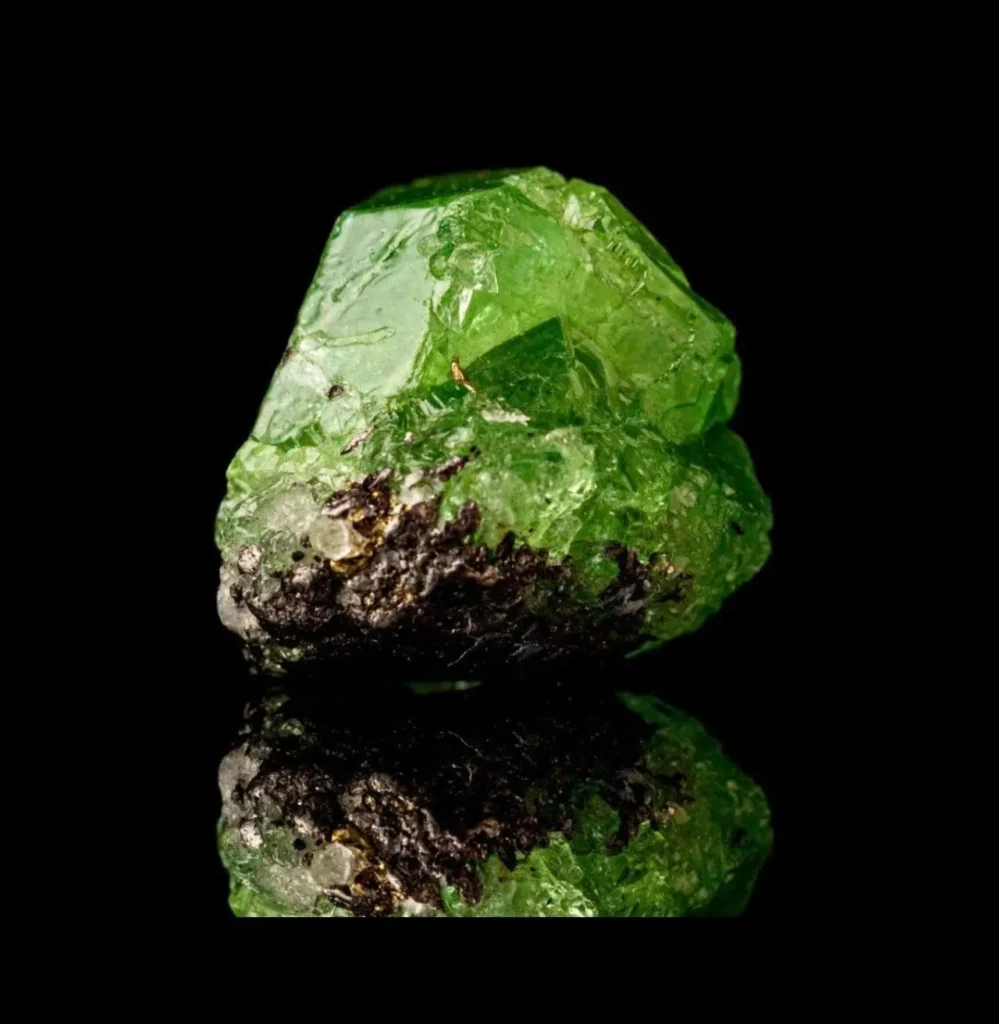
Demantoid is one of the rare gemstones where visible inclusions can increase value instead of reducing it. Fine, wispy golden fibers — nicknamed “horsetails” for their resemblance to a horse’s tail caught in the wind — radiate outward from a tiny mineral crystal inside the stone. These fibers are typically chrysotile, a serpentine mineral that grew alongside the garnet as it formed underground.
Horsetail inclusions are strongly associated with Russian Ural Mountains material and are much less common in demantoid from Namibia, Madagascar, or other sources, which makes a well-formed horsetail a practical clue to origin. Skilled cutters will often orient the stone specifically to display the horsetail pattern beneath the table facet, since a clear, attractive horsetail can raise a stone’s price rather than lower it — the opposite of how inclusions typically affect gemstone value.
Where Demantoid Garnet Comes From
- Russia (Ural Mountains): The original and still most prestigious source, discovered in the 1850s. Russian material is prized for vivid, chromium-driven green color and classic horsetail inclusions, though fine stones are rarely found above 2 carats, and supply remains limited.
- Namibia: Discovered in the 1990s and now a major modern source. The Namibian demantoid tends toward a more yellowish or olive green due to higher iron content, generally lacks horsetail inclusions, but is more often found in larger sizes than Russian material.
- Madagascar: An increasingly important source in recent decades, producing stones ranging from yellow-green to deep green, occasionally with inclusion patterns reminiscent of Russian material, though true horsetails remain rare outside Russia.
- Other sources: Small quantities have also been found in Iran, Pakistan, Italy, and Canada, though production from these regions is limited and inconsistent.
Is Demantoid Garnet Treated?
Most demantoid on the market is untreated. Some Russian material is given a mild, low-temperature heat treatment to improve color, a treatment that’s considered stable and permanent but currently undetectable in a lab meaning origin and dealer trust matter more here than with many other gems. As always, ask your dealer directly about treatment status before buying.
Demantoid Garnet Durability: Can You Wear It Every Day?
This is where demantoid needs a more careful answer than most gems on this site. It rates 6.5–7 on the Mohs hardness scale — noticeably softer than sapphire, ruby, or spinel, and soft enough that it can pick up scratches over years of regular wear, particularly from contact with household dust (which contains quartz, a harder mineral) or other jewelry. It’s a genuinely beautiful stone for rings, but if you want it in a piece you’ll wear daily, a protective setting — such as a bezel or halo that shields the girdle and edges — is a sensible precaution rather than a purely aesthetic choice. For earrings, pendants, and occasional-wear rings, this concern matters much less.
What Determines the Value of Demantoid Garnet?
- Color — A saturated, pure green without heavy yellow or brown modifiers is the most prized shade, generally more valuable than either very pale or overly dark stones.
- Origin — Russian provenance, especially with a well-formed horsetail inclusion, commands the highest premiums; Namibian and Malagasy stones are generally more affordable.
- Horsetail inclusions — Unusually, a clear and attractive horsetail pattern increases value rather than decreasing it, provided the stone is well-cut to display it.
- Dispersion and cut — Because fire is central to demantoid’s appeal, a cut that maximizes light return and dispersion significantly affects how the stone performs.
- Carat weight — Fine demantoid above 2 carats is rare, especially from Russia, and larger stones command a steep premium.
How to Care for Demantoid Garnet
Clean demantoid with warm water, mild soap, and a soft brush — avoid ultrasonic and steam cleaners, since its moderate hardness and any internal inclusions make it more vulnerable to stress fractures under vibration and heat than harder gems. Store it separately from harder stones like sapphire, ruby, and spinel to prevent scratching, and consider a protective setting if the piece will see regular daily wear.
Demantoid Garnet vs. Emerald: How to Tell Them Apart

Both gems get their green color from chromium, which invites comparison, but the similarities mostly end there. Demantoid has notably higher dispersion and brilliance than emerald, giving it a fierier, more diamond-like sparkle, while emerald typically has a softer, more velvety look and is usually treated with oil to improve clarity a near-universal practice that demantoid doesn’t share. Emerald is also somewhat harder at 7.5–8 on the Mohs scale, though it tends to have more internal inclusions that can affect durability. In practice, the two are easy to tell apart with a loupe: demantoid’s fire and possible horsetail inclusions are distinctive, while emerald’s inclusions look and behave differently entirely.
- “For a detailed look at trade name definitions, origin verification, and lighting response in neon spinels, see our deep dive into Jedi spinel gemstones.”