
Deep red garnet is one of the oldest gemstones worn by humans, and it remains one of the most recognizable. This guide covers what deep red garnet is, what causes its rich color, where it’s mined, how it’s graded, what treatments to watch for, and how to keep it looking its best.
What Is Deep Red Garnet?
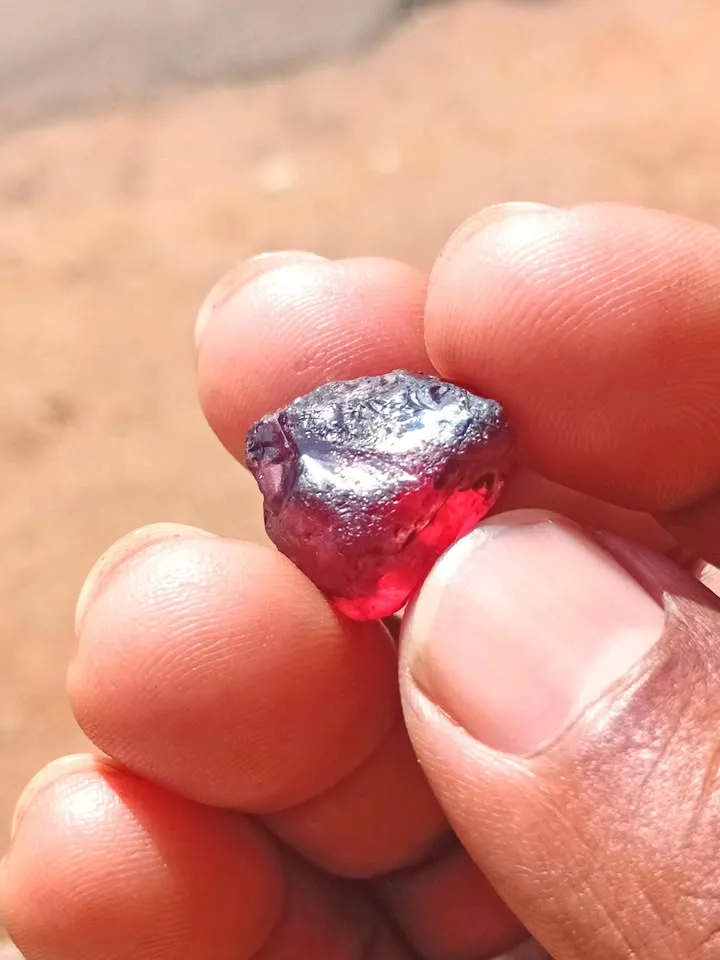
Deep red garnet isn’t a single mineral. It’s a member of the garnet group, a family of closely related silicate species that share the same cubic crystal structure but differ in chemical makeup. The two species responsible for most deep red garnets on the market are almandine (iron aluminum silicate) and pyrope (magnesium aluminum silicate). A blend of the two, called rhodolite, produces a lighter purplish-red.
Because garnet is singly refractive and has no cleavage, light travels through it predictably. That’s part of why deep red garnet reads as such a solid, evenly colored stone once it’s cut and polished, with strong brilliance across the face of the gem.
Garnet sits at 6.5–7.5 on the Mohs hardness scale, which makes deep red garnet durable enough for daily wear in rings, earrings, and pendants alike.
What Makes Deep Red Garnet So Special?
Deep red garnet has been worn for more than 5,000 years. Beaded garnet necklaces have been recovered from Egyptian graves dating back to roughly 3800 BC, and garnet ornaments have also turned up in burial sites in Sumeria and Sweden from thousands of years ago.
In antiquity, deep red garnet was grouped together with rubies and other fiery red gems under the term “carbuncle.” The Roman scholar Pliny the Elder used this word to describe finely colored red stones that seemed to glow like embers. [Unverified: exact original wording could not be confirmed in this research.]
Deep red garnet also carries a well-known piece of folklore: Jewish tradition holds that Noah carried a garnet aboard the ark to light his way through the dark. This story appears across multiple gemmological sources, though it should be treated as legend rather than documented history.
By the Middle Ages, deep red garnet was favored by clergy and European nobility. Its popularity surged again after 1500, when Bohemian garnet deposits were discovered in what is now the Czech Republic. That source fueled a regional jewelry industry that peaked in the late 1800s and still shapes how Czech garnet jewelry is made today.
What Causes Deep Red Garnet’s Color?
The deep red color in garnet comes down to trace elements locked into the crystal structure as the stone forms:
- Almandine garnet owes its wine-red to purplish-red tone mainly to iron.
- Pyrope garnet gets its more fiery, saturated red from a combination of iron and chromium.
- Rhodolite garnet, a pyrope-almandine blend, produces a lighter purplish-red to raspberry tone that tends to stay vivid even in larger stones.
Because deep red garnet doesn’t display pleochroism the way some colored gems do, its red body color looks consistent from every angle. That consistency is part of why deep red garnet reads as such a rich, solid stone in jewelry.

Where Is Deep Red Garnet Found?
Deep red garnet is one of the most widespread gem materials on earth, mined across nearly every continent:
- India — particularly Orissa (Odisha), a long-established source of fine deep red rough.
- Czech Republic (Bohemia) — historically significant, producing small, intensely red pyrope; still the country’s national stone.
- Sri Lanka — a traditional source of gem-quality deep red garnet alongside the island’s other colored stones.
- Mozambique and Madagascar — major modern sources of almandine and pyrope-almandine material.
- Tanzania and other East African localities — supplying much of today’s commercial-grade deep red garnet.
- Smaller deposits are also worked in Brazil, Russia, Afghanistan, and Austria.
Deep red garnet forms mainly in metamorphic environments, particularly mica schists and gneisses, and also occurs in some igneous rocks. Once eroded out of its host rock, it collects in alluvial gravel deposits, which is how a significant share of gem-quality rough is ultimately recovered.
Notable Deep Red Garnets in History
Deep red garnet beads more than 5,000 years old have been recovered from Egyptian graves, and garnet jewelry has been found in burial sites in Sumeria and Sweden dating back thousands of years, worn by both nobles and warriors.
The Bohemian garnet tradition produced some of history’s most recognizable deep red garnet pieces: small, densely clustered pyrope stones set in gold, a style still associated with the Czech Republic and historically exchanged as a token of love and commitment.
Deep Red Garnet Treatments
Deep red garnet, along with spinel, is unusual among colored gemstones because it’s rarely enhanced. Most deep red garnets on the market are natural, untreated color straight from the ground. Still, a handful of treatments do turn up occasionally:
- Dyeing — sometimes used on red garnet beads to intensify or even out color. Look for dye pooling in surface-reaching fractures or between grain boundaries.
- Fracture filling — occasionally used on included stones to improve apparent clarity, similar in principle to emerald or ruby filling, though far less common in garnet.
- Heat treatment—rarely applied to deep red garnet itself, though it’s used on green demantoid garnet to improve color.
- Diffusion — reported anecdotally in the trade from time to time, but not a standard or well-documented treatment for deep red garnet.
Because treatment is the exception rather than the rule, natural color is usually deep red garnet’s biggest selling point. Buyers should still ask for disclosure, particularly on very inexpensive beads or calibrated melee.
Deep Red Garnet Synthetics and Simulants
True synthetic deep red garnet isn’t produced commercially in any significant volume. Natural material is abundant and inexpensive enough that lab-growing it isn’t commercially worthwhile.
Where imitation does happen, it usually takes the form of red glass, or a “garnet-topped doublet”—a thin garnet crown paired with a glass or garnet pavilion. This is an older trick, historically used to stretch scarce resources further. Doublets like this can usually be spotted under magnification by trapped gas bubbles typical of glass or a visible join line at the girdle when the stone is viewed in immersion.
How to Choose Deep Red Garnet
When evaluating deep red garnet, gemologists and buyers typically weigh four factors:
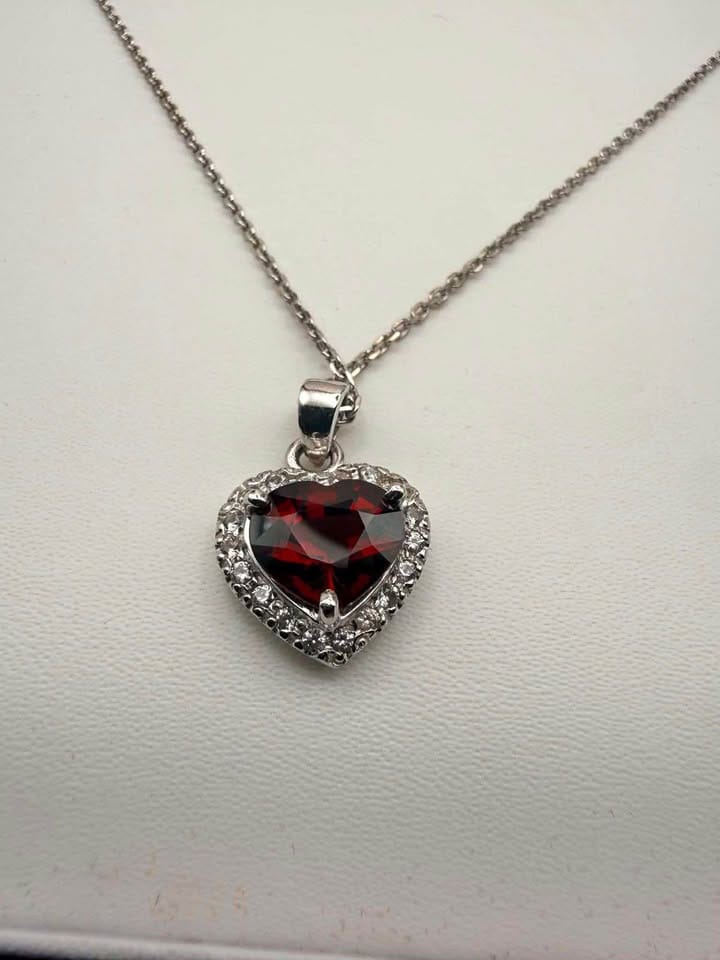
Color. This is the most important factor for deep red garnet. The best stones show a pure, saturated red that stays vivid in ordinary light, avoiding brownish or overly dark, inky tones that can look dull.
Clarity. Deep red garnet, particularly almandine and pyrope, is often eye-clean, so visible inclusions typically lower value.
Cut. Look for even brilliance across the face of the stone, with no washed-out or overly dark “extinction” zones.
Carat weight. Deep red garnet is available in a wide range of sizes, though very large, clean stones in the finest saturated red are less common and command a premium.
Ever wonder how deep red garnet compares in brilliance and light return to precious red rubies? Read our guide on The 360-Degree Secret: Why Everything You Know About Rubies and Sapphires is Only Half the Story.
How to Care for Deep Red Garnet
Deep red garnet’s Mohs hardness of 6.5–7.5 makes it durable enough for regular wear, including rings, though it should still be protected from hard knocks against other jewelry or hard surfaces.
Avoid prolonged direct sunlight and sudden temperature swings, which can stress the stone over time. Clean deep red garnet with warm, soapy water and a soft brush. Ultrasonic cleaning is generally safe for untreated stones but should be avoided if the garnet is dyed or fracture-filled, since heat and vibration can damage the treatment.
For more on gemstone care generally, see GIA’s overview of gem treatments, which explains how different enhancements affect long-term durability.