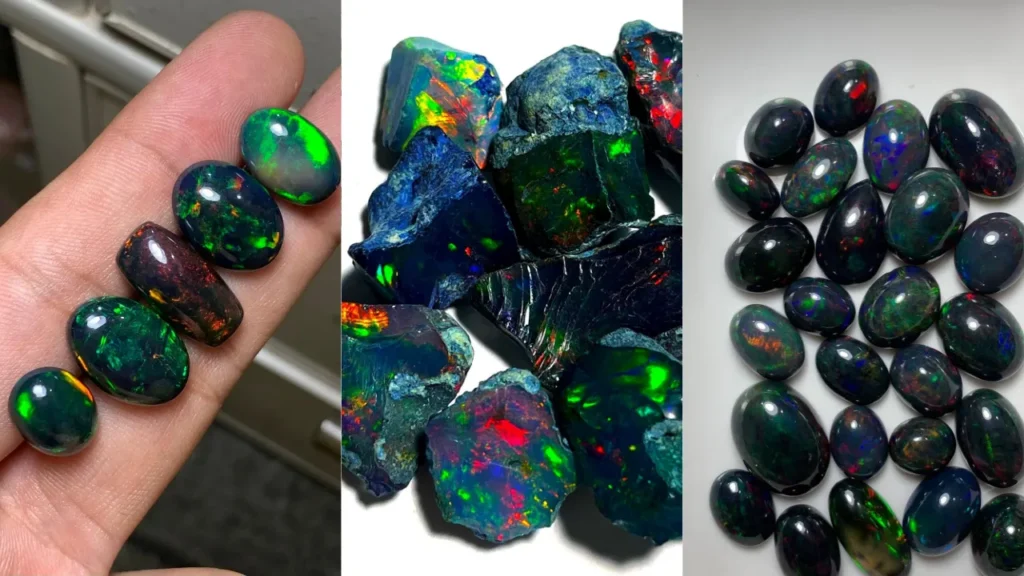
A truly black opal, one that’s completely, uniformly dark with no color at all, would be worthless. That’s the strange thing about black opal’s name: it describes a backdrop, not the gem’s actual appeal. What you’re really paying for is the fire that dances across that dark stage.
A Name That Describes the Wrong Thing
Black opal’s “black” refers strictly to its body tone, the underlying base color, which can range from dark grey to a deep chocolate brown or true jet black. On its own, that dark tone is just potch, an ordinary common opal with no play of color at all. The magic only happens when spectral flashes of color appear against it. Without that fire, you’re just holding a dark rock.
The Chemistry Behind the Darkness
In Australian material, the dark body tone comes from trace elements locked in during formation, mainly carbon and iron oxides, sometimes alongside iron sulfides like pyrite. Ethiopian black opal seems to work through a different chemical pathway entirely, with manganese oxides suspected as the main coloring agent there. Two different chemistries, arriving at a similar dark canvas.
Why Sphere Size Decides Which Colors You Get
Opal isn’t a crystal. It’s an amorphous, hydrated silica gel built from microscopic silica spheres. When those spheres stack in tight, evenly-sized, regular formations, light passing through the tiny gaps between them diffracts and interferes with itself, producing the shifting spectral flashes called play-of-color.
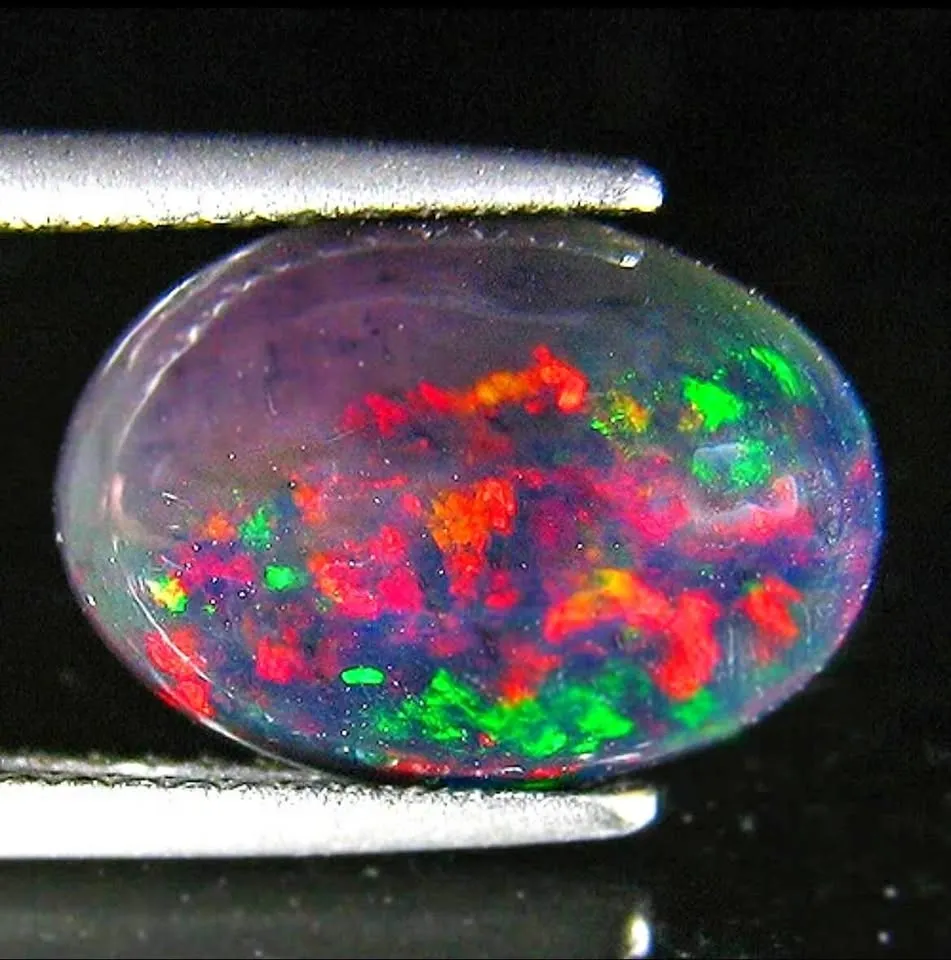
Here’s the part that determines everything about a stone’s value: sphere size dictates which colors can appear. Smaller spheres only produce violet, blue, and green. It takes noticeably larger spheres to bend light far enough to produce red and orange. That’s the entire reason “red on black,” vivid red fire against a jet-black body, sits at the very top of the opal hierarchy. Getting spheres that large to form with that level of regularity is a rare geological alignment, and buyers pay accordingly.
The Dark Body Is Doing More Work Than You’d Think
Think of the dark body tone the way a jeweler might use black velvet under a display case. A light-colored opal body lets scattered ambient light wash out and dilute the color flashes. A dark body swallows that stray light instead, so the exact same internal structure reads as dramatically more saturated and vivid than it would in a white or crystal opal.
Lightning Ridge and Beyond
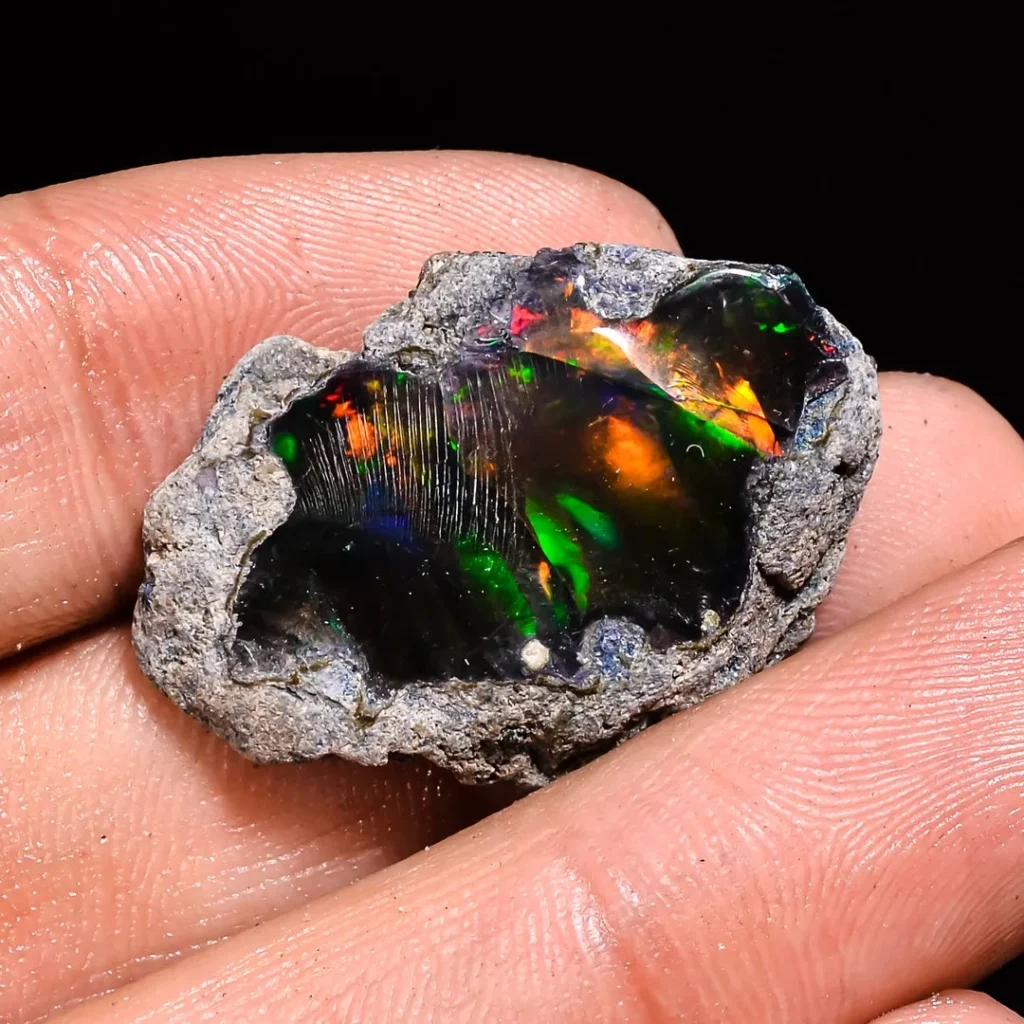
Most fine black opal in the world traces back to one place: Lightning Ridge, in northern New South Wales, Australia, where mining began in earnest around 1901–1902. Lightning Ridge is unusual even among opal fields because its rough form is in nodules called “nobbies,” rather than the seam deposits typical elsewhere.
Smaller quantities come from Ethiopia’s Wollo region, though that material is often hydrophane, meaning porous enough to absorb water, behaving quite differently in the hands of a jeweler than stable Australian stone. Honduras and Nevada’s Virgin Valley have also historically produced black opal, generally with less long-term stability than the Australian material.
Cutting Around a Thin Color Layer
The color-bearing layer inside a black opal, the color bar, is often thin. Cut too deep and a lapidary risks slicing straight through it, destroying the stone’s value permanently. That’s why black opal is almost always shaped into a low cabochon instead of a tall dome; it’s a technical necessity dictated by the stone’s geometry, not a style preference. Ovals are the standard shape, though freeform and teardrop cuts sometimes get used to save weight from oddly shaped rough.
Telling a Solid Stone From an Assembled One
Given how valuable fine black opal is, a real share of what’s sold isn’t one solid piece of natural stone.
A solid natural opal is one continuous piece, with no visible seam when you look at it from the side, though you might see a natural transition between the color layer and its darker backing.
A doublet is a thin slice of genuine opal glued onto a dark backing, black plastic, potch, or ironstone to cheaply fake a deep body tone. The telltale sign is an unnaturally straight glue line visible from the side.
A triplet adds a third layer on top, a clear dome of glass or quartz, which often gives the stone a slightly glassy, “watery” look compared to a solid piece.
None of this makes doublets or triplets scams by default; they’re legitimate products at a lower price point. The problem is only when they get sold as if they were solid.
Spotting Artificially Darkened Color
Some pale, porous opal, particularly Ethiopian material, gets darkened through a sugar-and-acid treatment that carbonizes sugar into black particles inside the stone, or through smoking, which forces soot into its pores. Under a loupe, this kind of treated color tends to show up as unnatural speckling clustered in surface cracks. Genuine natural color sits smoothly and evenly through the stone instead.
What Drives the Price
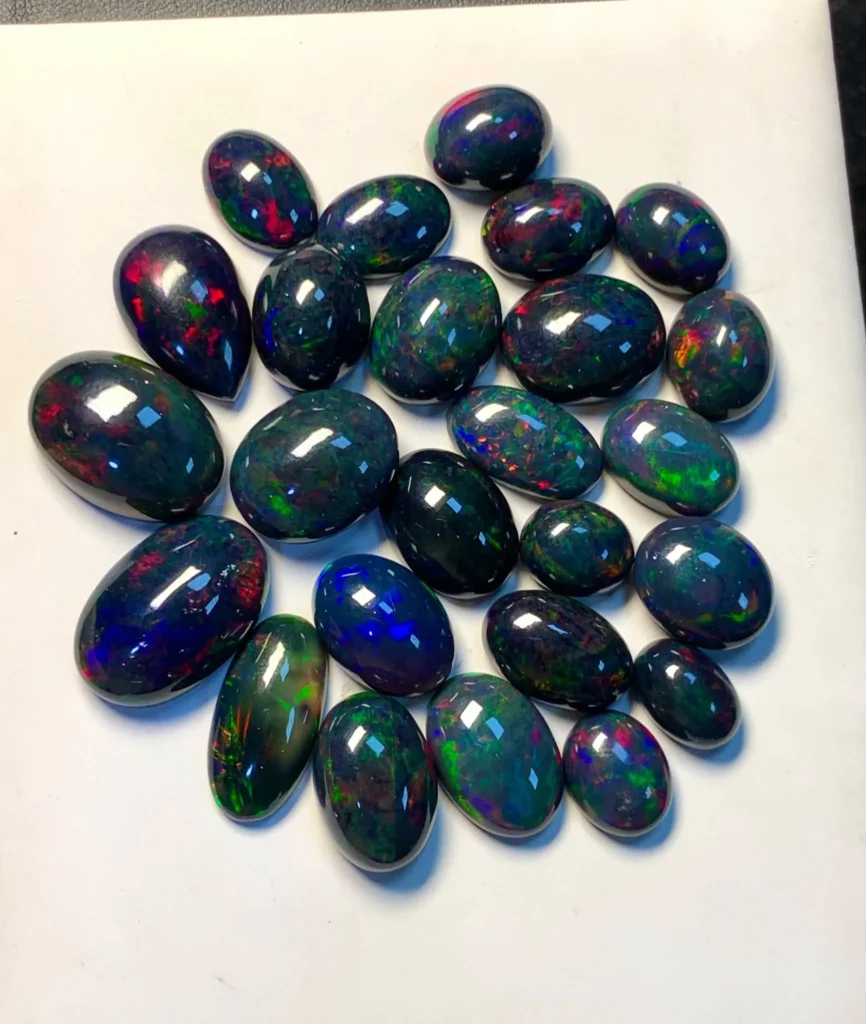
Fine black opal with strong, saturated color against a genuinely dark body can be extraordinarily valuable, and exceptional individual stones have sold for prices reaching into seven figures. There’s no single spec that determines this on its own. The body tone’s darkness, the brightness of the flashes, the pattern they form, and which color dominates (red being the rarest) all combine to set what a stone is actually worth.
Two Thousand Years of Reputation
This isn’t a stone riding on modern marketing. The Roman writer Pliny the Elder praised opal’s combined fire and color nearly two millennia ago, and Shakespeare referenced its shifting nature in Twelfth Night. One of history’s most famous specimens, a 700-carat stone known as the “Burning of Troy,” was said to have been a gift from Napoleon to Empress Joséphine. The stone itself has since disappeared from historical record.
Living With a Stone That Contains Water
Here’s what makes black opal genuinely different from most gems you’ll own: it contains real water, typically somewhere between 4% and 20% depending on the specific stone. That water content makes it sensitive to its environment in a way crystalline gems like sapphire simply aren’t built to be. Heat or prolonged dryness can pull that moisture out, leaving behind a network of cracks called crazing, and that damage doesn’t reverse.
Skip ultrasonic cleaners, steam, and harsh chemicals entirely. A soft, slightly damp cloth is all it needs. If you’re storing it for a long stretch, keeping a lightly moistened piece of cotton nearby helps maintain the humidity the stone wants. With a hardness of only 5.5 to 6 on the Mohs scale, black opal suits pendants and earrings especially well, and if it’s going into a ring, look for a setting that shields the edges from everyday bumps.
Understanding why the darkness matters, how sphere size decides color, and how to spot a solid stone from an assembled one turns black opal from “the expensive dark one” into a gem you can genuinely evaluate on its own terms.
According to the Gemmological Association of Great Britain (Gem-A), black opals rank around 6 on the Mohs hardness scale and require careful handling due to their natural water content and sensitivity to sudden humidity changes.
Read about black opal origins, body tone grading, and cutting techniques on Opals Down Under.
If you are curious about ultra-rare collector stones, check out our complete guide to taaffeite—one of the rarest gemstones on Earth.