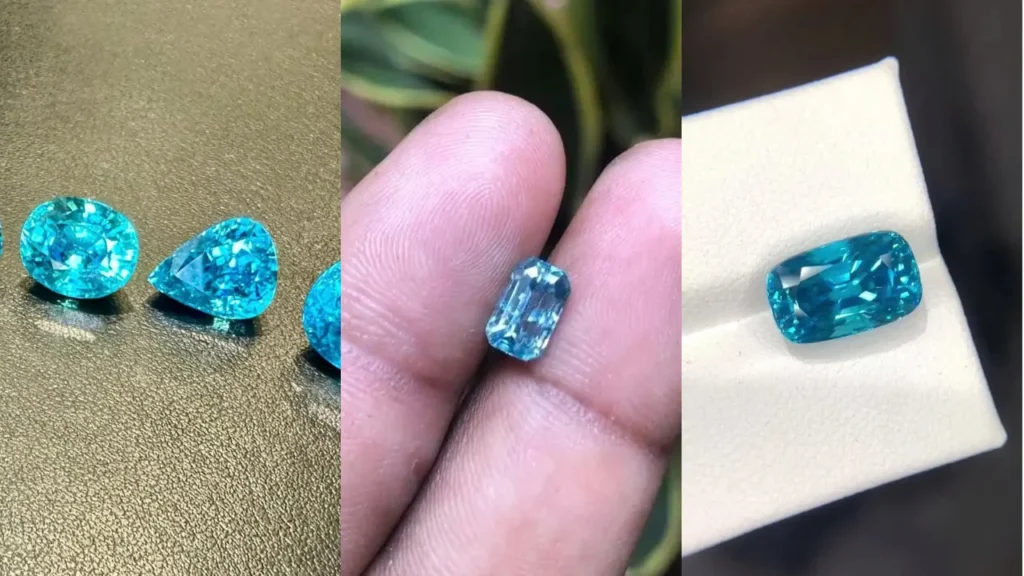
Almost every blue zircon in jewelry started life as a brown crystal. The stone is a natural zirconium silicate, not a lab-grown diamond lookalike, and the vivid blue that sells is produced by heating specific rough material, mainly from Ratanakiri, Cambodia. That single fact explains most of the confusion, the pricing, and the care rules.
What Is Blue Zircon?
Blue zircon is the market color of zircon, a natural mineral with the formula ZrSiO₄. It is one of three official December birthstones, alongside tanzanite and turquoise. Zircon is not cubic zirconia. Cubic zirconia is synthetic zirconium dioxide (ZrO₂), invented as a diamond simulant in the 1970s. Zircon is an older natural silicate that gem cutters have used for centuries, including colorless “Matara” stones from southern Sri Lanka that were once sold as diamond substitutes. Two historical trade names still turn up in older catalogs.
- Starlite, a 20th-century marketing name for blue zircon
- Hyacinth (or jacinth), the older name for reddish to reddish-brown zircon, not the blue material
Gemologists also sort zircon by crystal integrity. High-type zircon still has an intact crystal lattice and the highest optical values. Low-type (metamict) zircon has been damaged from the inside by traces of uranium and thorium; properties drop, and the stone often looks green or cloudy. Commercial blue zircon from Ratanakiri is high-type material with unusually low actinide content. Typical high-type properties:
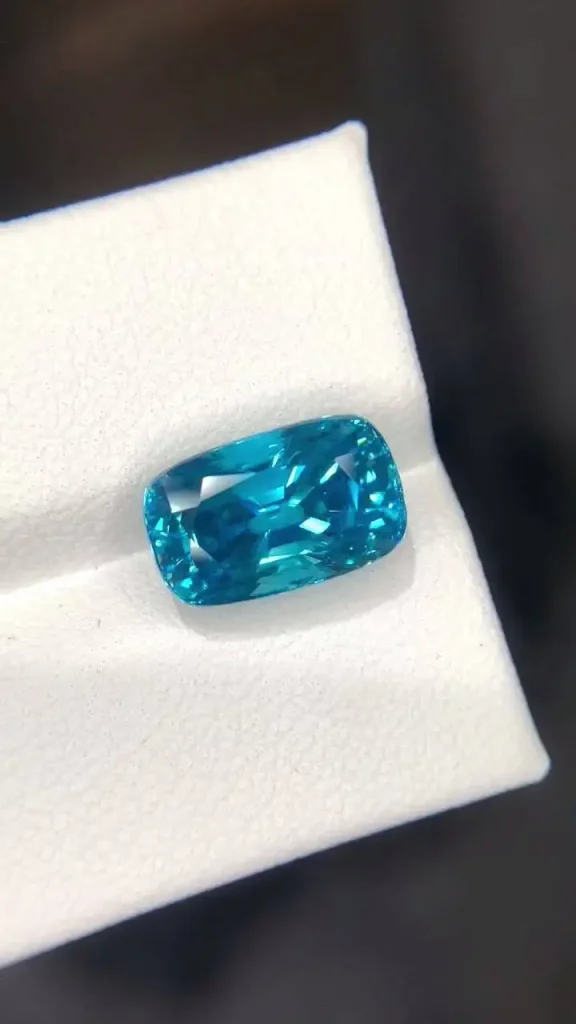
- Mohs hardness: about 7 to 7.5 (the species ranges from 6 to 7.5)
- Refractive index: about 1.925–1.984
- Birefringence: up to about 0.059 (strong enough that facet edges can look doubled)
- Specific gravity: about 4.6–4.7
- Luster: adamantine to vitreous
Those optics are why a well-cut blue zircon throws more “fire” than most blue topaz of the same size.
Why Is It Blue?
The crystals that become jewelry blue zircon come out of the ground reddish brown to brown. Heating that rough in a reducing (low-oxygen) atmosphere at roughly 900–1,000°C turns a portion of it blue. Some laboratory papers report good blues closer to 1,100°C. The spread is real; recipes vary by oven, atmosphere, and parcel. What actually causes the blue is still debated.
- Absorption spectra of treated Ratanakiri stones show a strongly pleochroic band in the yellow-to-red part of the spectrum. That band is what leaves the stone looking blue.
- A 2018 Journal of Gemmology study of Ratanakiri zircon concluded that the assignment of that band is unresolved. The treated spectrum does not match synthetic zircon doped with U⁴⁺ or V⁴⁺.
- Other papers have proposed valence changes involving uranium or terbium. Those assignments have not been universally accepted.
In other words, the trade knows how to make the color. Gemology has not closed the file on the chromophore. A separate point gets overstated in sales copy. Natural untreated blue zircon exists, but it is not the jewelry product. Small sky-blue crystals from the Somma-Vesuvius complex in Italy are documented; their color mechanism (scattering from tiny inclusions in very young, actinide-rich crystals) is not the same as heat-treated Cambodian gem zircon. A dealer’s claim that “no natural blue zircon exists anywhere” is too absolute. A dealer’s claim that “the blue zircon in the jewelry case is heat-treated Cambodian material” is accurate. GIA’s wording is the careful one: intense blue in zircon is usually the result of heat treatment. For practical buying, treat “untreated blue zircon” as a claim that needs a lab report. GIA’s own overview of the species is the best first reference: GIA’s zircon gem encyclopedia entry.
Where It Comes From
Brown zircon is common in many rock types. Gem-quality crystals that will heat to a fine blue are not. Cambodia, Ratanakiri Province, is the commercial source. The crystals occur in young volcanic debris fields, not in the classic river-gem gravels of Sri Lanka. Local parcels from neighboring vents can look similar before heating and behave very differently in the oven. That is why origin and “will it cook blue?” are field knowledge as much as geology. Other Southeast Asian localities (parts of Myanmar, Thailand, and Vietnam) can yield material that heats to a lighter blue. They are secondary to Ratanakiri for saturated stones. Sri Lanka is important for the species, not for the market blue. Zircon turns up in the island’s alluvial gem gravels, the gem-bearing layer miners call illam, worked in pits and vatti wash baskets in brown, yellow, green, and colorless. Colorless stones from the Matara district gave colorless zircon its old “Matara diamond” nickname. Sri Lankan zircon is a genuine alluvial product. Cambodian blue-making rough is not, and it should not be described with Sri Lankan mining vocabulary. Australia produces the oldest dated zircon crystals on Earth (about 4.4 billion years) and some gem material, including untreated pink to lilac stones from the Harts Range. Those are a different buying category from heated Cambodian blue. Malawi has also been reported as a source of heated blue, bi-color, and colorless gem zircon.
Is It Treated?
Yes, if it is blue and it is in a jewelry store, assume heat.
| Claim on a tag | What it usually means |
|---|---|
| Natural blue zircon | Natural mineral species; color almost always heated |
| Untreated blue zircon | Rare/verify with a lab; do not take the tag as proof |
| Heat-treated blue zircon | Standard, expected, and stable for normal wear |
| Cubic zirconia / CZ | Different material entirely |
Heat treatment of blue and colorless zircon is considered undetectable by routine gemological observation. A report that simply says “zircon” without a treatment opinion is not evidence the stone is unheated. Fracture filling exists in the species but is uncommon. Synthetic zircon is not a commercial jewelry product the way synthetic sapphire or CZ is. Some heated blue stones can shift toward brown after heavy long-wave UV exposure (tanning lamps, some nail-curing lights). GIA research has shown that the brown can often be reversed with incandescent light. That is a care issue, not proof the stone is fake.
Durability
Do not sell blue zircon as a no thought daily ring stone.
- Hardness: 6 to 7.5 Mohs across the species; jewelry-quality high-type blue is toward the upper end.
- Toughness: Fair to good. The stone can be brittle. Facet junctions abrade. Hard knocks chip.
- Cleavage: Poor to indistinct, but brittleness still matters.
- Everyday wear: Fine in earrings, pendants, and occasional-wear rings. Risky as an unprotected daily-wear engagement stone.
It is harder than opal or pearl and softer and more brittle than sapphire, spinel, or diamond. A bezel or sturdy basket helps. Prongs that leave thin corners exposed do not.
What Determines Value
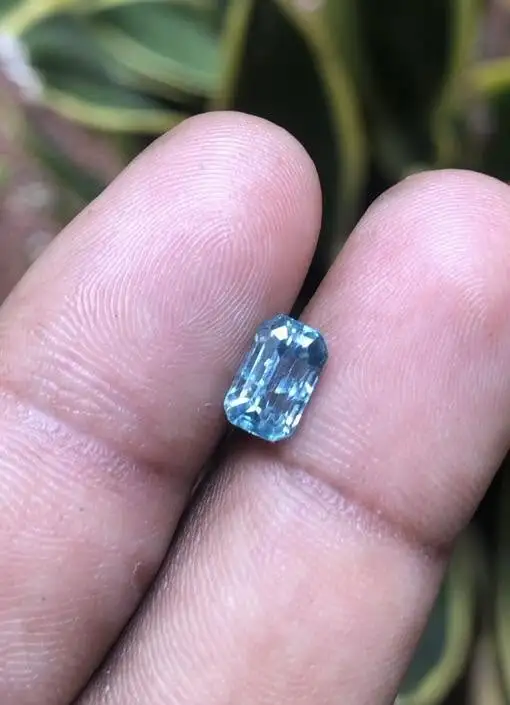
- Hue and saturation. Dealers buy blue. GIA has reported that about 80 percent of zircon sold is blue. Steely, saturated “Cambodian blue” brings more money than pale gray-blue or obviously greenish blue. Over-dark stones lose life.
- Cut quality. Zircon’s selling point is fire. A clumsy cut wastes it and makes the doubling of facets look messy instead of lively. Brilliant-style cuts are the trade default.
- Clarity. Most faceted zircon is eye-clean. Untreated stones can look smoky; extreme cloudiness drops the price. Eye-visible inclusions drop it further.
- Size. Commercial blues often fall between 1 and 10 carats. Fine stones above that range get scarce. Because zircon is dense, a 5-carat zircon looks smaller than a 5-carat quartz or beryl.
- Color origin of the parcel. Rough that heats to vivid blue is geographically picky. Cambodia still sets the standard for that look.
- Treatment honesty and paperwork. Heat is normal and should not be treated as a defect. A lab report matters more as size and price climb, and it is the only serious way to back an “unheated” claim.
- Condition of the facets. Worn girdles and rounded facet edges are common on older zircon and should be priced as worn goods, not as a new stone.
Red and green zircons are collector colors and follow a different price logic. They are not cheaper versions of blue; they are a different demand curve.
How to Care for it
GIA’s published care position is the one to follow: GIA zircon care and cleaning guide.
- Clean with warm water, mild soap, and a soft brush.
- Skip ultrasonic and steam.
- Take rings off for the gym, yard work, and anything that can knock a facet edge.
- Store zircon away from harder gems so it does not get ground down in a shared dish.
- Limit long sessions under strong UV (tanning beds, some salon lamps). If a heated blue stone browns, a gemologist can often advise on whether incandescent light will bring the blue back.
- Do not assume every jeweler will throw it in the ultrasonic with the sapphires. Say it is zircon before it goes in the machine.
Blue Zircon vs Cubic Zirconia
This is the comparison that actually matters at the counter.
| Blue zircon | Cubic zirconia | |
|---|---|---|
| Material | Natural ZrSiO₄ | Synthetic ZrO₂ |
| Color origin | Almost always heat on brown rough | Doped / grown in the desired color |
| Optics | High RI, strong fire, double refraction | High RI, single refraction |
| Hardness | 6–7.5 | About 8–8.5 |
| Weight | Noticeably heavy for its size | Also dense, but a different species |
| Price | A colored gemstone | A cheap simulant |
| Birthstone status | December (zircon) | None |
A loupe test still helps: zircon often shows doubled facet junctions because it is doubly refractive. CZ does not. CZ is also usually too optically “dead-perfect” and too inexpensive for the size. Blue topaz is the other stone customers put next to blue zircon. Topaz is singly refractive, usually less fiery, more durable for daily rings, and far more common in calibrated sizes. It is a different buying decision, not a substitute for the same gem.
💎 Explore the Entire Natural Zircon Group:
While blue zircon is celebrated for its extraordinary dispersion and Caribbean color, the broader zircon family spans an array of optical properties and collector varieties:
- Review clarity standards and durability in our Zircon Buying Guide.
- Learn how natural white stones differ from CZ in our Colorless Zircon Guide.
- Discover structural breakdown in metamict crystals in our Green Zircon Guide.
- Compare warm, untreated fire in our deep dives on Orange Zircon, Yellow Zircon, Red Zircon, and Brown Zircon.