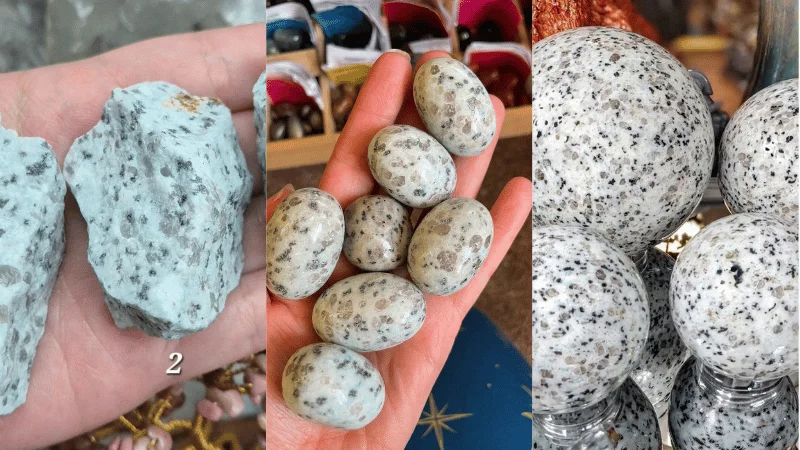
For a stone sold by hundreds of shops with near-identical descriptions, kiwi jasper has a strange gap in its story: almost nobody selling it seems to have actually had it tested. One person did. The result contradicts the standard sales copy on almost every point.
The story everyone tells
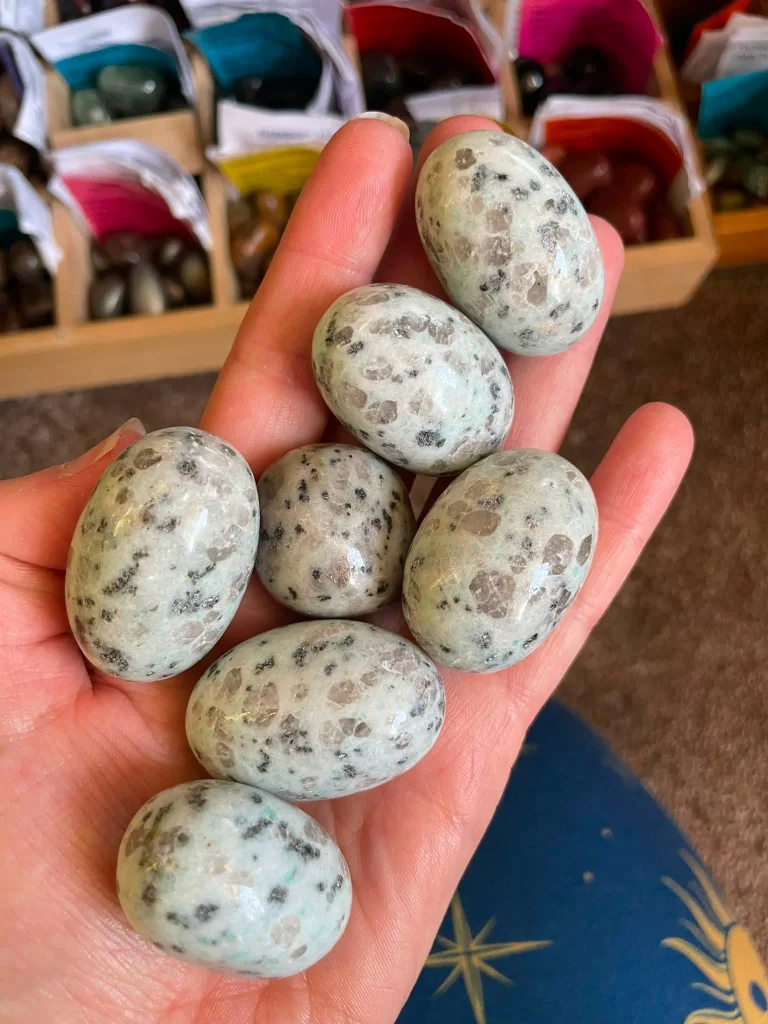
Discovered in New Zealand in 2014, reaching the collector market by 2015. Light green or sea-green base color, speckled with black spots, sometimes described as resembling a robin’s egg. Mohs hardness 6.5 to 7. And the composition line, repeated with remarkable consistency across dozens of listings: a pegmatite blend of amazonite, tourmaline, and quartz.
Even the name gets a tidy origin story a nod to New Zealand’s national symbol, or a reference to the mint-green resemblance to the fruit, depending which shop you ask.
It’s a clean narrative. Almost too clean, for a stone this recently discovered.
What actually happens when you look closer
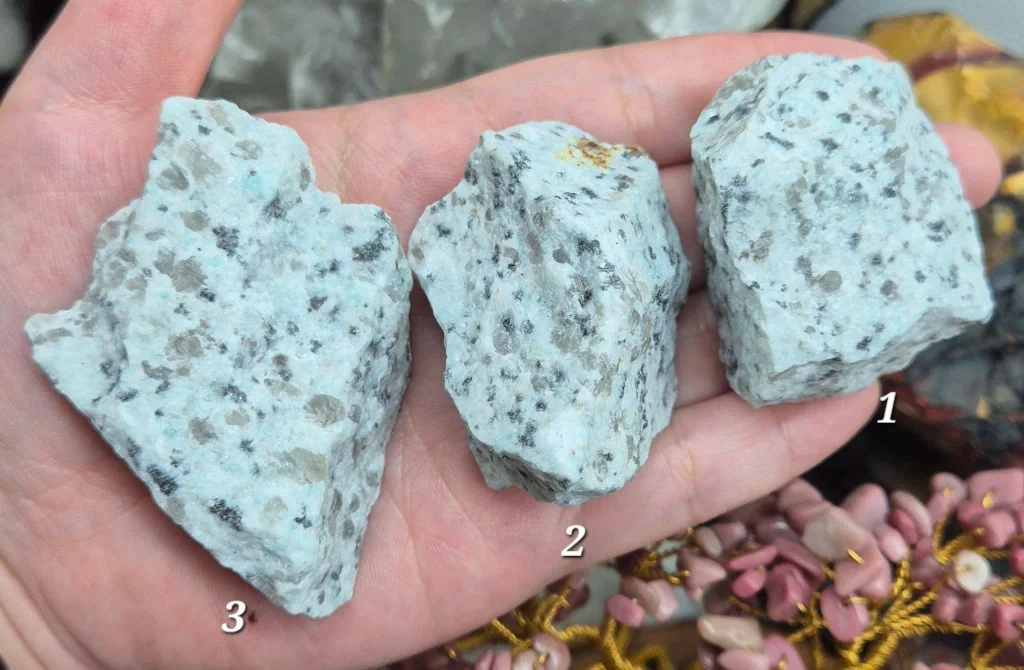
A geologist posting under the name Kevin Conroy on a Mindat identification thread wasn’t convinced by the amazonite-tourmaline story from the moment someone posted a photo asking for help. His read, based on visual and microscope inspection: the pale blue-green sections didn’t show the streaking typical of real amazonite, and the dark specks looked more like a mica mineral — muscovite or biotite, than actual tourmaline. His conclusion was blunt: definitely not jasper, looks like an igneous intrusive rock similar to granite, though you’d need a thin section to say exactly which type.
That was 2021. It didn’t end there.
Someone with actual doubts about the material sent a tumbled kiwi jasper stone to a laboratory in Germany for X-ray diffraction analysis,the kind of test that identifies a mineral’s actual crystal structure rather than relying on how it looks under a loupe. The result, posted back to Mindat: albite, orthoclase, a mineral from the smectite clay group, quartz, and muscovite. The poster’s summary was direct, kiwi jasper is most likely a micro granite, and not the amazonite-tourmaline blend the trade has been describing for a decade.
Read that composition list again. No amazonite. No tourmaline. Albite and orthoclase are both feldspars, which is likely where the earlier “amazonite” guess came from, since amazonite is itself just a blue-green variety of feldspar, but nothing in an XRD result confirms the specific amazonite variety versus plain feldspar. And muscovite mica, not tourmaline, appears to account for the dark speckling.
One caveat worth stating plainly: this is a single lab test on a single tumbled stone, not a systematic survey of every deposit sold under this name. The Mindat poster who commissioned it flagged that exact limitation themselves, noting that because “kiwi jasper” is a trade name, different vendors could be selling genuinely different material under the same label.
Why the “jasper” name stuck anyway
One retail source reasons that because “jasper” derives from a word meaning spotted or speckled stone, kiwi jasper “lives up to” the name through its appearance alone. That’s an argument about etymology, not mineralogy,jasper is a defined material (microcrystalline quartz), not just a description of any speckled rock. It’s a good example of how a trade name can feel earned by looks while having nothing to do with actual classification.
The color, as best anyone can explain it
If the XRD result holds up, the blue-green tint most likely comes from trace elements in the feldspar itself,the same mechanism that colors true amazonite, without necessarily being amazonite specifically. The dark flecking comes from muscovite mica rather than tourmaline, based on both the microscope read and the lab test. Nobody involved in this research, including the person who commissioned the actual lab work, claims full certainty on the exact coloring mechanism.
Where it’s actually from
- New Zealand,every source agrees on this, with no other locality documented anywhere. Discovery is consistently dated to 2014, with market availability starting around 2015.
Any treatment to worry about
Nothing in the sourcing points to dyeing or enhancement. The color and speckling are structural, tied to the stone’s actual mineral content rather than anything applied afterward. The real caveat here isn’t treatment, it’s that you may not be able to trust the mineral name on the listing at all, which matters more for a collector than a dye job would.
Should you wear it?
Every retail source quotes 6.5 to 7 on the Mohs scale, which would put it comfortably in daily-wear territory if accurate. Worth noting: that figure appears to be copied across listings rather than independently measured, the same pattern seen with the composition claims. Granite and feldspar-quartz-mica rocks generally do fall in a similar hardness range, so 6.5 to 7 isn’t an unreasonable estimate, just not one I found independently verified for this specific material. Treat it as durable enough for normal jewelry use, with the same light skepticism you’d apply to the composition claims.
Basic care
Warm water, mild soap, soft cloth. Skip harsh chemicals and prolonged soaking as a general precaution, since the exact mineral mix isn’t fully pinned down and different feldspar-mica rocks can respond differently to chemical exposure. Store separately from harder stones to protect the polish.
Kiwi jasper against genuine jasper
- What it’s actually made of,most likely a feldspar-and-mica micro granite per the one lab test available, not microcrystalline quartz
- What real jasper is made of,silica-based chalcedony, confirmed and consistent across every geological source
- Origin,kiwi jasper comes from New Zealand exclusively; true jasper is found on every continent
- Discovery timeline,kiwi jasper is barely a decade old in the trade; jasper has been used and documented for thousands of years
- The honest takeaway,the name tells you almost nothing reliable about what you’re holding, which isn’t true of most stones carrying the jasper label
Explore More Trade “Jaspers” & Composite Stones
Compare actual laboratory mineralogy across popular lapidary favorites:
How to tell speckled aplite varieties apart from kiwi stone.
Why layered carbonates are marketed as single-phase quartz.
True volcanic breccia naturally cemented by fine chalcedony.