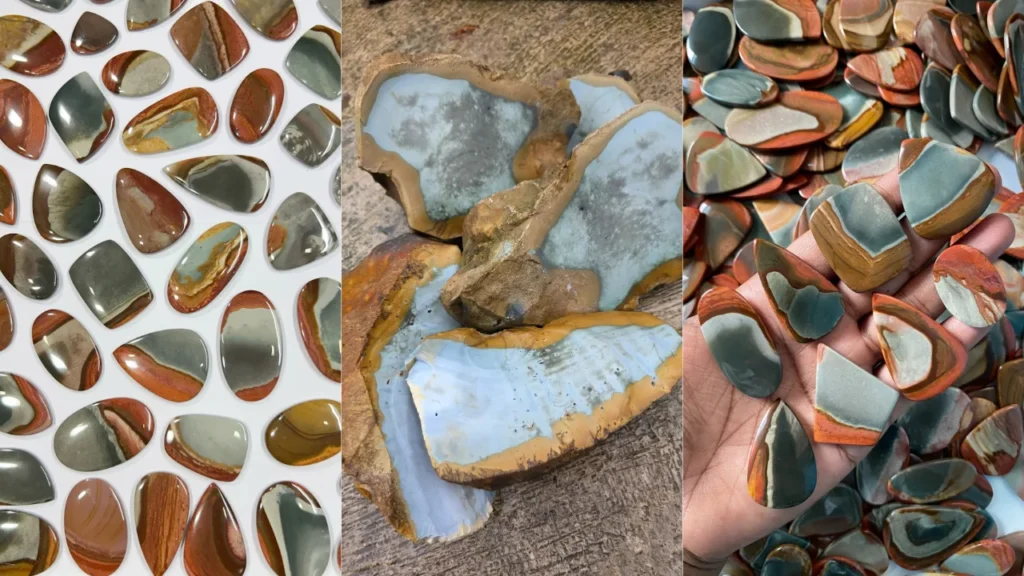
Most of the jasper varieties covered on this site have a naming problem. Polychrome jasper doesn’t everyone agree this one is genuinely jasper, genuinely from Madagascar? What it has instead is a formation story that splits three different ways depending on which source you happen to land on and a stray claim about a second country that nothing else backs up.
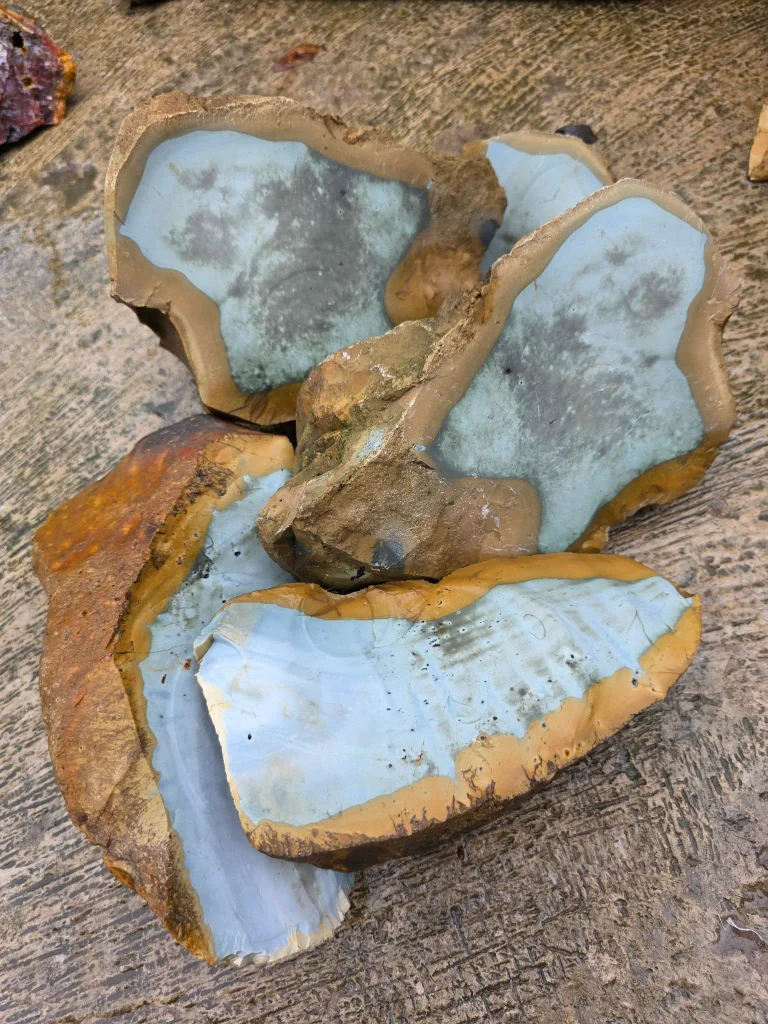
What it is, where the agreement holds
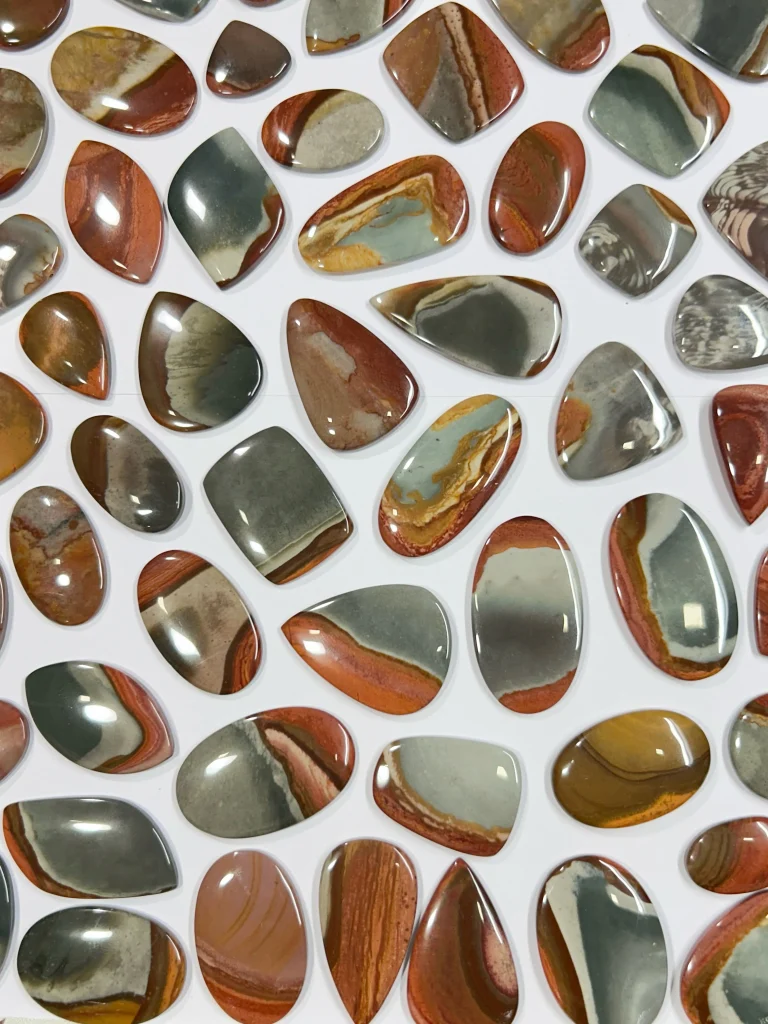
Polychrome jasper is a true jasper, opaque, microcrystalline quartz, the same chalcedony family as red jasper or spiderweb jasper. It also goes by Desert Jasper and Royal Savannah Jasper. Color comes from iron oxide inclusions running through the silica, producing bands and swirls of red, ochre, tan, brown, and occasionally purple, pink, or green in the same piece. Hardness sits at 6.5 to 7 on the Mohs scale, standard jasper territory. Every source agrees on all of this. The trouble starts one layer down.
Three different discovery years
The Crystal Council says 2008, found by accident while prospectors were searching for more Ocean Jasper deposits. A rock dealer selling the material directly, T-Rocks in Quartzsite, says 2006, the same story about searching for Ocean Jasper, a different year. Rare Earth Gallery hedges with “early 2000s” and doesn’t commit further. Nobody cites a geological survey or a dated field report; every account traces back to the same secondhand story about the Ocean Jasper search, just told with different years attached.
This kind of drift is common for stones this recently commercialized. Worth noting for accuracy rather than picking a year and stating it with false confidence.
Where the story genuinely forks: how it formed
This is the part worth slowing down for, because two respectable-sounding explanations contradict each other directly.
One line of sources describes polychrome jasper as sedimentary, silicified limestone, the same basic process that produced mookaite in Australia, with one source drawing that comparison explicitly. Under this account, mineral-rich groundwater moved through limestone in Madagascar’s sedimentary northwest and gradually replaced it with silica, locking in the iron staining as it went.
A different set of sources describes the opposite: volcanic tuff, meaning compacted volcanic ash that became saturated with silica-rich water and crystallized into dense jasper over time. Under this account, the coloring comes from the same hydrothermal process, but the starting material is ash rather than limestone.
Geology Science’s entry tries to have it both ways, describing the origin broadly as “volcanic activity and sedimentary processes” without committing to one mechanism for one specimen. That’s not necessarily wrong jasper formation genuinely can involve both stages in sequence but it also reads like a source hedging rather than resolving the disagreement.
The practical read: northwestern Madagascar, where this stone is dug, has both volcanic and sedimentary geology in the same general region, and different deposits within the polychrome jasper find may simply have formed through different local conditions. That would mean both camps of sources could be partially right about different rocks at the same trade name, rather than one side being straightforwardly wrong.
The claim almost nothing else supports.
Geology Science’s entry adds something no other source mentions at all: a locality in South Africa’s Kalahari Basin, describing polychrome jasper as occurring there as nodules within sandstone and conglomerate. Every other source, retailer, mineral dealer, and crystal-meaning blog alike describes Madagascar as the sole source, full stop.
Two things could explain the gap. It could be a genuine, under-documented second locality that simply hasn’t reached the retail trade yet. Or it could be a mix-up with “Royal Savannah “Jasper,” one of polychrome jasper’s alternate names, which shares wording with the Kalahari’s savanna geography and may have led to a locality being attached to the wrong stone during research or writing. I can’t resolve which explanation is correct, and I’m not aware of any polychrome jasper actually sold as South African in this research. Given how isolated this claim is against everything else, I’d treat the Madagascar-only story as the reliable one unless better evidence turns up.
What actually causes the color
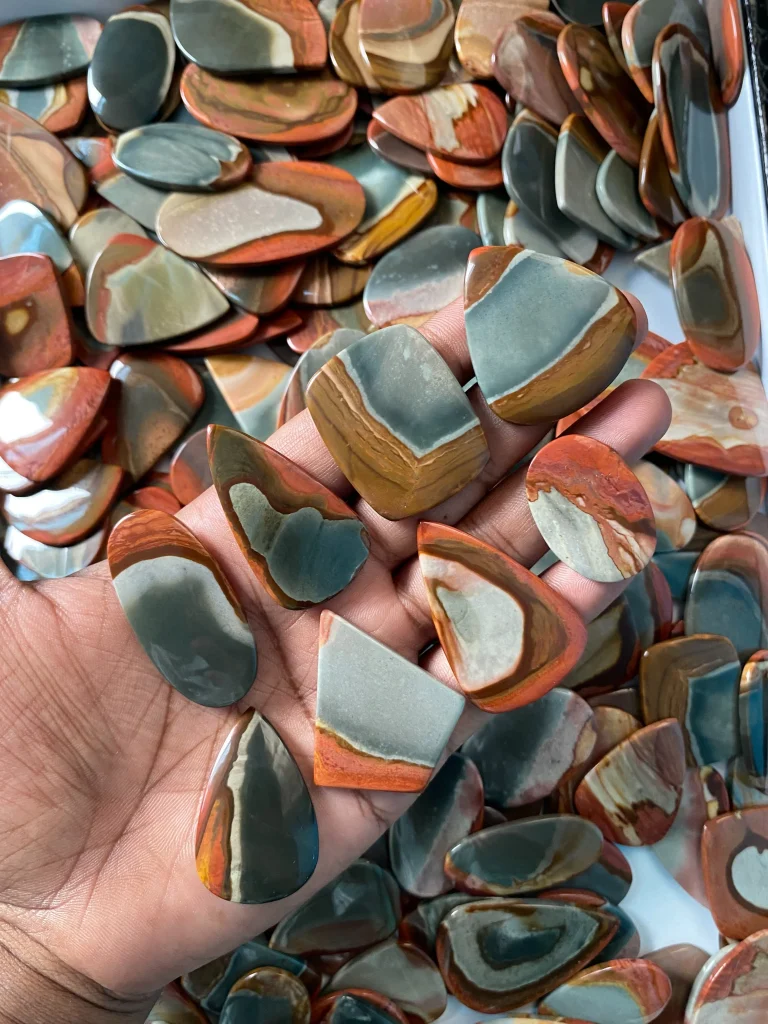
Iron oxide is the consistent, agreed answer across sources, this part isn’t in dispute the way formation and locality are. Manganese gets mentioned by one additional source as a contributing trace mineral alongside iron. The banding and swirling pattern comes from mineral deposition happening in layers or pulses rather than evenly, which is standard jasper behavior regardless of which formation story you favor. Some specimens show concentric “agate eye” orbs, and rare pieces contain fossilized shell or plant impressions a nice bonus detail that, incidentally, fits more comfortably with the sedimentary origin story than the volcanic one, since fossils don’t typically survive being embedded in ash.
Where it comes from
- Northwestern Madagascar — the source every article agrees on, discovered in the same general region that produces Ocean Jasper, currently understood to come from at least two or three separate deposits close together, all dug by hand due to difficult terrain
- South Africa (Kalahari Basin)—claimed by one source only; treat as unconfirmed until corroborated elsewhere
Treatment
Nothing in the sourcing suggests polychrome jasper is routinely dyed or enhanced. Its wide natural color range gives sellers plenty to work with without needing to add anything, which is likely why treatment isn’t a documented concern here the way it is for some other jaspers.
Wearing it
At 6.5 to 7 on the Mohs scale, polychrome jasper is squarely in daily-wear territory rings, bracelets, and pendants all hold up fine against normal use. Its density and fine grain also make it a favorite for carving and sculpting, which several sources mention specifically; if a piece is large enough to carve, it’s certainly durable enough to wear.
Care
Warm water, mild soap, and a soft brush. Untreated jasper of this type handles ultrasonic and steam cleaning without issue. Store away from harder stones to keep the polish intact, same as any jasper.
Polychrome jasper next to its closest relative
- Discovery story — both polychrome jasper and Ocean Jasper were found in the same general search effort in Madagascar’s northwest, which is why they’re so often mentioned together
- What they actually are — polychrome jasper is genuine chalcedony jasper; Ocean Jasper, despite the name, is classified by at least one source as rhyolite, a volcanic rock, not true jasper at all
- Pattern — Ocean Jasper is known for its orbicular, bullseye-style circles; polychrome jasper leans toward broader swirled banding, though both can show orb-like “eyes”
- The naming lesson — one found the other, shares part of its discovery story with it, and still ended up a completely different mineral classification, which is a good reminder that proximity and shared discovery stories don’t guarantee shared composition
Geology Science—Polychrome Jasper entry
Comparing Quartz & Chalcedony Formation Processes
Explore how pressure, fracture healing, and iron content shape natural chalcedony varieties:
The benchmark for homogenous hematite inclusions within opaque quartz.
How secondary mineral solutions heal and map ancient rock fissures.
Explosive volcanic fracturing bound by multi-stage agate infillings.