
How much is a Burmese ruby worth? The honest answer spans an enormous range, anywhere from a few thousand dollars per carat for commercial-grade heated material to well over $1,000,000 per carat for the finest certified unheated “pigeon blood” stones. Getting a real answer for a specific stone depends on four factors working together: color, clarity, treatment status, and certified origin ,and understanding how those interact matters far more than any single average price figure.
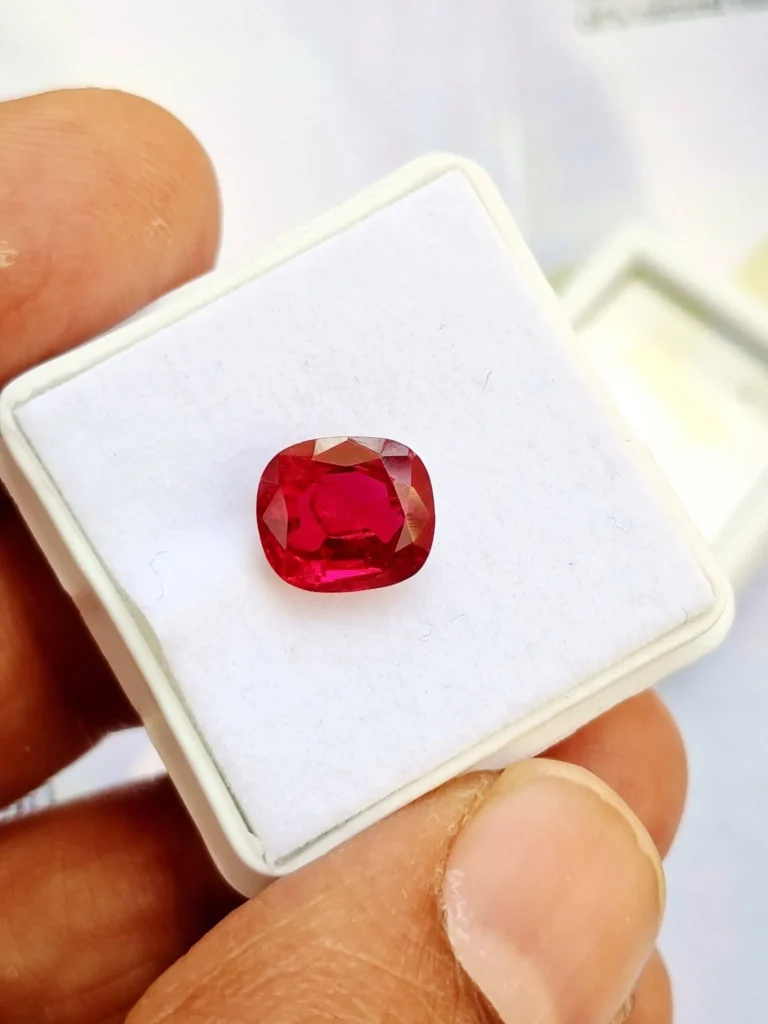
Burmese Ruby Price Per Carat: Real Pricing by Quality Tier
Rather than one number, Burmese ruby pricing is best understood in tiers, since treatment status and color intensity swing value dramatically even at identical carat weights:
| Quality Tier | Treatment & Clarity | Price Per Carat (USD) |
| Commercial / Entry | Heated, visible inclusions, lighter red | $500 – $3,500 |
| Good Quality | Heated, solid red, eye-clean | $3,500 – $12,000 |
| Fine AAA Quality | Heated, vivid red / near pigeon blood | $10,000 – $35,000 |
| Fine Unheated | Untreated, certified by recognized lab | $15,000 – $45,000 |
| Pigeon Blood (Top Tier) | Unheated, pure vivid red. GRS/Gübelin/SSEF | $80,000 – $500,000 |
| Auction / Museum | Exceptional Mogok provenance (e.g., Sunrise Ruby) | $1,000,000+ |
Because these ranges are genuinely wide and shift with market conditions, treat any single “average price” you see quoted elsewhere with some skepticism,a real appraisal from a qualified gemologist, based on your specific stone’s grading, is the only way to get an accurate figure.
Table of Contents
Why “Unheated” Is the Single Biggest Price Lever
Here’s the fact that matters more than almost anything else when pricing a Burmese ruby: roughly 95% of rubies sold on the market today have been heat-treated to improve color and clarity. This is standard, accepted industry practice,heating is stable and permanent, and a well-heated ruby retains real value. But certified unheated rubies, verified by a recognized gemological laboratory as never having undergone thermal treatment, consistently command a 2–4x premium over an equivalent heated stone, and at the very top of the market that gap can widen even further. This single factor affects Burmese ruby pricing more than almost any other variable besides color itself.
Because heat treatment can only be reliably detected through microscopic laboratory examination, not by eye, certification from a recognized lab (GIA, Gübelin, SSEF, or GRS) is essential for any purchase where treatment status meaningfully affects the price you’re paying ,which, for Burmese ruby specifically, is nearly always.
Why “Burmese” Specifically Commands a Premium
Origin plays an unusually large role in ruby pricing compared to many other gemstones. Rubies from Myanmar’s Mogok Valley are considered the historical benchmark for the trade’s most prized color grade, informally called “pigeon blood” a vivid, pure red with a slight bluish undertone, attributed to the specific combination of iron and chromium found in Mogok’s geology. Certified Burmese origin typically commands a 20–40% premium over visually similar rubies from Mozambique or Thailand at equivalent color and clarity, and in some cases the premium reaches 100–200%, largely due to Mogok’s centuries-long reputation and a well-documented, currently constrained supply of fresh material.
That said, it’s worth knowing that Mozambique’s Montepuez deposit, discovered in 2009, has become the world’s largest current source of fine ruby by volume, and top unheated Mozambique stones increasingly rival Burmese material in color offering a genuinely strong alternative at a meaningfully lower price point for buyers who care more about visual quality than origin prestige specifically.
How Carat Weight Affects Price
Ruby pricing scales more steeply with size than many gemstones, a 2-carat stone often costs 3–4 times the per-carat price of an equivalent 1-carat stone, not simply double, because fine material becomes disproportionately rarer as size increases. Above 5 carats, unheated Burmese rubies enter an extreme rarity tier where per-carat prices can run 5–10x higher than at the 1-carat mark. This is why a specific number like “$X per carat” is nearly meaningless without stating the carat weight it applies to the same color and clarity grade can command wildly different per-carat pricing depending on size alone.
What Determines Burmese Ruby Value: Quick Reference
- Color — A pure, vivid red with strong fluorescence and no visible brown, orange, or excessive purple is the top standard; each step away from that ideal reduces per-carat value substantially.
- Treatment status — Certified unheated stones command a 2–4x (or greater) premium over equivalent heated material.
- Certified origin — Documented Mogok/Burmese origin adds a real, substantial premium over Mozambican or Thai material of similar visual quality.
- Clarity — Eye-clean rubies are genuinely rarer than eye-clean sapphires; visible inclusions meaningfully affect value, though fine “silk” (rutile needle inclusions) that doesn’t dull the stone is tolerated and can even help prove natural origin.
- Carat weight — Value increases exponentially, not linearly, with size — particularly above the 3–5 carat range.
- Certification — Documentation from GIA, Gübelin, SSEF, or GRS confirming treatment status and origin can add a further 20–30% at resale, simply by removing buyer uncertainty.
A Word of Caution on “Bargain” Burmese Rubies
Given how steep genuine Burmese ruby pricing gets, be cautious of listings offering large, vividly colored “Burmese rubies” at prices far below the ranges above. Lead-glass-filled composite rubies a different category entirely from natural, treated corundum, are worth only a few dollars per carat regardless of size or apparent color and are sometimes marketed in ways that don’t clearly disclose this. Always request lab certification for any purchase where genuine Burmese origin and treatment status materially affect the price.
💡 Gemology Note: Mined alongside Burmese rubies, untreated “Jedi” spinels possess a high chromium content that gives them a glowing neon-red saturation under UV light. Learn how to identify and price these rare gems in our Jedi Spinel Gemstone Guide.