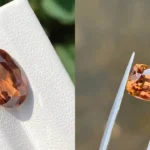

Yellow zircon spans a warm color range from pale lemon to a deep, honey-toned gold, the richer end of which is often marketed separately as “golden zircon,” though the two aren’t really distinct varieties so much as different points on the same spectrum. Like the rest of the zircon family, it carries brilliance and fire that genuinely rivals diamond, wrapped in one of gemology’s oldest and most historically overlooked color varieties.
What Is Yellow Zircon?
Yellow zircon is a color, a variety of zircon, a zirconium silicate mineral (ZrSiO₄), and one of the oldest minerals on Earth. Its color range runs from pale, almost pastel yellow through medium and strong yellows to a richer, deeper golden tone, and it’s that deeper end of the spectrum that’s frequently sold under the name “golden zircon.” There’s no meaningful scientific dividing line between the two; it’s a naming convention rather than a distinct gemological category, similar to how “orange” and “orange-red” blur together in other colored gems.
Historically, pale yellow to golden zircon carried its own trade name: jargoon, a term with the same linguistic root as “zircon” itself, both likely tracing back to the Persian zargun, meaning “gold-colored.” Modern gemology has mostly moved away from the name in favor of straightforward color descriptions, but it occasionally surfaces in historical references and collector circles.
As with every zircon color, it’s worth being clear upfront: zircon and cubic zirconia are entirely unrelated materials. Zircon is a genuine natural mineral with centuries of gemological history; cubic zirconia is a lab-created diamond simulant invented decades later. The similarity in name is a coincidence that trips up a lot of casual buyers.

Why Is Zircon Yellow? The Science of the Color
Yellow zircon’s color, like much of the rest of the zircon family, is tied closely to the mineral’s crystal structure and radiation history rather than a single dominant trace element. Undamaged, fully crystalline “high” zircon is the type typically cut into fine yellow and golden gemstones, prized for strong dispersion and a high refractive index that give the stone considerably more fire and sparkle than most other yellow gemstones on the market.
Much of the yellow and golden zircon sold today has been heat-treated from brownish rough to develop or intensify its color, a long-established and disclosed industry practice. That said, natural, unheated yellow zircon does exist and occasionally reaches the market with clear labeling — reputable dealers will state this directly, since untreated material commands a real premium given how much rarer it is than heat-treated stones.
One unusual shared trait with red zircon: some yellow zircon exhibits tenebrescence, a reversible color shift where a stone stored in the dark (such as in a safe) develops a deeper, brownish-yellow or orangey-yellow tone, which then fades back to its normal yellow within minutes of light exposure. This is a rare property even within zircon and isn’t something every stone displays.
Where Yellow Zircon Comes From
- Sri Lanka: One of the most significant sources of gem-quality zircon across nearly every color, including yellow and golden material. Zircon here is typically recovered from the same alluvial gem gravel deposits — known locally as illam — that also produce the island’s sapphires and spinel, traditionally hand-panned using woven baskets called vatti around Ratnapura.
- Cambodia: Best known for blue zircon production, but also a source of brownish rough that can be heat-treated toward yellow and golden tones.
- East Africa (including Tanzania): A meaningful modern contributor to global yellow zircon supply.
- Australia and Germany: Additional documented sources, though generally smaller contributors than Sri Lanka and Southeast Asia.
Is Yellow Zircon Treated?
Usually, yes. Most yellow and golden zircon on the market has been heat-treated from brownish rough to achieve or enhance its color, a standard, disclosed practice throughout the zircon trade. Natural, unheated yellow zircon is available less often, but reputable dealers will label it clearly when it is — and it’s worth asking directly, since natural material carries a genuine premium given how much rarer it is.
Yellow Zircon Durability: Should You Wear It Every Day?
Treat it the same as other zircon colors. It generally rates 7 to 7.5 on the Mohs hardness scale for fine, crystalline “high” zircon (somewhat higher than some other zircon colors, though still softer than sapphire), and it retains some brittleness, meaning facet edges can chip more easily under impact than harder stones. It’s a great fit for earrings, pendants, and occasional-wear rings; for a piece meant for daily wear, a protective setting is a sensible precaution.
What Determines the Value of Yellow Zircon?
- Color — Rich, saturated golden tones are generally more prized than very pale or washed-out yellow, though clean, bright colors across the spectrum are desirable.
- Natural vs. heat-treated origin — Confirmed natural material carries a real premium, since heat treatment is far more common in this color.
- Clarity — Zircon is generally eye-clean by nature; visible inclusions meaningfully reduce value.
- Carat weight — Larger stones with fine color are less common and priced accordingly.
- Cut quality — Given zircon’s exceptional fire, a well-executed cut significantly affects how the stone performs visually.

How to Care for Yellow Zircon
Clean it with warm water, mild soap, and a soft brush, and avoid ultrasonic and steam cleaners given zircon’s general brittleness and vulnerability to stress fractures under vibration and heat. Store separately from harder gems like sapphire and spinel to prevent surface abrasion.
Yellow Zircon vs. Citrine: How to Tell Them Apart
Yellow zircon is frequently compared to citrine, a much more common and affordable yellow quartz, and buyers sometimes confuse the two given their overlapping color range. The clearest difference is optical performance: zircon’s considerably higher refractive index and strong dispersion give it noticeably more fire and brilliance than citrine, along with a visible doubling of back-facet edges that citrine, a singly refractive gem, doesn’t show. Citrine also rates only 7 on the Mohs scale and is typically heat-treated from amethyst to achieve its color, a different process from zircon’s own heat treatment. Citrine remains the far more widely available and budget-friendly option, while yellow zircon is the rarer, more brilliant, and generally pricier of the two.
💡 Gemology Note: Like yellow zircon, brown zircon displays exceptional optical dispersion and high double refraction, giving champagne and chocolate varieties intense fiery brilliance. Learn how to grade clarity and color in our Brown Zircon Gemstone Guide.