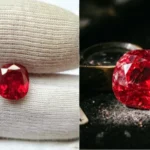

Spessartine is the orange member of the garnet family, colored not by dye or heat but by manganese trapped inside its crystal structure at the moment it formed. It’s also sold under a second name, spessartite, and the two terms are used interchangeably in the gem trade. Despite a color range that runs from pale “fanta” orange to deep mandarin and reddish-orange, it remains one of the least-seen garnets in everyday jewelry stores simply because clean, richly colored material is scarce.
What Is Spessartine Garnet?
Spessartine is the manganese-aluminum member of the garnet group, with the chemical formula Mn₃Al₂(SiO₄)₃. It belongs to the pyralspite series, the same chemical family as almandine (iron garnet) and pyrope (magnesium garnet), and it commonly forms a solid-solution blend with almandine, meaning most real-world spessartine crystals contain some iron alongside their manganese. The name comes from the Spessart Mountains in Bavaria, Germany, where the mineral was first identified and which remains its type locality. In the gem trade, dealers frequently call the same stone “spessartite,” an older mineralogical term that stuck; both names refer to the identical gemstone, so a buyer researching spessartine garnet should search both spellings.

Why Is It Orange?
The orange color in spessartine comes from manganese ions (Mn²⁺) built directly into the crystal lattice. Gemologists call this idiochromatic coloration, meaning the coloring agent is a structural part of the mineral rather than a trace contaminant. Where iron is also present in meaningful amounts (inherited from the almandine side of the pyralspite series), an iron-to-iron charge transfer effect adds red to the base orange, pushing the color toward reddish-orange or true red. The purest, most manganese-dominant stones, with the least iron interference, produce the vivid, saturated “mandarin” orange the gem is best known for. This is also why spessartine’s color is entirely natural and structural: unlike, say, blue topaz or certain quartz varieties, its hue isn’t something a treater can add after mining.
Where It Comes From
Spessartine forms in two main geological settings: manganese-rich granite pegmatites, where it grows as large, well-formed crystals during the slow final cooling of magma, and manganese-bearing metamorphic rocks such as schists and gneisses, formed under heat and pressure during mountain-building. Both settings concentrate the manganese needed to produce gem-quality orange material.
Namibia is the source most associated with the finest “mandarin garnet” vivid, unmodified orange with minimal brown or red secondary tone, first mined commercially in the Kunene region in the 1990s. Nigeria followed a few years later with larger, more affordable production, though trade sources note Nigerian material often carries a slightly more muted or secondary tone compared to top Namibian stones ,worth flagging as a point of disagreement, since not every dealer draws that line the same way. Tanzania, Mozambique, Brazil, and Madagascar also produce spessartine, though Madagascar’s material is frequently affected by higher almandine content, giving it high clarity but a less desirable brownish cast.
Sri Lanka is a genuine and historically significant source as well, spessartine has been recovered for centuries from the alluvial gem gravels of the Ratnapura district, alongside almandine, pyrope, and grossular garnets. These gem-bearing gravels are locally called illam, and traditional miners still recover them using hand tools and the woven vatti basket to sift washed gravel under running water, a method largely unchanged for generations. It’s worth noting that spessartine is a secondary character in Sri Lanka’s gem story rather than a headline export, the island is far better known for sapphire, spinel, and zircon, but it is a real and long-documented part of the Ratnapura gravels, not a marketing stretch.
Is It Treated?
Spessartine is one of the more honest gemstones on the market: it is almost never heat-treated or otherwise enhanced. Its color comes from manganese locked into the crystal at formation, and heat treatment the standard trick used to lighten or intensify color in gems like sapphire, zircon, or amethyst does little to nothing for spessartine’s hue. As a result, the overwhelming majority of spessartine garnet sold today is natural, unheated, and untreated. There is no widely established synthetic or lab-grown spessartine in the commercial jewelry market, unlike garnet’s cousin, synthetic YAG (yttrium aluminum garnet), which is a different mineral entirely used mainly as a diamond simulant. Buyers should still ask for a lab report on higher-value stones, but treatment disclosure is rarely a concern with this particular garnet.

Durability: Can You Wear It Every Day?
Spessartine sits at roughly 7 to 7.5 on the Mohs hardness scale, putting it in the same durability range as quartz and tourmaline , generally suitable for rings, though not as tough as sapphire or ruby. A few real caveats matter here:
- Heat and chemical sensitivity. Spessartine is noted as sensitive to sudden heat and to acids or salts. Avoid steam cleaning, ultrasonic cleaners, and harsh jewelry-cleaning chemicals like borax-based solutions.
- Inclusions affect toughness, not just looks. Spessartine is classed as a “type II” clarity stone in trade grading, meaning included crystals are expected and normal. Feathery liquid inclusions and fine rutile needles are common. Heavily included stones are more prone to chipping or fracturing under impact, so a garnet with visible internal stress lines is a poorer candidate for a daily-wear ring than a cleaner stone of the same species.
- Everyday wear verdict: clean, eye-clean spessartine handles rings and daily wear reasonably well. Included or fractured material is better suited to earrings, pendants, or occasional-wear pieces where knocks are less likely.
What Determines Value
- Color saturation and hue. Pure, vivid “mandarin” orange with minimal brown or red secondary tone commands the highest prices; muddier or overly dark stones are worth significantly less.
- Origin. Namibian mandarin garnet carries a trade premium over Nigerian, Tanzanian, or Malagasy material, largely tied to color purity rather than rarity alone.
- Clarity. Because spessartine is a type II stone, buyers should expect some inclusions — but eye-clean or near-eye-clean stones still bring a real premium over heavily included ones.
- Carat weight. Large, clean spessartine over 5 carats is genuinely scarce, especially in top mandarin color, and prices scale up sharply at larger sizes.
- Treatment status. Since almost all spessartine is untreated, this isn’t usually a differentiator, but a documented natural, unheated stone still reassures cautious buyers.
- Cut quality. Spessartine has strong brilliance when well-cut; a poor cut mutes both color and sparkle regardless of the rough material’s quality.
How to Care for Spessartine Garnet
Clean the spessartine with warm water, mild soap, and a soft brush, never an ultrasonic or steam cleaner, given its sensitivity to sudden heat. Avoid contact with chlorine, acids, and harsh household chemicals, and don’t use borax-based jewelry cleaners. Store it separately from harder gems like sapphire or diamond to prevent surface scratching, and remove rings before manual labor, gardening, or gym workouts. Because inclusions are common and can affect internal toughness, have a jeweler inspect a spessartine ring periodically for any new stress fractures, especially if it’s worn daily.
Spessartine vs. Hessonite Garnet: Don’t Confuse Them
Spessartine is frequently mixed up with hessonite garnet, a variety of grossular garnet, because both occur in overlapping cinnamon-to-orange color ranges. The distinction matters for buyers:
- Species: Spessartine is manganese-aluminum garnet; hessonite is calcium-aluminum garnet (grossular).
- Look: Hessonite often shows a distinctive “orange peel” or swirled, treacly internal texture caused by its inclusions, sometimes described as a “cinnamon stone” appearance. Spessartine tends toward cleaner, more saturated brilliance when good quality, though both species can carry inclusions.
- Color cause: Hessonite’s warm tones come from iron and manganese trace impurities in a different crystal chemistry; spessartine’s color is driven specifically by manganese as the dominant chromophore.
- Value: Fine, saturated mandarin spessartine generally outprices most hessonite of comparable size, though exceptional hessonite specimens can still be valuable collector stones.
A gemologist distinguishes the two with refractive index and specific gravity testing, the visual overlap alone isn’t reliable for a confident identification.
💡 Rare Garnet Spotlight: Spessartine isn’t the only garnet celebrated for extraordinary brilliance. Green demantoid garnet features higher optical dispersion than diamond itself. Learn more in our Demantoid Garnet Gemstone Guide.
💡 Garnet Family Comparison: Curious how brilliant orange mandarin garnets differ from classic almandine and pyrope varieties? Explore our breakdown in the Deep Red Garnet Gemstone Guide.
According to the Smithsonian’s National Museum of Natural History, Sri Lanka and Brazil rank among the major sources of gem-quality spessartine worldwide a useful anchor point before looking at how Sri Lanka’s material is actually mined.