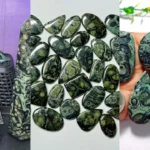

Bumblebee Jasper’s answer is more nuanced than a flat yes or no, and getting it wrong matters more than with most stones on this site, this one involves a real, documented toxic compound, not just marketing hype to sort through. Here’s what’s actually established, what’s still debated even among rockhounds and lapidaries, and how to handle it safely either way.
What Is Bumblebee Jasper?
Despite the name, bumblebee jasper isn’t true jasper at all. True jasper is a variety of chalcedony (microcrystalline quartz). Bumblebee jasper is instead a mixture of sulfur, realgar, orpiment, calcite, and aragonite, formed in volcanic environments, most commonly sourced from volcanic regions in Indonesia. Its Mohs hardness sits around 3.5–4, dramatically softer than true jasper’s 6.5–7, because it’s a calcite-based material rather than a quartz one. The name stuck purely because of its bold yellow-orange-and-black banded appearance, not its actual mineral composition.

Is It Really Toxic? The Honest Answer
This is where sources genuinely diverge, so it’s worth laying out what’s actually agreed upon versus what’s still debated.
What’s well-established: Bumblebee jasper contains arsenic-bearing minerals, specifically realgar and orpiment, both arsenic sulfide compounds, responsible for its vivid yellow and orange coloring. Realgar (As₄S₄) is a genuinely toxic compound. In raw or powdered form, dust from cutting, grinding, or polishing this material poses a real inhalation and ingestion risk, and arsenic dust is a recognized carcinogen with serious long-term health effects if inhaled repeatedly.
Where sources agree the real risk lies: almost every source checked for this article, from lapidary forums to crystal retailers to biology-focused explainers, agrees the primary danger is during raw handling, cutting, or polishing, not from touching or wearing a finished, polished piece. The consensus practical advice is consistent: wear a respirator, work wet to suppress dust, ensure ventilation, and wash hands after handling raw material.
Where sources genuinely disagree: whether a polished, finished piece is permanently and completely safe. Most sources say yes. The polishing process seals the minerals within the stone. But at least one source (a UK lapidary supplier, Albion Fire and Ice) pushes back directly on this, arguing that polishing doesn’t apply any actual coating or seal and that body oils are mildly acidic enough to potentially leach trace arsenic through microscopic surface imperfections over prolonged skin contact, a claim not fully echoed elsewhere.
One more data point worth knowing: a lapidary-focused source (Rock Seeker) notes they could not find a single documented medical case of arsenic or sulfur poisoning specifically attributed to bumblebee jasper, despite the material being widely sold and handled for years, though they also note data collection in the regions where it’s cut may be limited, so this absence of documented cases isn’t the same as proof of complete safety.
Bottom line: raw and powdered bumblebee jasper is genuinely toxic and should be treated with real caution. Finished, polished jewelry is considered safe for normal wear by the overwhelming majority of sources, with the sensible caveats of not putting it in your mouth, keeping it away from children who might do so, and washing hands after extended handling.
Why Does It Have That Color?
Yellow tones come primarily from sulfur and orpiment. Orange banding comes from realgar, the same arsenic-bearing mineral responsible for most of the safety discussion around this stone. Black or dark gray areas typically come from manganese oxides or other volcanic minerals. These layered mineral deposits form the striped, banded pattern that gave the stone its bumblebee nickname, with no two pieces looking exactly alike.

Where It Comes From
- Indonesia, specifically volcanic regions, the primary and most consistently documented source, where the material forms through volcanic fumarole activity that deposits these mineral layers together
How to Handle It Safely
- Finished jewelry: generally safe for normal wear according to the large majority of sources. Avoid putting it in your mouth, and keep it away from young children who might do so.
- Raw or rough material: treat with real caution. Wear a respirator and eye protection if cutting, grinding, or polishing. Work wet rather than dry to suppress dust. Ensure good ventilation.
- After handling raw material: wash your hands thoroughly before eating, touching your face, or touching your eyes.
- Storage: Keep raw material separate, labeled, and out of reach of children and pets.
- Water exposure: because the material is calcite-based and quite soft, avoid soaking or prolonged water exposure regardless of the toxicity question, it can damage the stone itself.

Durability: Can You Wear It Every Day?
Bumblebee jasper measures only around 3.5–4 on the Mohs scale, soft compared to true jasper and most gemstones generally.
- Not ideal for rings or bracelets. At this hardness, it scratches easily and isn’t well suited to jewelry that takes regular knocks.
- Better suited to pendants and earrings. Lower-contact settings reduce wear and accidental impact.
- Avoid acids and prolonged soaking. As a calcite-based material, it can react with acidic substances, including some cleaning products and even prolonged skin contact with sweat over time.
- Everyday wear verdict: wearable, but as a protected, low-contact accent piece rather than a daily-wear ring, the softness is a bigger practical limitation day-to-day than the toxicity question, once it’s polished.
Bumblebee Jasper vs. True Jasper: Not the Same Material
- Composition: True jasper is chalcedony (microcrystalline quartz). Bumblebee jasper is a sulfur/realgar/orpiment/calcite mixture, an entirely different mineral family despite the shared name.
- Hardness: True jasper sits at 6.5–7 on the Mohs scale; bumblebee jasper sits at only 3.5–4, making it far softer and more easily damaged.
- Safety: True jasper carries no comparable toxicity concern. Bumblebee jasper’s arsenic content is a genuine consideration absent from true jasper entirely.
- Shared buyer lesson: the “jasper” name here is a trade nickname based on visual similarity, not an accurate mineral classification, worth knowing before assuming it shares true jasper’s durability or safety profile.
💡 Looking for Safe Patterned Stones? Love high-contrast graphic patterns without the sulfur or arsenic content? Discover the natural fractured-vein structure of genuine quartz in our Spider Web Jasper Guide.
💡 Safety & Gemology Note: Bumblebee jasper is a trade name for a volcanic rock, not a true quartz jasper. True jaspers are completely safe, non-toxic, and composed of inert silica. Learn about genuine microcrystalline quartz in our Red Jasper Gemstone Guide.