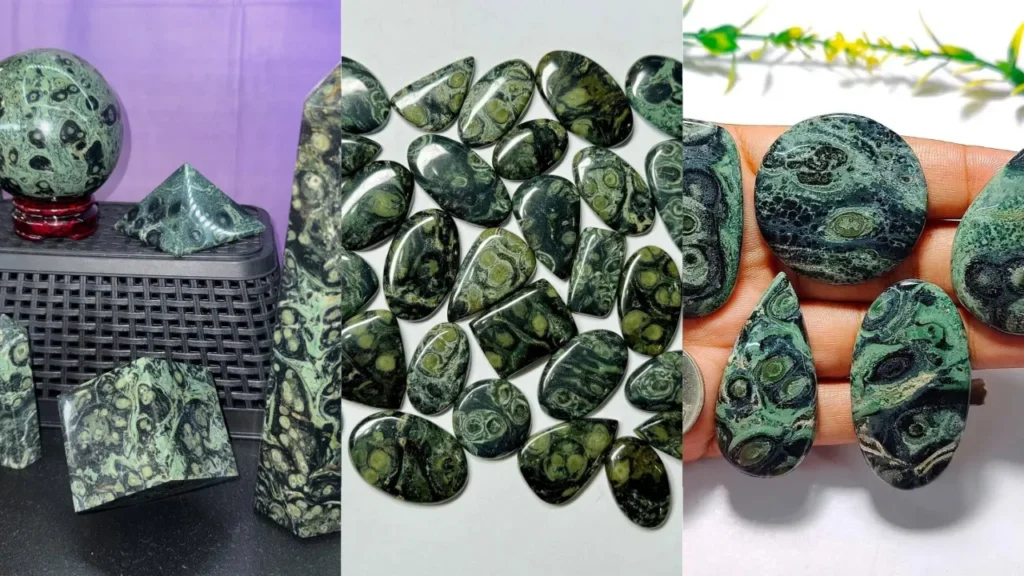
Kambaba jasper is a dark green, orbicular volcanic stone from a single region of Madagascar, prized for the distinctive circular patterns running through its surface. It’s also one of the most confidently mislabeled stones in the gem trade: widely marketed as a 3-billion-year-old fossilized stromatolite, a claim that fossil and mineral specialists have directly and publicly disputed.
What Is Kambaba Jasper?
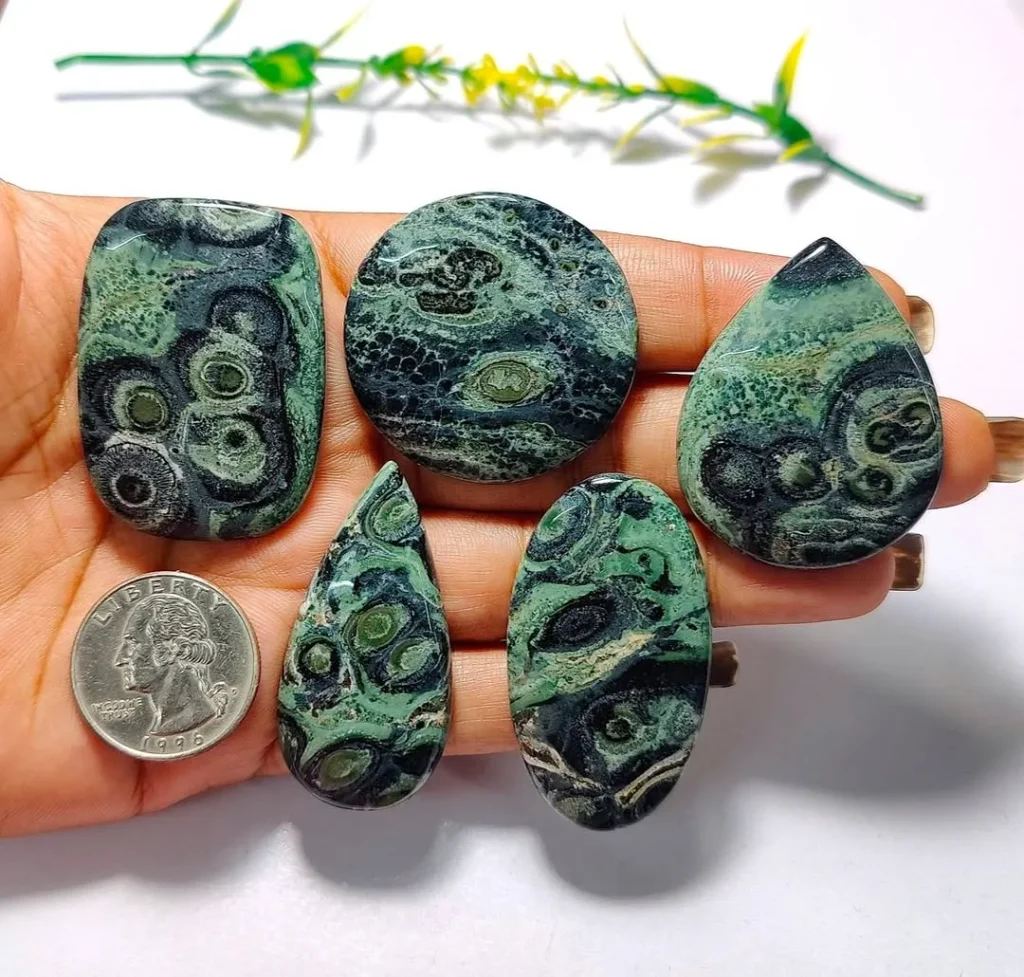
Kambaba jasper, also sold as crocodile jasper, green stromatolite jasper, or green supreme jasper, is, like mookaite, covered elsewhere on this site, a stone marketed under the “jasper” name that isn’t a true jasper in the strict mineralogical sense. True jasper is opaque chalcedony (microcrystalline quartz) colored by mineral inclusions. Kambaba jasper is instead most precisely described as a highly silicified rhyolite or volcanic tuff, an igneous rock, not a form of chalcedony with a matrix of microcrystalline quartz and potassium feldspar running through it, marked by the dark, circular orbicular structures the stone is best known for. Its Mohs hardness generally falls between 6.5 and 7, in line with quartz-family stones generally. As with mookaite, “jasper” has become the accepted trade name through long commercial use even though it isn’t strictly accurate geologically, which is worth knowing, though not something that’s likely to change in the marketplace.
Is It Really a Fossilized Stromatolite? The Honest Answer
This is the single most important thing to understand before buying kambaba jasper, and it’s a case where the popular narrative and the specialist consensus genuinely diverge. Across most of the crystal and jewelry trade, kambaba jasper is confidently described as a fossilized stromatolite, a mineralized colony of ancient cyanobacteria (blue-green algae) often dated at “over 3 billion years old,” making it, by this account, one of the oldest fossil materials sold as jewelry anywhere.
However, FossilEra, a specialty fossil dealer with direct expertise in identifying genuine stromatolite material, directly disputes this. They state plainly that the stromatolite claim is a repeated inaccuracy that has been passed along in the trade until it was simply assumed to be correct, and that kambaba jasper is instead a rhyolitic (volcanic) stone whose dark, irregular orbs merely resemble some stromatolite fossils without being genuine fossilized microbial structures. This account is echoed by a mineralogist who worked as a geologist in Madagascar, who described the “stromatolite” label as a case of two genuinely different materials with similar names becoming confused over time in the trade.
At the same time, it’s fair to note this isn’t a fully settled question; some crystal and mineral sources describe the orbicular texture as genuinely characteristic of silicified stromatolites and attribute the black orbs to organic carbon and iron carbonate residue from cyanobacterial activity. Sources also disagree wildly on age, with figures ranging from roughly 22 million years to over 3 billion years for the same material, which is itself a sign of how unsettled the actual geological dating is. Given this genuine disagreement between specialist fossil dealers and much of the broader crystal trade, the most honest position is this: kambaba jasper’s striking orbicular pattern is real and visually stunning, but the confident “3-billion-year-old fossilized algae” claim you’ll see almost everywhere should be treated as disputed rather than established fact.
Why Is It Green?
Even the cause of Kambaba Jasper’s green color is genuinely inconsistent across mineralogical sources, worth being upfront about rather than picking one explanation with false confidence. Some sources attribute the green matrix color to chlorite, an iron-bearing phyllosilicate mineral. Others attribute it specifically to aegirine, a sodium-iron pyroxene mineral, noting that comparative laboratory analysis has found kambaba jasper to be mineralogically very similar to eldarite (also called nebula stone), a related orbicular stone from Mexico with a similar composition but inverted coloring, dark green with lighter orbs rather than kambaba’s lighter green with dark orbs. Still other sources cite hornblende, an amphibole mineral, as a contributing factor to both the green and black coloration. Given this spread of credible but differing explanations, it’s most accurate to say kambaba jasper’s green color comes from iron-bearing silicate minerals within its volcanic matrix, most likely chlorite or aegirine, possibly both depending on the specific specimen, rather than a single, universally agreed-upon cause.
Where It Comes From
Kambaba jasper’s primary and most reliably documented source is the Bongolava region of west-central Madagascar, roughly 200 kilometers west of the capital, Antananarivo, the origin of the stone’s name itself, taken from a local place name in that district. Some sources also list South Africa and Zimbabwe as sources, though the Madagascar deposit is by far the most consistently cited and commercially significant origin across the sources checked for this article. As with mookaite, another single-region Madagascar-adjacent volcanic stone covered on this site, kambaba jasper’s supply is geographically concentrated rather than broadly distributed.
Is It Treated?
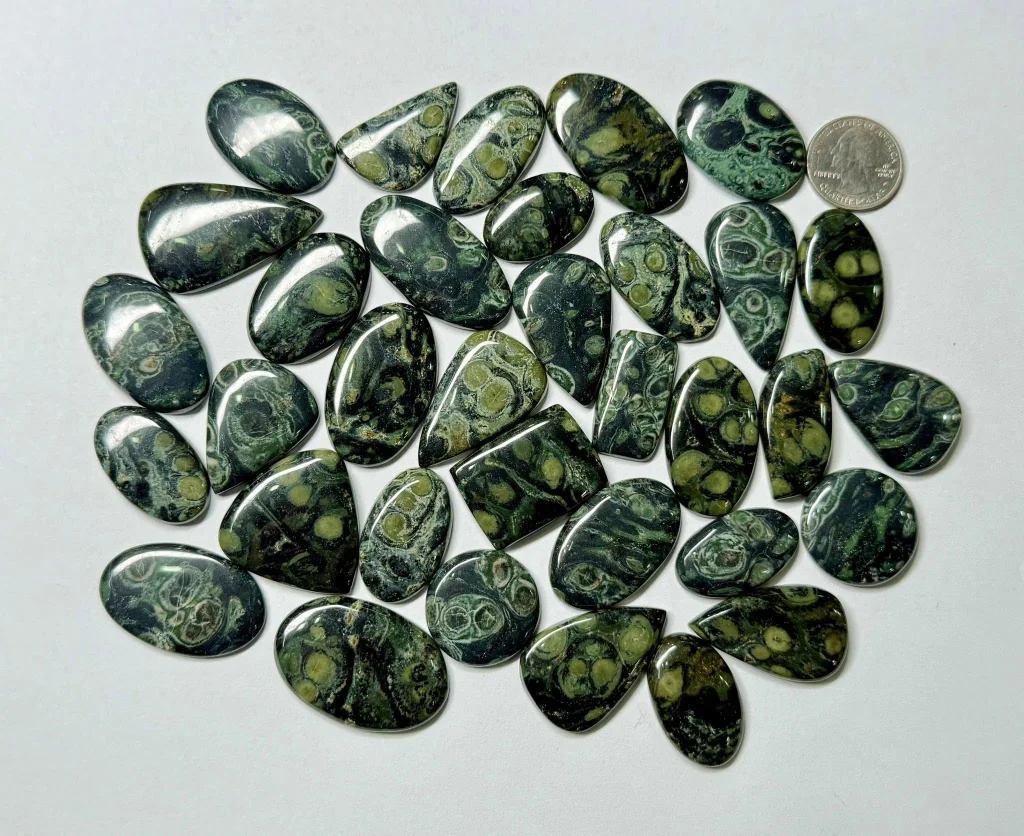
Genuine kambaba jasper is generally sold untreated, with its green and black coloring coming naturally from the minerals within its volcanic matrix rather than any added color. That said, dye, wax coatings, and resin treatments are documented as occurring on individual pieces within the broader orbicular-stone market, so it’s worth knowing what to look for: pigment that appears to cross mineral grain boundaries rather than following them naturally, color pooling in scratches or surface wear, or dark coloring that stops abruptly at chips and drill holes are all signs of applied color rather than natural mineral banding. For casual jewelry purchases this is rarely a significant concern, but for larger carved pieces or specimens sold at a premium, it’s reasonable to examine the piece closely or ask the seller directly about treatment.
Durability: Can You Wear It Every Day?
Kambaba jasper measures roughly 6.5 to 7 on the Mohs hardness scale, comparable to quartz-family stones generally and to true jasper varieties like red jasper, also covered on this site. A few practical points:
- Solid everyday hardness. In this hardness range, kambaba jasper handles normal daily wear reasonably well, similar to other jasper-family and quartz-adjacent stones.
- Color can fade with prolonged sun exposure. While the mineral coloring itself is stable under ordinary conditions, extended direct sunlight exposure is documented to cause some fading over time, so it’s worth avoiding leaving pieces in direct sun for extended periods.
- Generally safe for brief water exposure, but not prolonged soaking. Kambaba jasper tolerates brief contact with water reasonably well, though prolonged saltwater exposure specifically is noted as potentially damaging to the surface over time.
- Everyday wear verdict: protected settings—pendants, earrings, and bezel-set rings with rounded edges handle daily wear better than exposed rings or bracelets subject to regular knocks and abrasion, which is standard practical advice for most opaque ornamental stones in this hardness range.
What Determines Value
- Pattern definition and contrast. Clear, well-defined circular orbs with strong contrast against the green matrix are more desirable than muddy, indistinct, or washed-out patterning.
- Color depth and evenness. A rich, consistent green base color is preferred over pale, patchy, or unevenly toned material.
- Absence of dye or coating. Natural, untreated material with genuine mineral coloring is preferred by collectors over dyed or resin-coated pieces sold under the same name.
- Size and structural soundness for carved pieces. Because kambaba jasper is popular for spheres, palm stones, and carvings, larger pieces free of cracks or structural flaws are harder to produce successfully and priced accordingly.
- Honest representation. Given the disputed stromatolite claims discussed above, material sold with accurate, non-exaggerated geological information arguably represents better value for an informed buyer than material marketed with unverified age and origin claims, even if the stone itself is identical.
How to Care for Kambaba Jasper
Clean kambaba jasper with warm water, mild soap, and a soft cloth, keeping soaking brief rather than prolonged, particularly in salt water. Avoid extended direct sunlight exposure to prevent gradual color fading. Store it separately from harder gemstones to prevent surface scratching, and choose protected jewelry settings, pendants, and earrings over exposed rings and bracelets if you want to minimize wear on the polished surface over time. As with most polished ornamental stones, avoid harsh abrasive cleaners that could dull the finish.
Kambaba Jasper vs. Mookaite: Two “Jaspers” That Aren’t True Jaspers
Kambaba jasper and mookaite, also covered on this site, make an interesting pair. Both are marketed under the “jasper” name despite not being true jasper in the strict mineralogical sense, and both come from a single, geographically concentrated source rather than being broadly distributed:
- True classification: Kambaba jasper is a silicified volcanic rhyolite or tuff; mookaite is a silicified sedimentary radiolarite. Neither is technically chalcedony-based jasper, though both carry the name commercially.
- Origin: Kambaba jasper comes primarily from Madagascar’s Bongolava region; mookaite comes exclusively from Mooka Creek in Western Australia, both single, narrow localities rather than broadly distributed sources.
- Pattern cause: Kambaba jasper’s orbicular pattern is disputed between a volcanic mineral origin and a possible (contested) stromatolite fossil origin. Mookaite’s swirling bands come from iron, and manganese-rich groundwater moving unevenly through fossilized marine sediment, a different and less disputed mechanism.
- Color range: Kambaba jasper is characteristically green and black; mookaite spans reds, yellows, creams, and purples.
- Shared lesson for buyers: both stones are genuinely worth owning for their visual character, but both also illustrate how trade names and popular marketing claims can outrun what’s actually been geologically established, a useful pattern to recognize across ornamental stones generally, not just these two.
💡 Gemology Note: Kambaba jasper is one of many stones labeled “jasper” in the gem trade that is actually a complex volcanic rock. Learn how other popular volcanic trade stones are identified and handled in our Bumblebee Jasper Safety Guide.
💡 Looking for Distinctive Patterned Gems? Love high-contrast graphic patterns like Kambaba’s dark orbicular eyes? Discover the fracture-vein structure of genuine quartz in our Spider Web Jasper Guide.