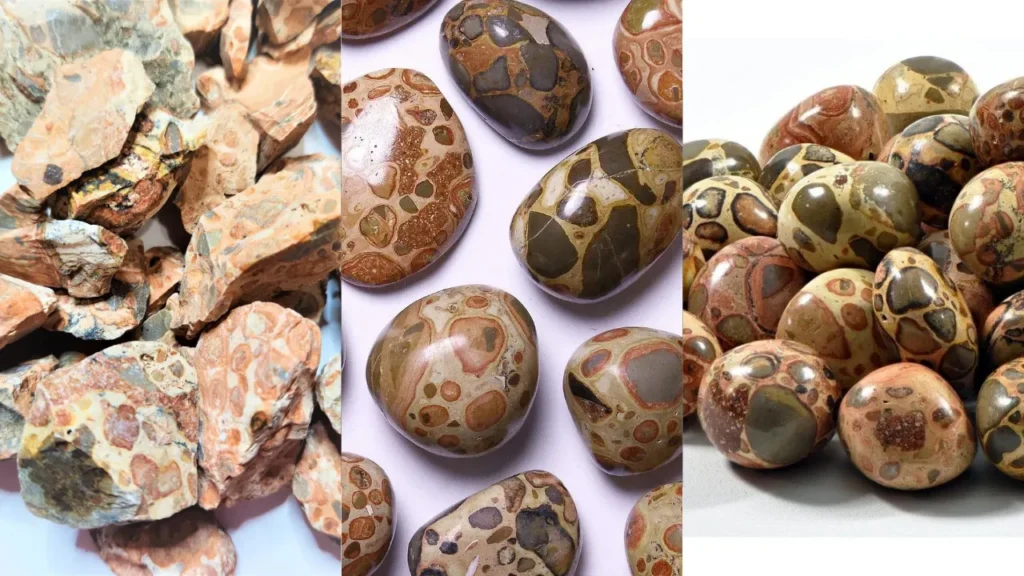
Leopardite is a spotted, manganese stained igneous rock named for its resemblance to a leopard’s coat, or leopard skin jasper and it’s also one of the more genuinely confused names in the gem trade, with sources disagreeing on its exact rock classification and dealers frequently conflating it with an entirely different stone, leopard skin jasper.
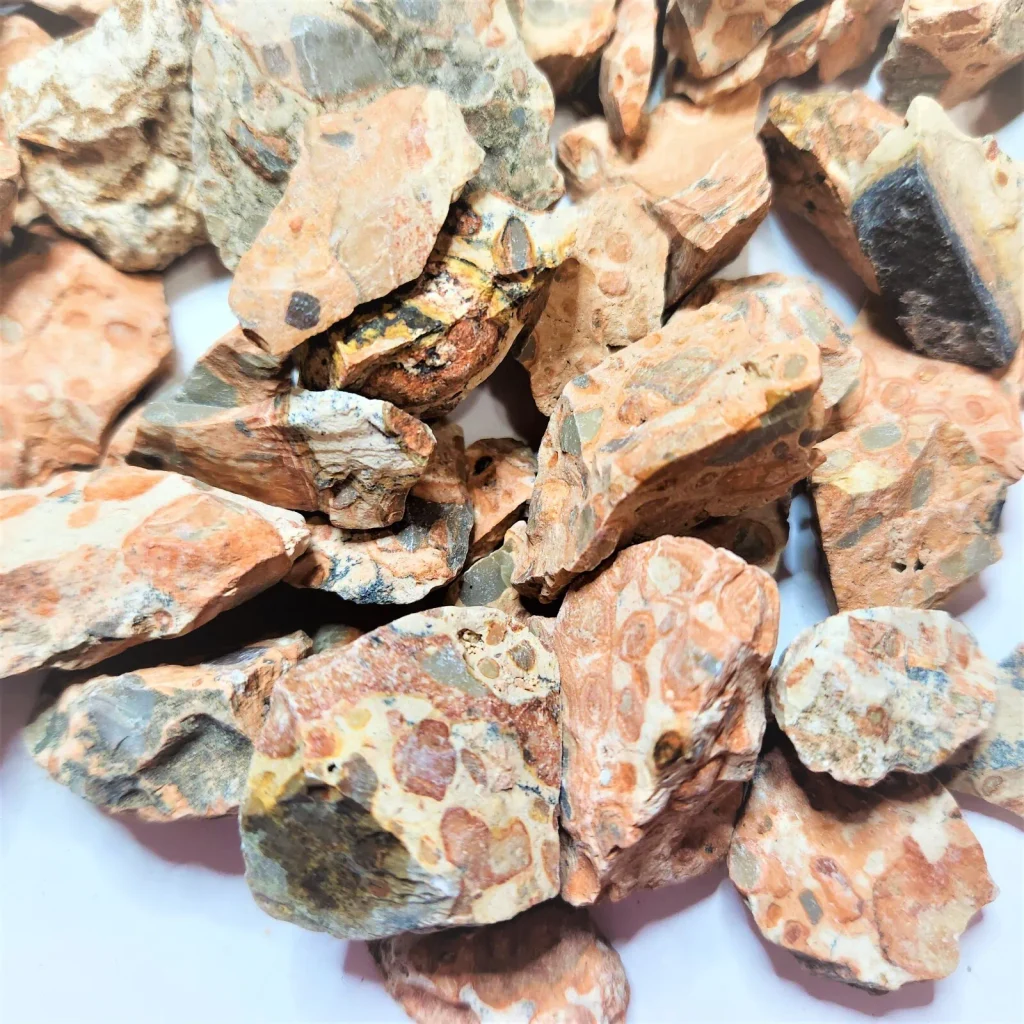
What Is Leopardite?
The name “leopardite” was first used in geological literature in the 1850s, coined by mineralogist C.L. Hunter to describe a spotted rock he documented in North Carolina. In that original, historical sense, leopardite was described as a fine-grained aplite (a light-colored, fine-grained granite-family rock) marked by dark gray to black or brownish, roughly rod-shaped zones pigmented by manganese hydroxides, sometimes with iron as well. However, the name has since been applied inconsistently to a range of visually similar spotted rocks, and academic mineralogical sources acknowledge this has led to what one university geology resource bluntly calls a “nomenclature nightmare.” The material most commonly sold as “leopardite” today, particularly from Peru, is instead typically described as a variety of quartz porphyry (also called orbicular rhyolite) a volcanic rock containing small quartz crystals (phenocrysts) within a fine-grained groundmass of quartz, orthoclase, albite, and mica, marked by the same kind of iron and manganese hydroxide staining. So while the general “spotted rock stained by manganese and iron oxides” description holds up across sources, the precise rock classification behind material sold as leopardite varies by origin and even by seller.
A Genuine Naming Tangle Worth Understanding
This is worth spelling out clearly before anything else, because it affects what you’re actually buying. At least three separate points of confusion surround this name:
First, even dealers selling material from the same Peruvian source disagree on its basic rock classification: some describe Peruvian leopardite spheres as orbicular rhyolite, an igneous rock with radial, needle-crystal spotting; at least one specialty dealer explicitly states that Peruvian leopardite spheres are actually conglomerate stone, a sedimentary rock formed from cemented rounded fragments,and were, in their words, “wrongly called” leopard skin jasper for a time. Conglomerate and orbicular rhyolite are structurally very different kinds of rock, so this isn’t a minor labeling quibble.
Second, leopardite is frequently used interchangeably with an entirely different stone: leopard skin jasper (also called leopard jasper or jaguar stone). According to a detailed mineralogical write-up hosted by Central Michigan University’s geology program, true leopardite in the historical, North Carolina sense is an aplite, while leopard skin jasper is a genuinely different material, a type of orbicular jasper, meaning silicified rhyolite or tuff in which quartz and feldspar crystallize into needle-like structures that fan out into circular spots, chemically and structurally distinct from leopardite’s original definition even though both show a similar spotted “big cat” appearance.
Third, geographic sourcing adds to the confusion: the original, type-locality leopardite is from North Carolina, while nearly all commercially available “leopardite” today comes from Peru, Brazil, or Mexico, meaning the material most buyers encounter under this name today likely isn’t the same rock the name was originally coined for.
Given all this, the most honest guidance is to treat “leopardite” as a popular trade name rather than a precisely defined material, and if exact rock identification matters to you, ask your seller directly what specific rock type and locality their material comes from.
Why Is It Spotted?
Across essentially all the material sold under this name, the characteristic spotted or streaked pattern comes from staining by iron and manganese hydroxides that infiltrated the host rock, concentrating unevenly to create the leopard-like markings. In orbicular rhyolite specifically, this staining interacts with a radial, needle-like crystal growth pattern (quartz and feldspar crystallizing outward from central points) to produce the rounded, orb-like spots associated with true orbicular jasper varieties. In more streaked or rod-shaped material, closer to the original aplite-based definition, the manganese staining follows fracture patterns and mineral zoning within the rock rather than radiating from central points, producing a more linear, streaked appearance rather than distinct circular orbs.
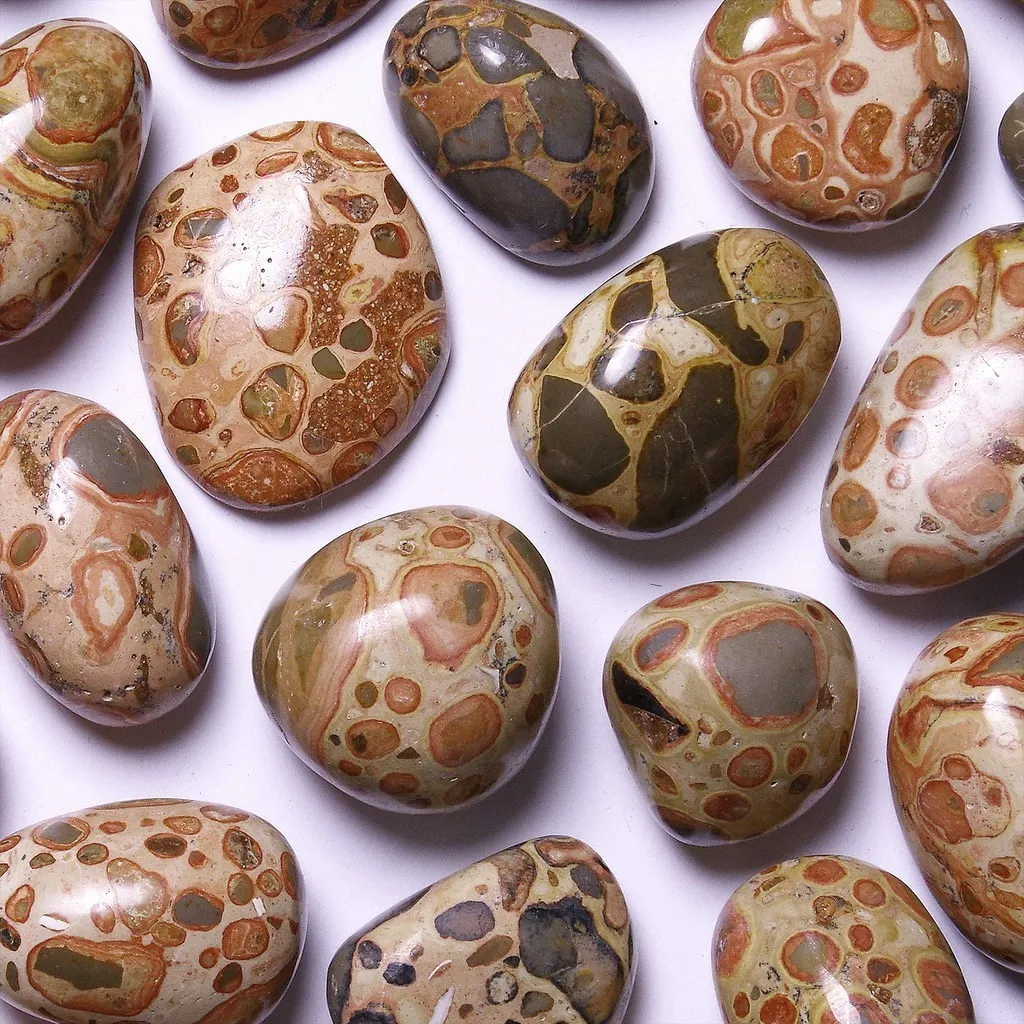
Where It Comes From
Peru is the dominant modern commercial source for material sold as leopardite, with Brazil and Mexico also contributing supply. The original, historically significant leopardite locality is in North Carolina, tied to the rock’s initial description in the 1850s, though this material is not the primary source for what’s commercially available today. Leopard skin jasper, the related but distinct stone frequently confused with leopardite, is documented from Mexico, Peru, and the United States, with a related orbicular jasper from Madagascar marketed separately as ocean jasper.
Is It Treated?
Material sold as leopardite is generally natural and untreated, with its spotted coloration coming from iron and manganese staining that occurred during the rock’s formation rather than anything added afterward. Sources consistently describe leopardite and leopard skin jasper as enhanced only by ordinary cutting and polishing. Given the naming inconsistencies discussed above, the more relevant honesty concern for buyers isn’t treatment in the traditional sense; it’s accurate material identification. A seller confidently telling you their piece is “leopardite” doesn’t guarantee a precise, verified rock classification, given how loosely the term is applied across the trade.
Durability: Can You Wear It Every Day?
Reported hardness for leopardite ranges from roughly 6 to 7 on the Mohs scale, with sources noting that some material labeled as leopardite may fall toward the lower end of that range, itself a reflection of the naming inconsistency discussed above, since different underlying rock types will naturally have somewhat different hardness. A few practical points:
- Generally comparable to quartz-family stones, at the upper end of its hardness range, making it reasonably durable for jewelry and decorative use.
- Hardness may vary more than usual, piece to piece, given that “leopardite” covers more than one rock type depending on source and seller, a genuine caveat that applies less to more precisely defined single-mineral gemstones.
- Everyday wear verdict: leopardite handles moderate daily wear reasonably well for jewelry pieces like pendants and earrings, though given the hardness variability, a cautious approach (avoiding hard knocks, treating it gently) is sensible advice regardless of which specific material you own.
What Determines Value
- Pattern clarity and contrast. Well-defined, high-contrast spotting against a clean background is more desirable than faint, muddy, or poorly defined patterning.
- Rock type and verified sourcing. Given the genuine classification confusion discussed above, material with clearly documented origin and rock type may represent better value for informed buyers, even when visually similar to less precisely identified material.
- Size and structural soundness for carved and polished pieces. Spheres, palm stones, and cabochons free of cracks or structural flaws are harder to produce successfully and priced accordingly.
- Polish quality. A smooth, well-executed finish that shows the spotted pattern clearly adds real value.
- Color combination. Certain background and spot color combinations (tan-and-black versus pink-and-brown, for example) may be more sought after depending on current market taste.
How to Care for Leopardite
Clean leopardite with warm water, mild soap, and a soft cloth. Given the hardness variability discussed above, treat any individual piece with reasonable caution rather than assuming maximum quartz-family durability, hand-washing and gentle handling are the safer default over ultrasonic cleaning. Store it separately from harder gemstones to prevent scratching, and avoid harsh abrasive cleaners that could dull the polish. As with most opaque ornamental stones in this category, there’s no special sunlight or water sensitivity to worry about beyond standard care.
Leopardite vs. Leopard Skin Jasper: Don’t Confuse Them
Given how often these two names are used interchangeably in the trade, it’s worth laying out the distinction directly rather than treating them as the same stone:
- Rock classification: Leopardite, in its original and technically correct sense, is an aplite or quartz porphyry (igneous rock); leopard skin jasper is a form of orbicular jasper, silicified rhyolite or tuff with quartz and feldspar crystallizing in radial, needle-like patterns. Both are igneous-derived, but they’re structurally and mineralogically distinct rock types.
- Type locality: Leopardite’s original description comes from North Carolina; leopard skin jasper is primarily associated with Mexico.
- Pattern mechanism: Leopardite’s spots often follow a more streaked, rod-shaped staining pattern in its historical definition, while leopard skin jasper’s spots form through a distinct radial orbicular crystallization process, producing more clearly circular orbs.
- Commercial reality: Because both names get applied loosely to visually similar spotted stones from various localities (particularly Peru), a piece labeled “leopardite” in a shop may, per some dealers’ own admissions, actually be leopard skin jasper, a conglomerate, or orbicular rhyolite, underscoring that the name on the label is a weaker guarantee here than for most gemstones.
A geologist can resolve the actual rock classification through mineral composition analysis, but visual similarity between these spotted “big cat” stones is not a reliable way to distinguish them, and even experienced dealers demonstrably disagree on individual pieces.
💡 Volcanic Geology Spotlight: Curious how rapid lava chilling creates amorphous glass instead of spotted porphyry rock? Learn about microscopic crystal layers in our Rainbow Obsidian Guide.
💡 Gem Trade Misnomers: Leopardite is one of several volcanic rocks marketed as “jasper” due to its spotted matrix. Discover how Madagascar’s orbicular stone shares the same geological debate in our Kambaba Jasper Guide.
💡 Mineral Safety Note: While leopardite is an inert, non-toxic silicate stone safe for daily handling, other volcanic trade stones require caution. Read the full safety analysis in our Bumblebee Jasper Safety Guide.