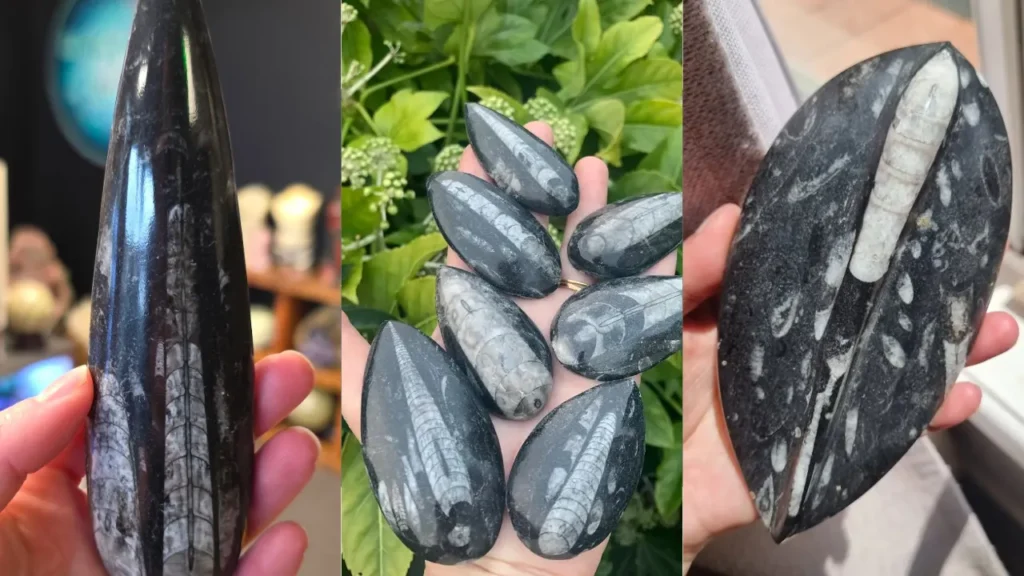
Search “orthoceras fossil meaning,” and you’ll mostly find crystal-shop pages talking about ancient wisdom and grounding energy, but almost none of them mention that orthoceras is a real, scientifically documented fossil with a genuinely fascinating true story, one that doesn’t need embellishment to be interesting. Here are both sides, clearly separated.
What Is an Orthoceras Fossil?
Orthoceras is the common name given to fossils of extinct “straight-shelled” cephalopods, ancient relatives of today’s squid, octopus, and nautilus. The name means “straight horn,” referring to their long, conical shells, which ranged from under a centimeter to reportedly more than 14 feet in some species. These animals lived inside their shells, used tentacles to grab food, and moved through jet propulsion, expelling water to push themselves backward, a genuinely early version of a locomotion strategy still used by their modern relatives today.
Most specimens sold commercially date to the Devonian period, roughly 370–400 million years ago, though the broader group ranged from the Ordovician through to the Triassic period, meaning some lineages persisted for hundreds of millions of years before finally going extinct, well before the first dinosaurs existed. Wikipedia’s entry on Orthoceras covers the genus’s taxonomic history in more depth for readers who want the full paleontological classification.
Is the “Orthoceras” You’re Buying Actually Orthoceras? The Honest Answer
This is worth knowing before anything else: most fossils sold under the name “Orthoceras” likely don’t belong to the Orthoceras genus itself. Several very similar-looking genera, including Michelinoceras and Arionoceras, are found in the same Devonian deposits in Morocco and are essentially indistinguishable from true Orthoceras without expert examination. One fossil retailer states plainly that unless you’re one of the world’s leading experts on fossil cephalopods, you likely won’t be able to tell them apart.
This doesn’t make the fossils fake or the name meaningless. “Orthoceras” functions as a widely accepted common trade name for this whole family of straight-shelled nautiloids, similar to how “jasper” or “spinel” cover a range of related materials. But it’s worth knowing that the specific genus name on a listing is more of a convention than a guarantee.
How Did the Fossil Form?
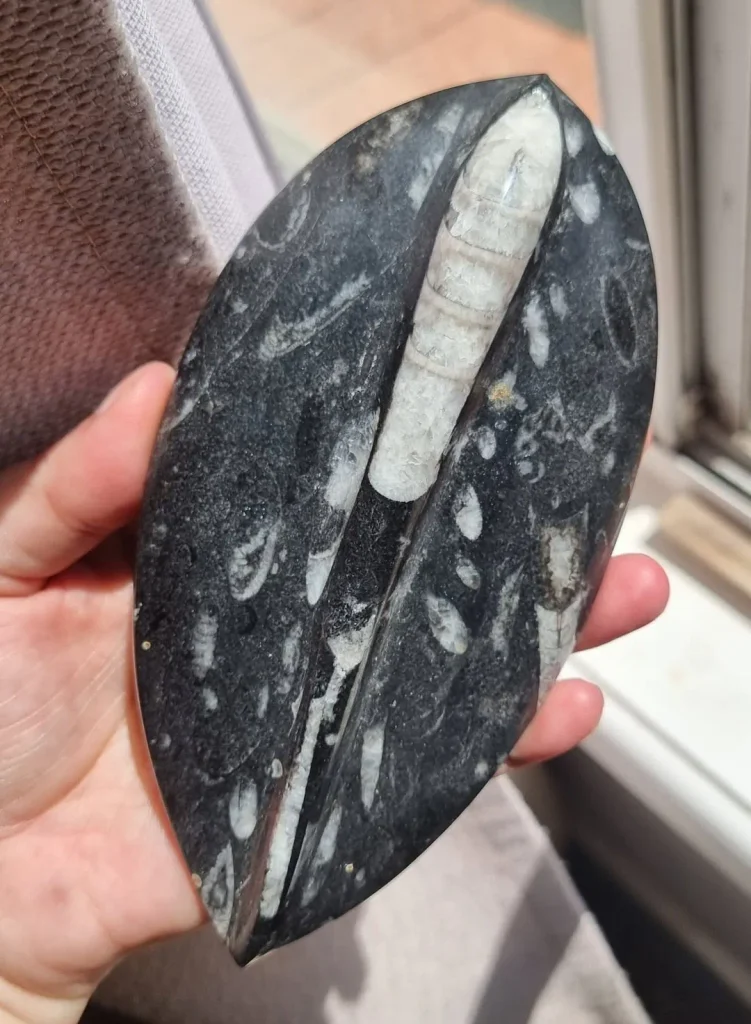
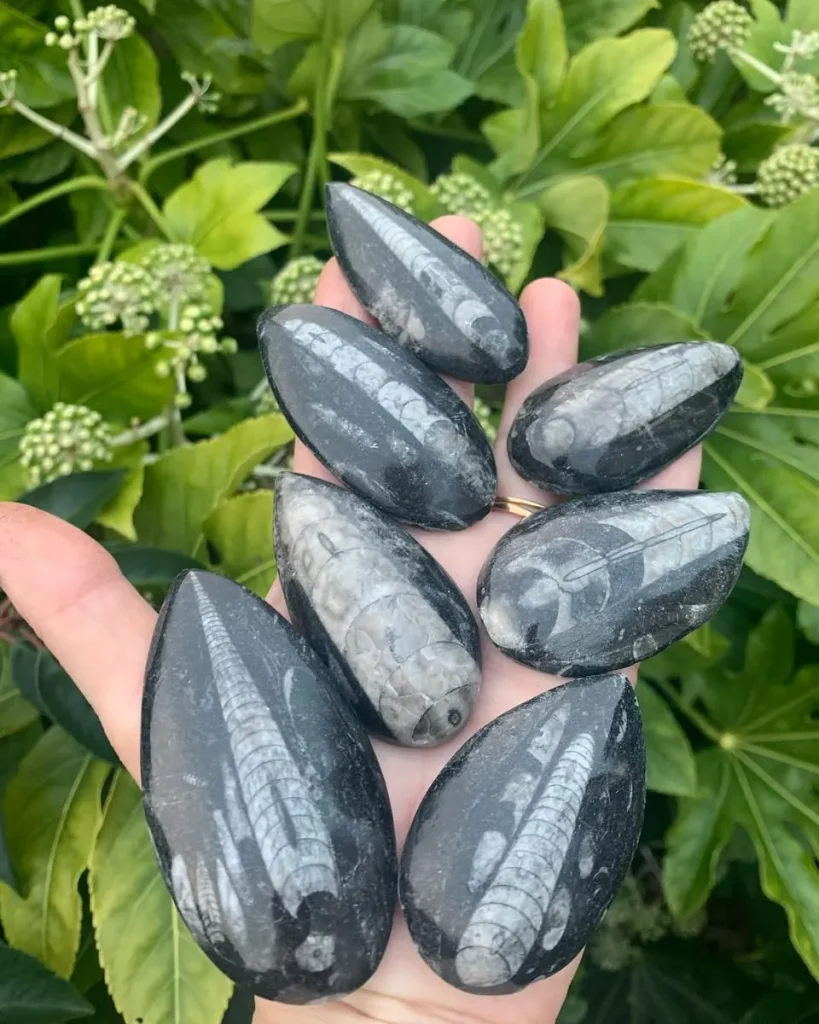
When these cephalopods died, their shells settled into fine seafloor sediment, which slowly hardened into limestone over millions of years. During this process, minerals gradually replaced the original shell material, preserving the internal chambered structure in stone rather than the organic material itself,this is what makes it a true fossil rather than a preserved shell. Much of the material sold today is quarried from black limestone in the Atlas Mountains near Erfoud, Morocco, where the pale, mineral-replaced fossil stands out sharply against the surrounding dark rock once cut and polished.
Why Are Polished Orthoceras Fossils Usually Black?
The dark color comes from the surrounding limestone rock, not from the animal itself. When Moroccan limestone containing these fossils is cut and polished, the pale, mineral-replaced fossil shell contrasts against the naturally dark rock matrix, the black background is simply the local geology, unrelated to the creature’s original coloring, which isn’t preserved in the fossilization process at all.
Where It Comes From
- Morocco (Atlas Mountains, near Erfoud), the primary and most commercially significant source, where Devonian-age black limestone deposits are quarried and polished into decorative items
- Orthoceras fossils are also documented globally from Ordovician through Silurian-age marine deposits, but the polished decorative specimens sold commercially are overwhelmingly Moroccan
For a closer look at how these fossils are quarried and prepared, FossilEra’s Orthoceras collection notes go into more detail on the Moroccan sourcing process.
What About the “Spiritual Meaning”? Separating Fact From Folklore
Nearly every top-ranking page for this exact search term (“orthoceras fossil meaning”) comes from crystal-healing and metaphysical retail sites, describing orthoceras as connected to ancient wisdom, grounding, stability, or ancestral energy. These are folklore and marketing claims, not scientifically verifiable properties, there is no established scientific mechanism by which a fossil transmits “energy” or “wisdom,” and no credible source in this research supports these claims as fact.
That said, it’s worth noting why the association makes intuitive sense even without any scientific basis: orthoceras genuinely is one of the oldest and most tangible physical objects most people will ever hold, predating dinosaurs by hundreds of millions of years. The appeal of holding something that old is real and understandable, it just isn’t the same thing as the specific metaphysical claims made about it.
Durability: Can You Wear or Display It Safely?
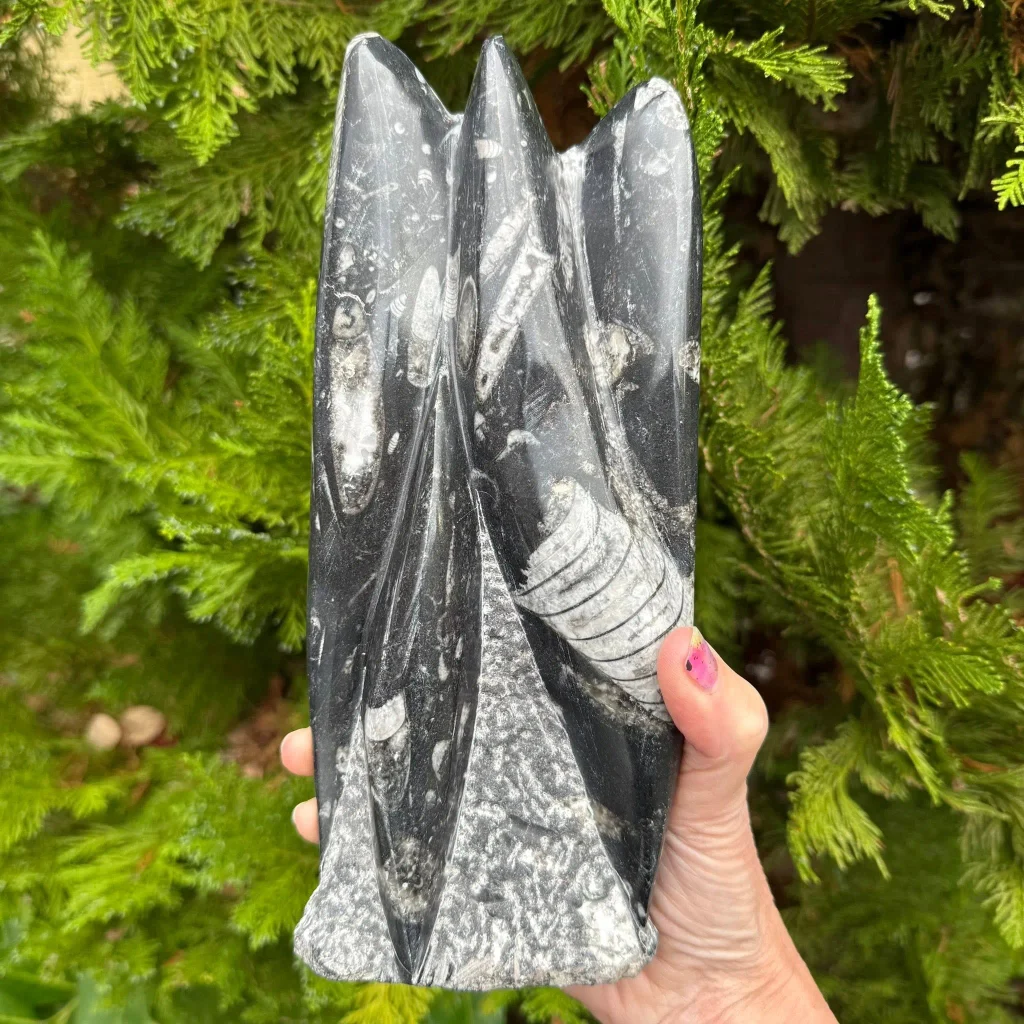
Orthoceras fossils are typically sold as sets in polished limestone slabs, bowls, or as standalone specimens rather than worn as everyday jewelry.
- The limestone matrix is relatively soft, generally in the range of 3–4 on the Mohs scale, since it’s a carbonate rock rather than a hard gemstone.
- Not suited to rings or bracelets subject to daily knocks, the material scratches and chips more easily than true gemstones.
- Well suited to display pieces: bookends, coasters, dishes, and tabletop sculptures, where its main appeal (the visible fossil structure) is best appreciated anyway.
- Everyday wear verdict: this is a display and collector’s item, not everyday jewelry, its value and appeal come from being seen and handled occasionally, not worn daily.
How to Care for Orthoceras Fossil Pieces
Clean with a soft, dry cloth or slightly damp cloth; avoid acidic cleaners, since the limestone matrix is a carbonate rock and will react with acids (including some common household cleaning products and even prolonged exposure to lemon juice or vinegar). Keep away from direct impact given its relative softness, and store separately from harder stones or metal jewelry that could scratch the polished surface.
Orthoceras vs. Ammonite: Two Famous Fossils, Often Confused
- Shape: Orthoceras has a long, straight, conical shell; ammonites are coiled in a spiral, resembling a ram’s horn.
- Age and lineage: Both are extinct cephalopods, but ammonites appeared later and are more closely related to modern squid and cuttlefish through a different evolutionary branch than the nautiloid line orthoceras belongs to.
- Extinction: Ammonites went extinct at the same mass extinction event that ended the dinosaurs; orthoceras-type nautiloids had already died out earlier, during the Triassic period.
- Shared buyer lesson: both are commonly sold polished in decorative slabs, and both attract similar “ancient wisdom” marketing claims. Worth applying the same fact-vs-folklore separation to ammonite listings too.
Explore More Gemstone History & Symbolism
- Discover the real history behind celestial stones in our Star Sapphire Meaning & Symbolism Guide.
- Explore needle inclusions and asterism optics in our Black Star Sapphire Feature.
- Learn how natural crystalline garnets were worn as ancient talismans in our Deep Red Garnet Guide.