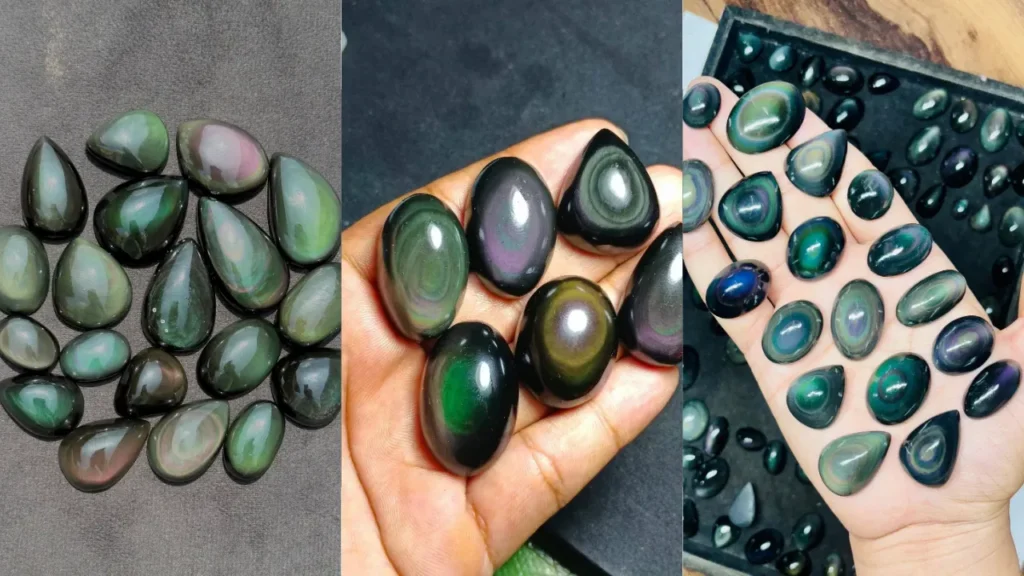
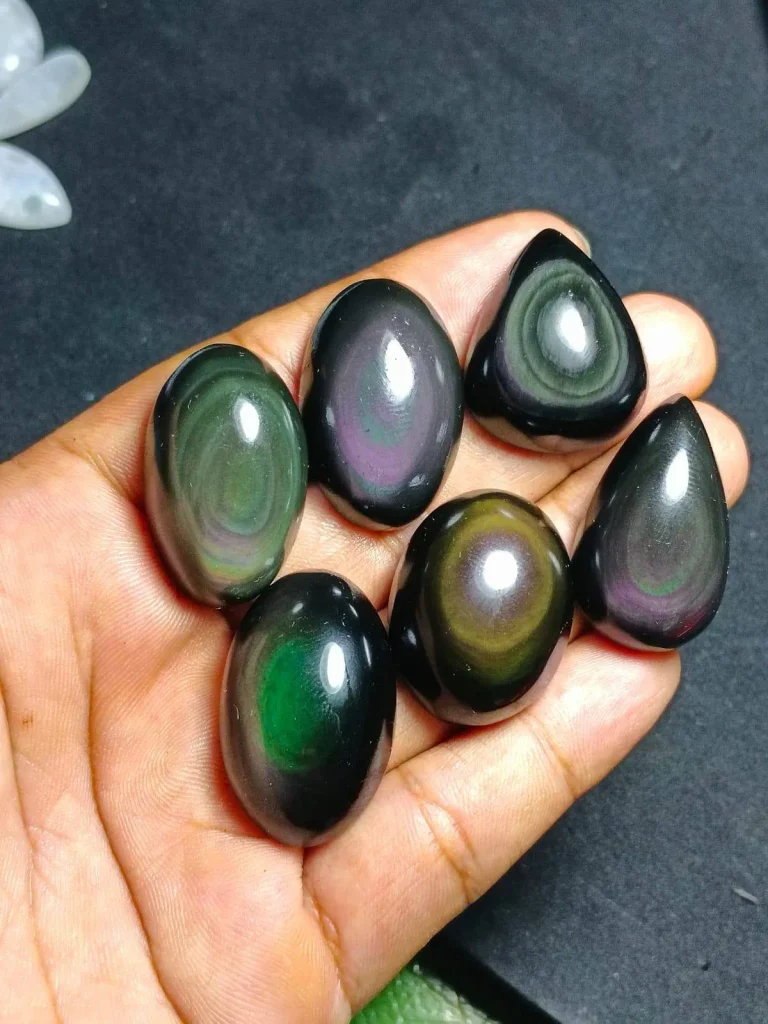
Rainbow obsidian is a naturally occurring volcanic glass that displays iridescent bands of color, gold, green, blue, and violet. when cut and polished at the right angle. Unlike most gemstones, obsidian isn’t a mineral at all; it’s amorphous glass formed when silica-rich lava cools too quickly for crystals to grow, and rainbow obsidian’s color comes from an unusual internal structure that’s genuinely still debated in mineralogical literature.
What Is Rainbow Obsidian?
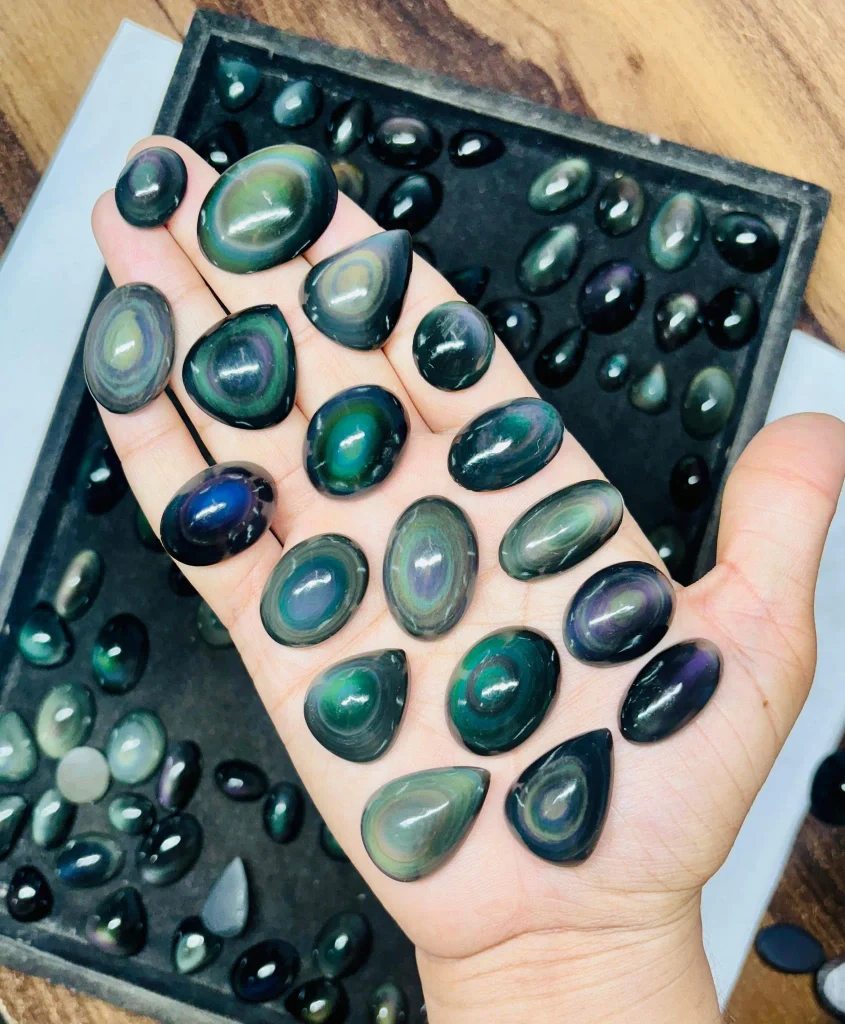
Rainbow obsidian is a variety of obsidian, a naturally occurring volcanic glass formed when silica-rich (typically 70–75% SiO₂) felsic lava cools so rapidly that its atoms have no time to organize into a crystal lattice. This is the key thing that separates obsidian from essentially every other gemstone covered on this site: it’s amorphous, meaning it lacks the ordered internal structure that defines a true mineral, which is why gemologists sometimes describe obsidian as a “mineraloid” rather than a mineral in the strict sense. Obsidian typically registers 5 to 5.5 on the Mohs hardness scale and fractures conchoidally, breaking into smooth, curved surfaces with edges sharp enough that ancient civilizations used obsidian for cutting tools and blades, a practice that continues in specialized modern surgical scalpels prized for edges finer than surgical steel. Standard obsidian is black, but rainbow obsidian is a rare variety showing a distinctive iridescent sheen across bands of color when the polished surface catches light at the correct angle.
Why Does It Show Rainbow Colors?
This is a case where the honest answer involves genuine, ongoing scientific disagreement rather than a single settled explanation. Rainbow obsidian’s color comes from thin-film interference, the same optical phenomenon responsible for the colors seen in a soap bubble or an oil slick on wet pavement, produced by extremely thin, regularly spaced layers of nanoscale inclusions embedded within the glass and aligned by the flow direction of the original lava. Where mineralogical sources disagree is on exactly what those nanoscale inclusions are made of. A 2007 paper in The Canadian Mineralogist identified the coloring layers as oriented nanocrystals of magnetite (Fe₃O₄), an iron oxide, a finding that corrected an earlier, now-discredited assumption that the effect came from aligned gas bubbles. However, subsequent analysis by mineralogist George Rossman at Caltech identified the coloring agent in at least some rainbow obsidian as tiny oriented crystals of hedenbergite, a calcium-iron pyroxene mineral, rather than magnetite. Both explanations appear in credible, expert-sourced material, and it’s possible both mechanisms occur in different specimens or localities, so rather than presenting one as definitively correct, the fair summary is that rainbow obsidian’s iridescence comes from nanoscale mineral inclusions (most likely magnetite, hedenbergite, or possibly both depending on the specimen) arranged in parallel layers thin enough to interfere with light in the 100–500 nanometer range.
Where It Comes From
Mexico is essentially the sole commercial source of true rainbow obsidian, with production concentrated in the volcanic terrain of Jalisco state; sources specifically cite the La Revoltosa Mine near San Andrés in the Magdalena Municipality, along with the broader Sierra de Tapalpa and El Calvario volcanic areas. While standard black obsidian occurs in volcanic regions worldwide, including Armenia, Iceland, Italy, Japan, New Zealand, the United States, and many other countries with rhyolitic volcanic activity, the specific combination of cooling conditions and mineral chemistry needed to produce genuine rainbow iridescence appears to be a distinctly Mexican phenomenon in terms of commercial availability, with only a small number of newer localities in the United States reported in recent years.
Is It Treated?
Genuine natural rainbow obsidian is not treated, its iridescent sheen is a structural property of the glass itself and can’t be added or artificially enhanced through heat or chemical processing. What buyers genuinely need to watch for is imitation rather than treatment of authentic material: multicolored glass produced industrially can visually mimic rainbow obsidian’s sheen but lacks the natural inclusion patterns and specific magnetite or hedenbergite layer geometry that produce the real effect. Standard gemological observation under magnification can typically distinguish natural rainbow obsidian from man-made imitation glass in most cases, since the natural banding pattern and the way the color shifts with viewing angle differ from artificially layered glass. For any higher-value rainbow obsidian purchase, particularly larger polished spheres or cabochons sold at a premium, it’s reasonable to ask a seller whether the material has been verified as natural.
Durability: Can You Wear It Every Day?
Rainbow obsidian sits at 5 to 5.5 on the Mohs hardness scale, in a similar range to opal and turquoise, notably softer than quartz and considerably softer than sapphire or topaz. A few practical points:
- Conchoidal fracture means sharp, unpredictable breaks. Obsidian’s glass-like fracture pattern is exactly why it made such effective ancient cutting tools, but that same property means a hard knock doesn’t just chip or scratch obsidian jewelry; it can shear off a sharp-edged fragment.
- No cleavage, but genuine brittleness. Unlike crystalline gems that split along predictable internal planes, obsidian’s amorphous glass structure means breaks can occur unpredictably under stress, without the more forgiving controlled cleavage seen in some other soft-to-moderate-hardness stones.
- Vulnerable to scratching in daily wear. At 5–5.5 Mohs, obsidian can be scratched by household dust containing quartz particles and by contact with harder gems in storage.
- Everyday wear verdict: Rainbow obsidian works well in earrings, pendants, and display pieces but isn’t the ideal choice for a daily-wear ring subject to regular knocks against hard surfaces. Cabochon and polished sphere forms are more forgiving than thin, sharp-edged cut pieces.
What Determines Value
- Sheen intensity and color range. A strong, full-spectrum iridescence showing multiple colors (gold, green, blue, and violet) at once is more desirable than a faint, single-color, or barely visible sheen.
- Cut orientation. Because the color effect depends entirely on the angle between the internal layering and the cut surface, a well-oriented cut that displays the sheen clearly face-up is significantly more valuable than a poorly oriented piece where the effect barely shows.
- Freedom from cracks or chips. Given obsidian’s conchoidal fracture and brittleness, pieces free of visible internal stress fractures or edge damage hold value and structural integrity better.
- Authenticity. Verified natural material commands a real premium over imitation multicolored glass sold under the same name.
- Size and polish quality. Larger polished pieces (spheres, palm stones, and cabochons) that maintain a strong, even sheen across their surface are harder to source and cut successfully than small fragments, given the material’s brittleness.
How to Care for Rainbow Obsidian
Clean rainbow obsidian with warm water, mild soap, and a soft cloth; avoid ultrasonic cleaners, since the vibration can risk stressing internal fracture-prone areas in a brittle glass material. Store it separately from harder gemstones to prevent surface scratching, and handle polished spheres and cabochons carefully, since a hard drop onto a hard surface can chip or fracture the material given its conchoidal fracture behavior. Avoid extreme temperature swings, which can stress glass materials generally. Given its edge sharpness when fractured, take extra care when handling any chipped or broken piece.
Rainbow Obsidian vs. Labradorite: Don’t Confuse Them
Rainbow obsidian and labradorite are sometimes mentioned together because both display a form of internally generated color play that shifts with viewing angle, but the mechanisms and materials involved are fundamentally different, and this comparison ties directly to labradorite’s own coverage on this site:
- Material class: Labradorite is a crystalline mineral (a calcium-sodium feldspar); rainbow obsidian is amorphous volcanic glass with no crystal structure at all, genuinely different categories of material despite both showing angle-dependent color effects.
- Color mechanism: Labradorite’s labradorescence comes from exsolution lamellae, alternating calcium-rich and sodium-rich feldspar layers that separate as the crystal cools slowly over geological time. Rainbow obsidian’s iridescence comes from nanoscale mineral inclusions (magnetite or hedenbergite, per the ongoing scientific discussion above) trapped within rapidly cooled glass. Both are thin-film interference effects, but the underlying material and formation process are entirely different.
- Typical body color: Labradorite is usually gray to black with color flashing across a duller base; rainbow obsidian is glossy black with the color sheen visible as bands or an overall shimmer across the polished surface.
- Hardness: Rainbow obsidian (5–5.5 Mohs) is somewhat softer than labradorite (6–6.5 Mohs), making obsidian the more delicate of the two in daily handling.
- Formation timescale: Labradorite’s internal layering forms over long, slow geological cooling; rainbow obsidian’s nanocrystal layers form during comparatively rapid volcanic cooling, a genuinely different formation story despite the similar visual result.
A gemologist can confirm species instantly through basic tests like hardness, specific gravity, and the presence or absence of crystal cleavage. The shared “color that moves” effect is a visual coincidence between two very different materials, not a sign of any real relationship between them.
Explore More Volcanic & Patterned Stones
- Discover the volcanic debate behind orbicular stones in our Kambaba Jasper Guide.
- Learn how volcanic mineral safety compares in our Bumblebee Jasper Safety Analysis.
- Explore high-contrast fracture patterns in our Spider Web Jasper Overview.