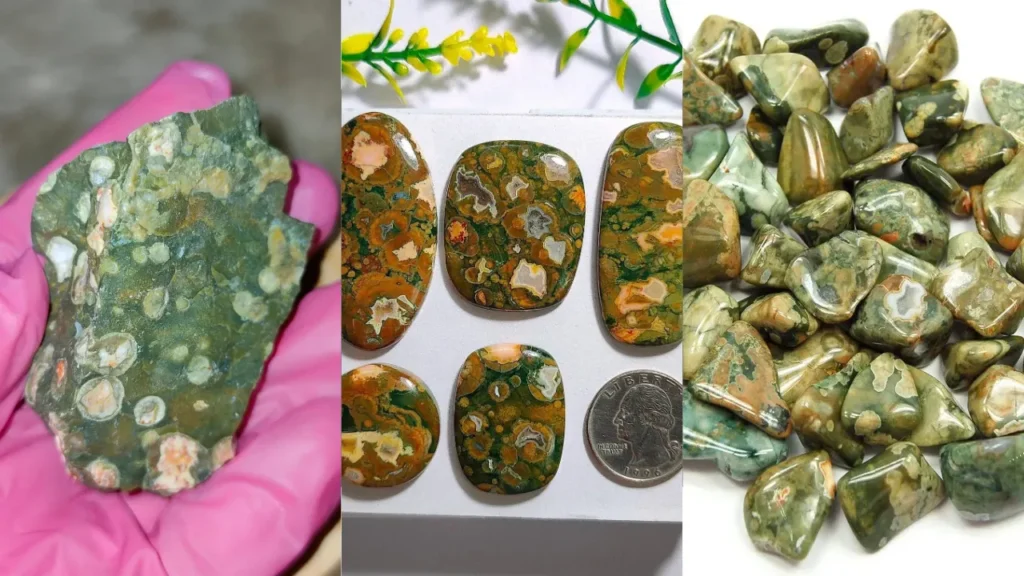
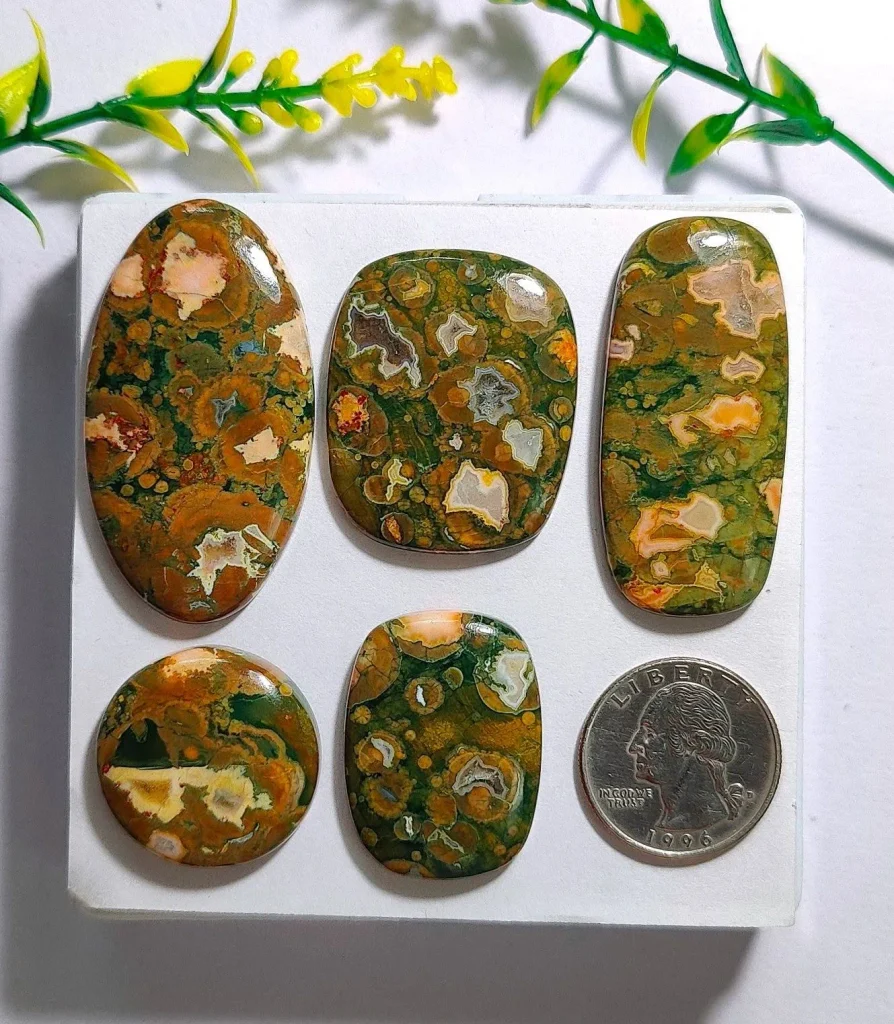
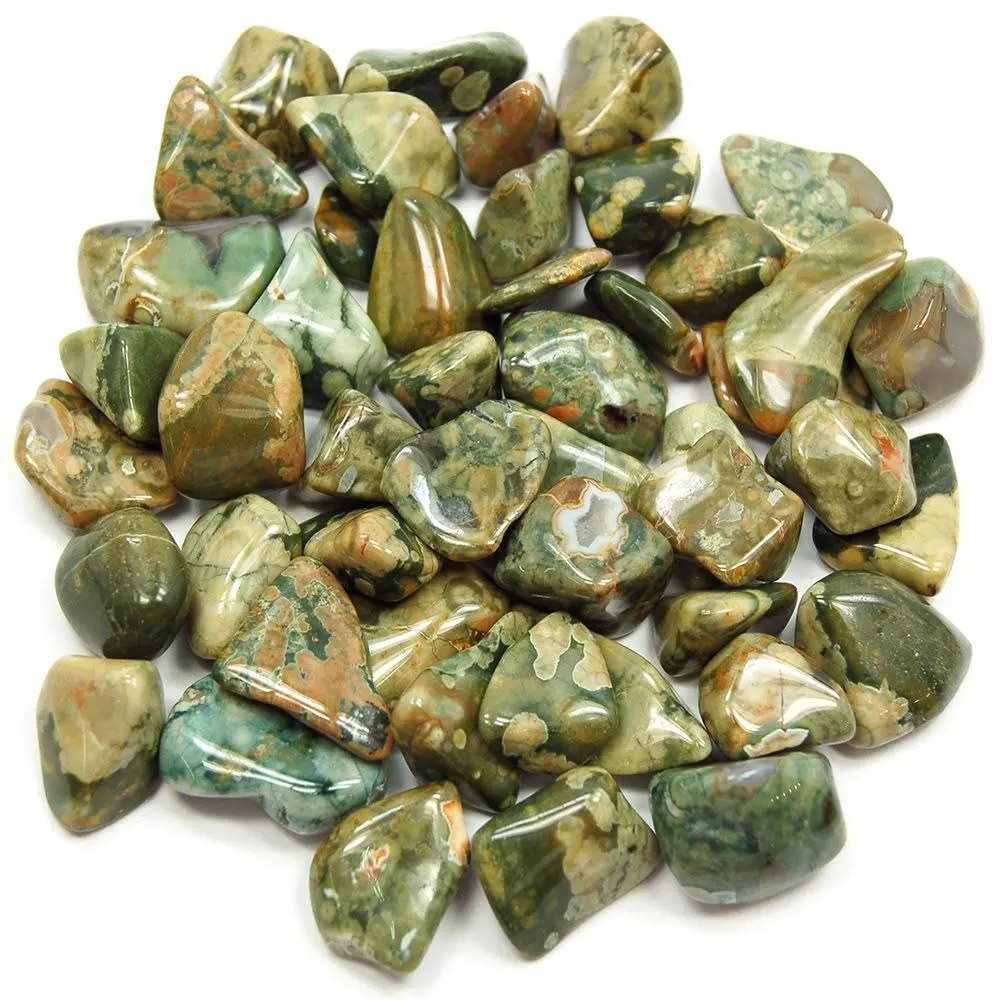
Rainforest rhyolite is a colorful, orb-patterned volcanic rock from a single extinct volcano in Queensland, Australia, prized for its green, brown, red, and cream swirls resembling a forest canopy. It’s almost universally sold as “rainforest jasper,” a name that, as at least one specialty dealer’s own headline puts it, isn’t accurate at all, joining mookaite, kambaba jasper, spider web jasper, orca agate, and leopardite, all also covered on this site, in the growing list of “jasper” trade names that outrun the actual geology.
What Is Rainforest Rhyolite?
Rainforest rhyolite is, properly speaking, a rhyolite, a high-silica volcanic rock formed from the eruption of dense, granitic magma, rather than true jasper, which is defined as opaque chalcedony. The trade name “rainforest jasper” persists for the same reason seen across several other stones on this site: it’s a name that sells, applied loosely rather than with strict geological precision. It’s also sold under several other names, including rainforest rhyolite, spherulitic rhyolite, agitated rhyolite, and green rhyolite, none of which have a single official, standardized definition. As one experienced rockhound put it on Mindat’s own discussion board, there’s genuine ongoing uncertainty about how to precisely characterize this material, and to their knowledge, nobody has actually examined it in thin section (a standard mineralogical technique) to settle the question definitively. That’s an unusually candid admission for a gem material this widely sold, and it’s worth knowing going in: “rainforest rhyolite” is a real and beautiful stone, but its exact technical classification is less settled than the confident marketing copy you’ll find most places suggests.
Why Does It Have Those Colorful Orbs?
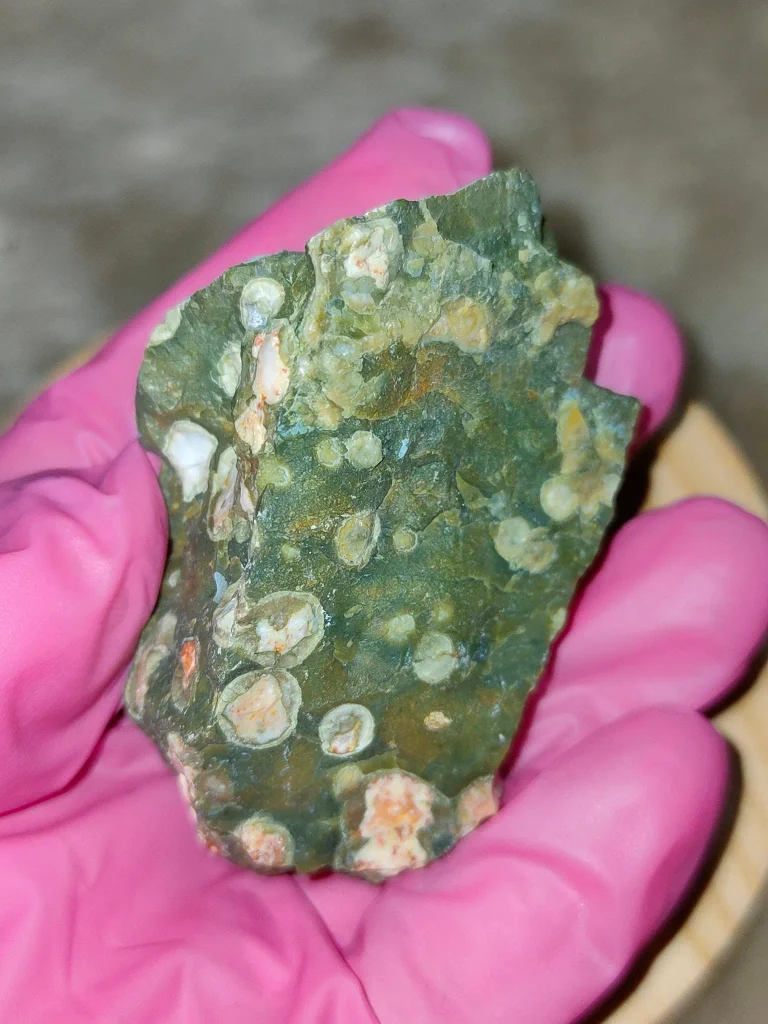
Rainforest rhyolite’s structure comes from how its parent magma cooled. Rhyolite forms from dense, silica-rich granitic magma that cools relatively slowly, giving time for two related but distinct structures to develop: spherulites, which are radiating, ball-like crystalline growths that form as silica minerals crystallize outward from central points during cooling, and separately, gas bubbles (vesicles) trapped in the cooling lava, which later became hollow cavities. Over time, low-temperature hydrothermal fluids moved through the rock and partially to fully filled these spherulites and cavities with chalcedony, agate, and macrocrystalline quartz, along with opal and tridymite in some specimens, creating the colorful, orb-patterned appearance the stone is known for. The specific colors (green, brown, red, yellow, orange, and cream) come from the various minerals infilling these structures. Separately, when these agatized, silica-filled spherical structures weather out of the surrounding rock as loose nodules, they’re commonly called “thundereggs” a related but distinct collecting category from the polished slab material typically sold as rainforest rhyolite.
Where It Comes From
This is one of the more genuinely singular sourcing stories on this site: rainforest rhyolite comes from exactly one place, Mount Hay, an extinct volcano located near Wycarbah in the Rockhampton region of central Queensland, Australia, roughly 38 kilometers west of Rockhampton itself. The volcanic rock there dates to approximately 120 million years old, and the material was first mined commercially in the late 1960s. A related but visually distinct variety with pinkish orbs is also documented from Turee Creek in the Pilbara region of Western Australia, and structurally similar orbicular rhyolites exist elsewhere in the world under different names. Que Sera stone from Brazil and Llanite from Texas both show comparable spherulitic structures, though with their own distinct color palettes and mineral compositions.
Is It Treated?
Rainforest rhyolite’s coloring comes naturally from the various minerals that infilled its spherulites and cavities during formation, and it’s not typically treated or enhanced. Given the genuine uncertainty around its precise technical classification discussed above, the more relevant honesty point for buyers isn’t treatment in the traditional sense, it’s realistic expectations about sourcing verification. Because virtually all commercial supply comes from a single Australian locality with a long production history, and because much of the cutting and polishing work happens overseas at lapidary facilities that, as the Mindat discussion notes, don’t necessarily track precise technical origin details, asking a seller to confirm genuine Mount Hay material is reasonable for higher-value pieces, though this is a less pressing concern than the dye and treatment issues documented for some other stones on this site.
Durability: Can You Wear It Every Day?
Rainforest rhyolite measures 6.5 to 7 on the Mohs hardness scale, in line with quartz-family and chalcedony-based stones generally, including true jasper varieties like red jasper, also covered on this site. A few practical points:
- Solid everyday hardness, comparable to most of the durable, quartz-adjacent stones on this site.
- Structural consistency can vary somewhat by specimen, given that individual pieces contain a mix of harder silica-filled orbs and the surrounding rhyolite matrix, which may not be perfectly uniform in toughness a milder version of the specimen-to-specimen variability discussed for kambaba jasper.
- Everyday wear verdict: rainforest rhyolite handles daily wear well for jewelry and decorative pieces, making it one of the more practical, low-maintenance stones in this “not really jasper” family, alongside orca agate rather than the more fragile stones on this site.
What Determines Value
- Color richness and orb definition. Vivid, well-defined orbicular patterning with strong color contrast is more desirable than muted, indistinct, or sparse patterning.
- Color variety within a single piece. Specimens showing a wider range of the characteristic green, brown, red, and cream tones together are often more visually striking and sought after than single-tone material.
- Polish quality. A smooth, well-executed finish that shows the orb patterning clearly adds real value, particularly for slabs and cabochons cut to showcase the pattern.
- Rarity of source. Given the single-locality sourcing discussed above, supply is inherently limited compared to more broadly distributed gem materials, even though individual pieces aren’t typically expensive.
- Size and structural soundness, as with most polished ornamental stones on this site.
How to Care for Rainforest Rhyolite
Clean rainforest rhyolite with warm water, mild soap, and a soft cloth. Given its solid quartz-family hardness, it tolerates normal handling and occasional ultrasonic cleaning reasonably well, similar to other durable chalcedony-adjacent stones on this site. Store it separately from harder gemstones to prevent scratching, and avoid harsh abrasive cleaners that could dull the polish. There’s no special sunlight or water sensitivity to worry about beyond standard care, making it one of the more forgiving stones covered here.
Rainforest Rhyolite vs. Ocean Jasper: Two Orbicular Stones, Different Stories
Rainforest rhyolite and ocean jasper are both prized for spherical, orb-like patterning, and both carry a “jasper” name that doesn’t map perfectly onto strict geology, but their underlying stories differ in a genuinely interesting way:
- Base material: Rainforest rhyolite is fundamentally a volcanic rock (rhyolite) with its orbs formed by silica infilling spherulites and gas cavities. Ocean jasper, by contrast, is more precisely chalcedony-rich by composition, despite its own “jasper” name, recent analysis suggests it’s better classified as an orbicular chalcedony than a true rhyolite-based rock.
- Origin: Rainforest rhyolite comes from a single Queensland, Australia, locality; ocean jasper comes from Madagascar’s Analalava district, another concentrated, single-region source.
- Color palette: Rainforest rhyolite tends toward greens, browns, reds, and creams; ocean jasper spans a wider pastel range, often including more distinct multicolor orb rims within a lighter overall body.
- Shared lesson: both stones illustrate how popular “orbicular jasper” branding can obscure real, and sometimes still-debated, differences in what these materials actually are geologically, a pattern worth recognizing across ornamental stones generally.
A geologist examining a thin section could resolve the precise classification of either stone with certainty, though as the Mindat discussion referenced above notes, this level of rigorous analysis is rarely applied to commercially traded specimens of either material.
Explore the “Not Really Jasper” Gem Cluster
- Discover the spotted porphyry debate in our Leopardite Guide.
- Explore volcanic rhyolite with orbicular eyes in our Kambaba Jasper Overview.
- Learn why sulfur-rich vent rocks need special handling in our Bumblebee Jasper Safety Analysis.
- Compare volcanic textures to pure fracture-healed quartz in our Spider Web Jasper Guide.